

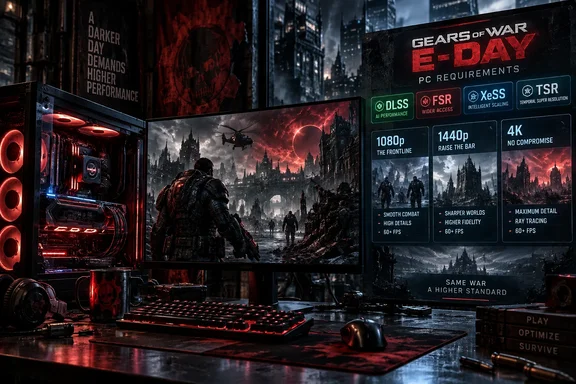
The Coalition confirmed the gold milestone in an Xbox Wire post published September 17, with pre-installs scheduled to begin September 29 at 8 a.m. Pacific, or 15:00 UTC, on Xbox Series X|S, Xbox on PC, and Steam. Neowin separately reported the same launch timing and published the final PC requirements, though its minimum-GPU line does not entirely match Microsoft’s own specification graphic.
For prospective buyers, the practical point is straightforward. E-Day is not presenting a conventional “native 1080p at 60 fps” minimum. Microsoft’s figures describe Medium, High, and Ultra presets at 1080p, 1440p, and 4K respectively, each with DLSS, FSR, TSR, or XeSS enabled. Players trying to judge whether an existing PC can run the game need to treat those as upscaled performance targets, not equivalent native-resolution benchmarks.
The official launch sheet requires ray-tracing-capable hardware
The Xbox Wire launch graphic lists a GeForce RTX 2060, Radeon RX 6600, or Radeon RX 7600 as the minimum GPU class, paired with a Ryzen 5 2600X, Core i7-6850K, or Core i5-10400. It specifies 6GB of VRAM, 12GB of system memory, and 115GB of SSD space for a Medium-preset 1080p, 60-fps target.
A footnote beneath the graphic says a hardware-ray-tracing-capable graphics card is required and that graphics cards without dedicated hardware ray-tracing support are not supported. That closes the door on a number of older but still common GPUs that might otherwise meet a game’s raw shader or VRAM requirements, including Nvidia’s GTX-era cards and older AMD Radeon products without dedicated RT acceleration.
Microsoft’s prior July technical post had already established that E-Day is built with Unreal Engine 5 and DirectX 12, and said the game would use hardware ray tracing for reflections, shadows, and global illumination. The launch sheet now makes clear that this is part of the game’s base PC compatibility model rather than a visual extra that can simply be turned off to accommodate older hardware.
That choice raises the floor for players with machines built around GPUs such as the GTX 1660 Ti, GTX 1080, or RX 590. Some of those cards can still run many current Windows games adequately at 1080p, but E-Day’s supported configuration list gives them no official path. The minimum requirement is therefore less about general GPU horsepower than the game’s rendering pipeline.
Microsoft’s minimum-GPU listing conflicts with the submitted report
The most obvious discrepancy is in the entry for Nvidia’s lower-end minimum GPU. Neowin’s report says the minimum tier includes a GeForce RTX 3050. Microsoft’s own launch specification image instead names a GeForce RTX 5050, alongside the RTX 2060, RX 6600, and RX 7600.
That is not a cosmetic distinction. An RTX 3050 and an RTX 5050 belong to different generations and could set different expectations for laptop and desktop owners shopping against the requirements. The official Xbox Wire image should carry more weight than a third-party transcription, but Microsoft has not supplied the specifications as selectable page text, a downloadable table, or a clarification addressing the mismatch.
Readers should therefore avoid treating an RTX 3050 as definitively approved based on the current public record. Its ray-tracing support may satisfy the stated architectural requirement, but Microsoft’s official image does not list it. Conversely, anyone with an RTX 5050 should recognize that the model is listed only as one route to the minimum 1080p target, not an assurance of native-resolution performance or high settings.
The rest of the published tiers are more direct. The Recommended specification calls for an RTX 5060, RTX 3060 Ti, RX 6700 XT, or RX 7700 XT; a Ryzen 5 5600 or Core i5-11600K; 8GB of VRAM; and 16GB of RAM. Microsoft frames that class of system as suitable for High settings at 1440p and 60 fps or more.
For Ultra at 4K and 60 fps or better, The Coalition lists an RTX 5070 Ti or Radeon RX 7900 XT, a Ryzen 7 7800X3D or Core i7-14700K, 12GB of VRAM, and 16GB of RAM. The 115GB SSD requirement remains unchanged across all three rows, so storage capacity, rather than GPU selection, will be the immediate upgrade issue for smaller system drives.
The advertised frame rates depend on reconstruction
Every tier on Microsoft’s chart has the same qualifier: DLSS, FSR, TSR, or XeSS is enabled. This includes the minimum 1080p target and the flagship 4K Ultra target.
That makes the chart useful as a compatibility guide, but limited as a direct indicator of raster performance. Upscaling methods render the game internally below the display’s output resolution and reconstruct the image. The actual internal resolution varies with the selected quality mode, game settings, and in some cases dynamic-resolution behavior. A 4K output target with DLSS or FSR engaged can involve substantially less GPU work than native 4K.
The Coalition has confirmed support for Nvidia DLSS 4.5, AMD FSR 4, Intel XeSS 3.0t, and Unreal Engine’s Temporal Super Resolution. Nvidia hardware also receives Reflex support and Dynamic Multi Frame Generation. Those features could substantially improve the responsiveness or reported frame rate on compatible GeForce systems, although generated frames do not reduce the rendering load in the same way as conventional GPU performance.
For that reason, a player using an RTX 5070 Ti or RX 7900 XT should read “4K 60+ FPS” as a target reached with the listed reconstruction tools active, rather than a promise of native 4K Ultra at a locked 60 fps. Microsoft has not published the selected quality preset for DLSS, FSR, TSR, or XeSS at each tier, nor has it detailed whether the Ultra result includes frame generation. Those omissions make independent launch-day testing especially important for anyone planning a new GPU purchase around E-Day.
PC features are broader than the three-tier table
The specification graphic identifies HDR and ultrawide-monitor support, plus built-in Benchmark Mode with advanced PC settings. Those are useful inclusions for a major Unreal Engine 5 release, particularly because the game is targeting high-resolution output and ultrawide displays are common among PC enthusiasts.
The game will also use Advanced Shader Delivery on compatible systems, according to The Coalition’s July Xbox Wire technical briefing. The feature is intended to deliver precompiled shaders, reducing load times and avoiding first-run shader stutter where supported. Microsoft said at the time that Advanced Shader Delivery would be available on the Microsoft Store and Xbox PC app, with support for more storefronts and hardware to expand over time.
That wording leaves a meaningful Steam question unresolved. E-Day is launching on Steam as well as through Xbox on PC, but Microsoft has not said whether Steam users will receive the same Advanced Shader Delivery behavior at launch. Given the industry’s uneven record with shader compilation stutter in Unreal Engine 5 games, that distinction could affect the experience more than a small difference in average frame rate.
The hardware-ray-tracing requirement also means users should expect a modern graphics API stack and current drivers. Microsoft has not published a minimum Windows version, a required DirectX runtime revision, a driver branch, or a supported handheld-PC list in the final specification announcement. The Xbox storefront identifies PC, console, and handheld availability, but it does not establish that every Windows handheld meeting the minimum GPU requirement will deliver a satisfactory experience.
Gold status fixes the disc build, not the launch experience
“Gone gold” means the team has completed a release candidate suitable for manufacturing and distribution. It is particularly relevant here because the Collector’s Edition includes a physical Xbox Series X disc. The Gears of War site says the Xbox Collector’s Edition contains a physical disc, while Steam buyers receive a digital code.
But going gold should not be read as a promise of a patch-free October 6 launch. Microsoft’s storefront warns that the game requires an initial download and may require future updates, while The Coalition has not said whether a day-one patch is planned or whether the disc build will contain all launch content and fixes. The studio says it continued stability and performance work after the multiplayer open beta, which makes further pre-release and launch-period updates entirely plausible.
Premium Edition owners receive access beginning October 1 at 8 a.m. Pacific, five days before the wider October 6 release. The standard edition costs $69.99 in Microsoft’s U.S. store, while the Premium Edition is listed at $99.99. Game Pass Ultimate and PC Game Pass subscribers gain access on October 6 rather than during the Premium early-access window.
Pre-install availability on September 29 will give PC players time to verify whether the 115GB allocation fits their SSD before launch. With mandatory ray-tracing-capable hardware, performance targets tied to upscaling, and an unresolved RTX 3050-versus-RTX 5050 discrepancy, that pre-install window is also the last sensible moment to check a machine against Microsoft’s official image rather than relying on copied requirement tables.
Update: PC Gamer lists newer Radeon RX 9060-series alternatives (September 18, 2026)
PC Gamer’s September 18 report lists Radeon RX 9060 as an additional minimum-tier GPU option and Radeon RX 9060 XT for the recommended tier, rather than the RX 7600 and RX 7700 XT named in Microsoft’s earlier specification image.
If accurate, that expands the published AMD guidance to include newer Radeon hardware while retaining the same 1080p Medium, 1440p High, and 4K Ultra performance targets. PC Gamer also repeats the RTX 5050, RTX 2060, RX 6600, RTX 5060, RTX 3060 Ti, RTX 5070 Ti, and RX 7900 XT entries.
The differing Radeon lists create another compatibility ambiguity for PC buyers. Until The Coalition or Microsoft posts a selectable, updated requirements table, Windows users should treat the RX 9060 and RX 9060 XT entries as reported by PC Gamer rather than confirmed replacements for the RX 7600 and RX 7700 XT.
References
- Gears of War: E-Day goes gold, PC requirements revealed Neowin · 2026-09-17T17:30:01+00:00
- Gears of War: E-Day system requirements require ray tracing-capable graphics card to play, alongside 115 GB of free space on an SSD PC Gamer · 2026-09-18T13:46:09+00:00