

The timing matters. Xbox Wire's September 17 announcement says Premium Edition early access starts October 1 at 8 a.m. Pacific (15:00 UTC). The worldwide launch follows on October 6, the same day the game arrives in Game Pass Ultimate and PC Game Pass. Platforms are Xbox Series X|S, Xbox on PC and Steam. Below is what Digital Foundry found, what other sources confirm, and where the reports disagree.
MegaLights: lots of lights that all cast shadows
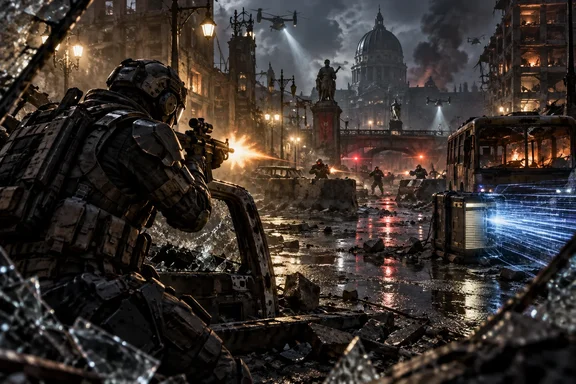
Digital Foundry calls MegaLights the game's headline technology. It is Unreal Engine 5's ray-traced direct lighting system, and it works alongside Lumen, which handles indirect light. Traditional rasterised shadow maps get expensive quickly, so games normally limit how many lights can cast shadows. Digital Foundry says MegaLights uses a fixed budget of lighting samples per pixel instead. That lets thousands of dynamic shadow-casting lights run at once, including street lamps, muzzle flashes and emergency vehicle lights.
Epic's own State of Unreal 2026 recap supports the main claim. It says The Coalition used MegaLights in E-Day to go from a handful of lights in some areas to hundreds or thousands, all casting dynamic shadows, while holding 60fps on Xbox Series X. Epic also lists MegaLights among the features now marked "Production Ready" in Unreal Engine 5.8. OC3D noted that this made Gears of War E-Day the first game to use MegaLights, and the first game to prove that it can run at 60 FPS on Xbox Series X.
Getting there took a lot of optimisation, according to Digital Foundry:
- MegaLights was first shown in 2024 running on a PS5 with a 1080p, 30fps target.
- The Coalition and Epic more than doubled the system's execution speed while keeping image quality acceptable.
- The game was developed alongside the engine, so features that started as experiments ended up as core Unreal Engine capabilities.
The light-count claim comes with a caveat. Hardwareluxx's PC testing reports that MegaLights handles ray-traced shadows for up to 100 light sources simultaneously. That doesn't necessarily contradict Epic. Being able to scale to thousands of lights in a scene is not the same as having that many visible on screen at once. Still, "thousands" is the ceiling, not something you'll see in every room.
Summary: Epic independently confirms the MegaLights story and the 60fps Series X target. The "more than doubled" speed improvement comes from Digital Foundry's interviews.
RTX Mega Geometry and the DXR question
High-end Nvidia PCs get one more feature. Digital Foundry says Mega Geometry lets ray tracing work against full-detail Nanite meshes, which improves self-shadowing and reflections. Its estimate is a cost of about 1–2GB of extra VRAM and roughly a seven percent drop in performance.
Nvidia's pre-launch explanation, as summarised by VideoCardz, is that current ray-traced Nanite implementations still rely on a separate simplified mesh for acceleration structures. This means shadows and reflections can be generated from geometry that does not match the detailed object visible on screen. Nvidia also says the technique can reduce flickering and other artifacts in ray-traced shadows and reflections when the player or camera moves.
Two points need more context than Digital Foundry gives them:
- DXR status. Digital Foundry says the technology is part of Microsoft's DXR standard, so AMD and Intel versions should follow. Nvidia describes it as future work. Guru3D reports that NVIDIA says techniques developed for Mega Geometry are expected to be adopted into Microsoft's forthcoming DirectX Raytracing 2.0 specification. Treat cross-vendor support as planned for DXR 2.0. It is not available on Radeon or Arc cards today.
- Performance cost. Hardwareluxx tested at 4K with High settings and DLSS Quality. On a GeForce RTX 5080, turning Mega Geometry on dropped the average from 87.0 to 73.7 FPS. That is roughly a 15 percent hit, about double Digital Foundry's estimate. The cost clearly depends on the GPU, resolution and scene.
PC players can at least check this themselves. Tom's Hardware reports that E-Day exposes Mega Geometry as a toggle, so it's easy to compare its impact on scenes. Its own comparisons found the improvements subtle but solid.
For PC players: if you have VRAM to spare and some performance headroom, turn it on. If you're near your card's memory limit or aiming for a high-refresh target, leave it off and you won't lose much.
Hardware Lumen only
Digital Foundry reports that E-Day began as a hybrid that used software or hardware Lumen depending on the platform. At launch it uses hardware-accelerated Lumen only, for global illumination and reflections, on every target platform. According to the studio, dropping software Lumen simplified the rendering pipeline and allowed accurate ray-traced reflections on difficult surfaces such as curved mirrors. Diffuse ray-traced global illumination provides multi-bounce lighting throughout the game.
This raises the hardware floor, since ray tracing is now required rather than optional. Guru3D's description of the PC version matches Digital Foundry's: the game employs Lumen for ray-traced lighting and ambient occlusion, while MegaLights enables large quantities of dynamic ray-traced lights.
Characters, destruction and animation
Digital Foundry also describes several systems beyond lighting:
- Nanite skinning: high-poly characters render without traditional LOD swaps, using the same technology as Nanite terrain.
- Main character detail: more than 300,000 triangles each, with custom facial rigs, expanded morph targets and hand-sculpted strand hair.
- Shader-based gore and grime: blood, gore and dirt build up through systems built into the character shaders.
- Destruction: cover breaks apart and sheds debris, glass cracks along impact lines, and debris is simulated with GPU-accelerated particle physics.
- Motion matching: Digital Foundry credits For Honor and The Last of Us Part 2 with pioneering the technique. It searches a large animation database in real time to produce smooth transitions when clambering and vaulting.
The common thread is that the game draws far more geometry than before, much of it reacts to combat, and characters move with fewer visible animation seams. OC3D reported from Epic's State of Unreal demo that E-Day has "100x the geometric detail" of prior Gears games.
Xbox Series X: three modes, mostly smooth
Digital Foundry's Series X measurements:
| Mode | Frame-rate target | Approx. internal resolution | Upscaler |
|---|---|---|---|
| Performance | 60fps | ~936p | TSR |
| Balanced | 40fps | ~1000p | TSR |
| Quality | 30fps | ~1152p | TSR |
These are internal rendering resolutions before TSR upscales the image, not output resolutions. Xbox advertises "4K resolution and up to 60FPS" with the footnote that a compatible display is required. Both statements can be true. TSR reconstructs a 4K output from a much lower internal resolution, which is how most demanding Unreal Engine 5 console games work.
According to Digital Foundry, linear levels run consistently well. Larger, more open areas can produce occasional CPU-bound frame-time spikes when you move through them quickly. A 120Hz display with VRR helps smooth out these dips. VRR makes the spikes less noticeable but doesn't remove the CPU bottleneck behind them. Digital Foundry suggests the day-one patch may bring a small performance boost, but it presents this as possible, not confirmed.
Xbox Series S: an SSD workaround with trade-offs
Series S has less RAM, and Digital Foundry says this was the hardest constraint. The Coalition worked with Xbox engineers on an extended memory architecture that moves inactive data out to the NVMe SSD. That lets the game run on the platform, with these concessions:
| Mode | Approx. internal resolution | Reported behaviour |
|---|---|---|
| Performance (60fps) | ~576p | Frequent frame-rate drops |
| Balanced (40fps) | ~648p | More stable |
| Quality (30fps) | ~792p | More stable |
Global illumination is simplified and reflections are less detailed. Digital Foundry also observed occasional pauses lasting close to a second, though it says they were infrequent. That fits a streaming-heavy approach: the SSD paging lets the game fit in memory, and brief stalls are a plausible side effect. Digital Foundry doesn't identify the cause, so this is analysis, not a confirmed diagnosis.
Practical advice for Series S owners:
- If your TV supports 120Hz VRR, turn it on in the console's video settings. Digital Foundry says it smooths out most of the performance mode's drops.
- Without VRR, try balanced or quality mode first, since Digital Foundry found both more stable.
- Install the day-one update before judging performance. Early access players are running pre-launch code.
How to read this coverage
Digital Foundry visited The Coalition and spoke to its engineers, so much of the feature is the studio describing its own work. The measurements are Digital Foundry's, but the explanations behind them come from the developer. Some claims are stronger than others:
- Confirmed by other sources: MegaLights in E-Day, scaling to hundreds or thousands of shadow-casting lights, the 60fps Series X target, and Mega Geometry shipping on PC.
- Reported by Digital Foundry alone: the speed-up factor, the triangle counts, the Series S paging design and the per-mode resolutions.
- Disputed or overstated: Mega Geometry's performance cost (about 7 percent per Digital Foundry versus about 15 percent in Hardwareluxx's RTX 5080 test) and whether the technology is already part of DXR.
Digital Foundry is also careful in its conclusion. It calls the visuals beyond what early previews showed, but says performance "remains rocky" in open sections, especially on Series S.
Why it matters beyond Gears
E-Day is Microsoft showing what current consoles and DirectX 12 PCs can do as a new hardware generation gets closer. Epic says Unreal Engine 5.8 is the last planned major UE5 release, and Unreal Engine 6 is targeting early access at the end of 2027. Features that The Coalition helped harden, such as production-ready MegaLights and hardware-only Lumen, are likely to show up in other Unreal games. Mega Geometry's planned move into DXR 2.0 could also turn an Nvidia-only option into a standard Windows graphics feature.
For players, the short version: E-Day looks as good as early reports suggested on Series X and on capable PCs. Series S runs it with real compromises, including occasional stalls. Expect sharp, mostly smooth lighting on Series X and a playable but rougher experience on Series S.
Update: New PC testing reports 30–50fps in demanding combat (October 2, 2026)
GamingBolt’s October 2 graphics analysis adds a performance result for an older high-end Windows PC: according to the outlet, an RTX 3080 Ti paired with a Ryzen 9 5900X and 32GB of RAM delivered roughly 30–50fps during particularly chaotic combat. Its testing used High-to-Ultra settings, 4K output and DLSS Ultra Performance—not native 4K rendering. GamingBolt also reports occasional noticeable performance drops during heavy action.
That result provides another configuration-specific reference point, rather than a directly comparable benchmark against the RTX 5080 testing covered above. GamingBolt does not provide a controlled Mega Geometry comparison, so its figures do not resolve the differing estimates of that feature’s performance cost.
On Xbox Series X, GamingBolt reports almost no stuttering or dropped frames during its playtime. That differs from Digital Foundry’s observations, but does not establish that the previously reported open-area spikes have been fixed: the new analysis does not identify a patch or demonstrate matching test conditions.
There is also a multiplayer caveat: according to GamingBolt, hosting a three- or four-player campaign co-op session reduces Performance mode’s target to 30fps. If accurate, the advertised 60fps mode should not be assumed to apply to those hosting configurations.
Update: Broader PC benchmarks show steep demands at native 4K (October 5, 2026)
According to DSOGaming’s October 5 PC performance analysis, native 4K at Ultra settings proved demanding enough that only the RTX 5090 delivered what the outlet described as a smooth experience—and it still recommended a G-Sync display. The RTX 4090 did not approach 60fps in its testing. These results were recorded with RTX Mega Geometry disabled, so they do not resolve the earlier disagreement over that feature’s performance cost.
DSOGaming tested nine GPUs using a Ryzen 9 7950X3D, 32GB of DDR5 memory and Windows 10. According to the outlet, all tested cards except the RTX 2080 Ti ran well at 1080p Ultra, although it recommended variable-refresh-rate displays for the RTX 3080 and Radeon RX 6900 XT. At 1440p Ultra, its five fastest tested cards provided a smooth experience; the Radeon RX 9070 XT occasionally dipped to 57fps.
For Windows players, these findings add a useful distinction to the earlier 4K-output results: native 4K Ultra remains substantially more demanding than rendering at a lower resolution with upscaling. DSOGaming recommends DLSS or FSR at 4K.
The outlet also reports no major stuttering during its first few missions and confirms shader pre-compilation at initial launch. That is encouraging for PC players, but the limited testing scope does not establish that later areas are stutter-free or that the previously reported Xbox issues have been fixed.
References
- Gears of War: E-Day Graphics Analysis – Xbox Series X vs PC Graphics Compared - GamingBolt GamingBolt · 2026-10-02T00:00:00+00:00
- Gears of War: E-Day Benchmarks & PC Performance Analysis - DSOGaming DSOGaming · 2026-10-05T15:00:00+00:00
- Inside Gears of War: E-Day: How The Coalition and Epic Pushed Console Visuals To New Heights - Digital Foundry Digital Foundry · 2026-10-01T13:00:00+00:00