

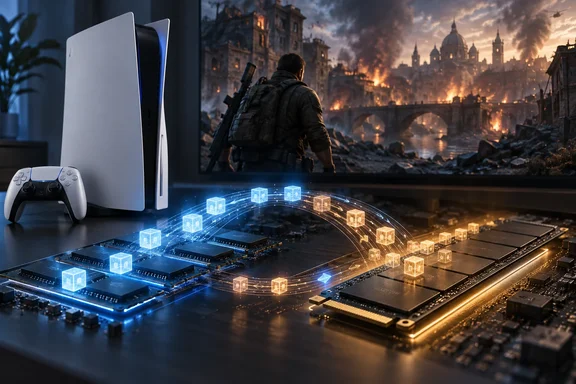
According to Digital Foundry, the game supplements the Series S's 10GB of GDDR6 by treating the internal NVMe drive as a new memory tier. The system is bespoke, and The Coalition built it together with Xbox's platform team and the Advanced Technology Group (ATG). Digital Foundry calls the approach a possible blueprint for future games on Series S and other memory-constrained platforms. The timing is good: Xbox's official game page lists E-Day for October 6, 2026, and up to 5-day Early Access for Premium Edition players beginning October 1.
What The Coalition actually built
Every PC user already knows the basic trade-off, even if they've never thought about it. CPU caches are extremely fast but tiny. RAM sits in the middle. SSDs hold huge amounts of data but take far longer to access. When data gets pushed out of a faster tier, the system pays a speed penalty to fetch it back.
The Coalition's system moves data that isn't in active use out to the NVMe drive and pulls it back into system RAM when the game needs it. Digital Foundry compares this to paged virtual memory, with one key difference. It only applies to specific subsets of memory that the team decided could come back from the drive without slowing the game down.
Digital Foundry puts the payoff this way:
- Cost: about "a couple of gigabytes" of SSD space
- Gain: roughly one gigabyte of extra usable system memory
- Scope: only data the developers chose as safe to page. This is not a console-wide RAM upgrade.
Take that 2:1 ratio as Digital Foundry's description of this game's implementation, not a published Xbox specification. Nothing in the reporting says the system is a general platform feature that other games get automatically.
Section summary: This isn't "the SSD becomes RAM." It's a selective, game-managed paging system that keeps hot data in memory and parks cold data on fast storage.
The special sauce: deciding what gets evicted
Digital Foundry says the hard part is choosing what to page out. The Coalition uses heuristics that track access patterns and how recently each piece of data was used. Memory that goes unused for a frame, or for a run of frames, becomes a candidate for paging. Frequently used data stays in RAM, and idle data can move to the SSD.
The reporting doesn't include the algorithm, thresholds, page sizes, or latency figures, so nobody outside the studio can judge how aggressive the system is. Broadly, though, it resembles the "least recently used" eviction policies found in operating systems and caches. My comparison comes from general systems knowledge, not from anything The Coalition has disclosed.
Why the official specs explain the caution
Microsoft's published specs show why this has to be a scalpel and not a sledgehammer. The Series S has 10GB GDDR6 on a 128-bit-wide bus, with memory bandwidth of 8GB @ 224 GB/s and 2GB @ 56 GB/s. Its SSD is rated at 2.4 GB/s raw and 4.8 GB/s compressed, with a custom hardware decompression block.
| Tier (Series S, official figures) | Throughput |
|---|---|
| Main GDDR6 pool (8GB) | 224 GB/s |
| Slower GDDR6 pool (2GB) | 56 GB/s |
| Internal NVMe SSD (raw) | 2.4 GB/s |
| Internal NVMe SSD (compressed) | 4.8 GB/s |
Do the arithmetic and the SSD's raw throughput is roughly 1/93rd of the main memory pool's bandwidth. Even the compressed figure is still about 47 times slower. Access latency is a separate problem, and the gap there is typically larger still (general industry knowledge, not a figure from the reporting).
That's why the system only covers data the team has judged tolerant of the round trip. Page out the wrong asset, such as something the renderer needs this frame, and the console stalls. Digital Foundry is explicit that the trick only works because the NVMe drive can return paged data fast enough that players don't notice. Note that Series S memory isn't one uniform pool either. Developers were already juggling a fast 8GB region and a slower 2GB region before an SSD tier entered the picture.
Microsoft markets both consoles as powered by Xbox Velocity Architecture. That has usually meant faster loading and asset streaming. E-Day shows the same storage hardware being used to ease pressure on working memory itself.
Section summary: The SSD is fast for storage but very slow compared with GDDR6. The technique depends on putting only truly cold data there.
1.6 million actors and one cut feature
Digital Foundry reports that E-Day's world contains around 1.6 million actors, so fitting everything into Series S memory became the baseline for all of the game's scaling work. (The reporting doesn't define "actors" here. Don't read it as 1.6 million NPCs, or as everything sitting in memory at once.) The developers credit the paging technique with making the city's density possible on Series S.
The setting explains the ambition. In Xbox Wire's June 2026 interview, creative director Matt Searcy described the city of Kalona this way: "We're not an open-world game, but this technology has allowed us to build an entire city that feels alive". Xbox Wire also notes the game was rebuilt from scratch in Unreal Engine 5, and that it is among the first to ship with MegaLights, UE5's lighting system.
According to Digital Foundry, only one major feature had to be cut on Series S to reach what it calls a reasonable 60fps lock: Lumen reflections. That's the reported target, not a measured result. Digital Foundry says its full review coverage still has to confirm the real-world performance.
It's worth remembering, as Digital Foundry points out, that the Series S isn't a slow machine. Its CPU comfortably beats last-generation hardware like the Xbox One X and PS4 Pro. The constraint is memory capacity: 10GB of shared GDDR6 against 16GB on the Series X.
The limits, in the studio's own words
The approach has limits. Studio technical director Kate Rayner told Digital Foundry that overusing the technique eventually hurts performance. Swapping data has a cost, and every frame still has to be produced within its time budget.
There's a subtler catch too. The operating system takes time to reclaim freed memory, so a game can be "technically out of memory" while it waits. That describes a transient state that has to be managed. It doesn't mean players will see crashes. Digital Foundry says The Coalition spent a lot of time tuning the system so it should carry no visible performance penalty. "Should" is doing real work in that sentence until independent testing on retail code arrives.
According to Rayner, the technique let the team avoid "really lowering the quality of the game." The Coalition believes it's one of the first studios to use the idea, and Rayner said other game teams are already interested. No studios are named, and there's no sign yet that the system is available as a shared toolkit.
Why Windows and PC readers should care
If this sounds familiar, it should. Windows has paged memory to disk through the pagefile for decades. What's different is the level of control. An OS pager has no idea which game data can tolerate a delay. The Coalition's system is application-aware and only pages what the developers have marked as safe. That's the gap between "the system is thrashing" and "the system planned this."
Some broader takeaways (my analysis, based on general industry knowledge):
- Fast NVMe storage is becoming part of the memory hierarchy, not just the loading path. Console makers have mostly pitched SSDs on load times and streaming. This pitch is about RAM pressure.
- Memory-constrained hardware is everywhere. Handheld gaming PCs, budget laptops, and cloud instances all run into the same wall. A well-tuned, selective paging layer is a pattern that can travel, though only with similar engineering effort.
- It isn't free. SSD space is consumed. On a 512GB Series S, a couple of gigabytes for paging is small but not nothing. And the technique depends entirely on correct heuristics.
- The Series S debate may shift. The console is often blamed for holding back cross-generation games. If ATG-backed techniques like this spread, developers get another tool besides cutting features.
Some skepticism is healthy, though. Every detail of this system comes from the developer's own account through one outlet, and no one has independently verified it yet. Until Digital Foundry's review lands, the claim of no visible penalty is the studio's goal, not a proven fact.
The bottom line
Gears of War: E-Day turns the Series S's internal SSD into a carefully fenced memory tier. According to Digital Foundry, The Coalition traded a couple of gigabytes of storage for about a gigabyte of extra working memory and lost only Lumen reflections on the way to a 60fps target. Microsoft's own specs show how big the speed gap is between GDDR6 and NVMe, which is why only cold data goes to the drive. If the retail game holds up under testing, this could be one of the more important pieces of Series S engineering yet. Expect the debate over whether "the SSD is the new RAM" to keep going in the Xbox and PC gaming threads.
Update: Series S testing reports stutters and broader visual cuts (October 1, 2026)
According to TwistedVoxel’s October 1 report on Digital Foundry’s testing, Gears of War: E-Day’s Series S Performance mode reportedly suffers frequent frame-rate drops and stutters, with some frame-time spikes exceeding 100 milliseconds. Larger, open environments are reportedly particularly troublesome. These findings qualify the earlier expectation of a reasonable 60fps lock; they do not establish that the SSD-paging system itself causes the problems.
Contrary to the earlier account that Lumen reflections were the only major feature sacrificed, TwistedVoxel reports additional Performance-mode compromises: reduced MegaLights quality, removed muzzle-flash lighting, and lower global-illumination quality and foliage density. According to the outlet, measured average internal resolutions on Series S were approximately 576p in Performance mode, 648p in Balanced mode and 792p in Quality mode, before Temporal Super Resolution reconstruction.
For players, TwistedVoxel reports that 120Hz output and variable refresh rate can soften the perceived disruption but do not eliminate it. Its account describes the 40fps Balanced mode as more predictable in smaller areas, while larger city sections can still stutter; Quality mode also reportedly experiences substantial drops in demanding scenes on a fixed 60Hz display.
Crucially, TwistedVoxel says the testing preceded the Day One patch. The reported results therefore challenge the earlier performance expectations, but patched-code testing remains necessary before treating them as the final release verdict.
References
- Gears Of War E-Day Series S Takes Major Performance Hit - TwistedVoxel TwistedVoxel · 2026-10-01T16:48:21+00:00
- How Gears of War: E-Day Solves the Series S Memory Issue by Tapping the SSD - Digital Foundry Digital Foundry · 2026-10-01T13:00:00+00:00
- How Gears of War E-Day Squeezes More Power From Xbox Series S - games.gg games.gg · 2026-10-06T13:07:29.028000+00:00