

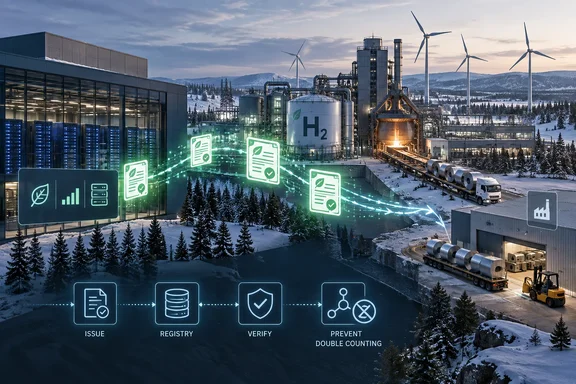
That distinction is the central fact missing from the more sweeping version of this story. Google said September 17 that the agreement will help bring Stegra’s large-scale, hydrogen-based steel facility in Boden, Sweden, online and could support lower-carbon data-center construction. Stegra’s own announcement describes a book-and-claim transaction: the environmental attribute moves to Google, while the steel itself can be sold elsewhere without the corresponding low-carbon claim.
For IT infrastructure teams, this is a real change in how a hyperscaler may account for construction emissions. It is not proof that Google’s next server hall, rack enclosure, cable tray, or structural beam will be made from Stegra steel.
Google bought the claim, not necessarily the metal
Google says the certificates cover up to 91,000 metric tons from Stegra’s first production year, with the possibility of adding volume over the agreement’s life. The company frames the purchase as a way to create demand and early cash flow for a new industrial process that substitutes renewable electricity and green hydrogen for coal in ironmaking.
Stegra says the certificates are associated with its non-prime steel: material made in the same process as its other output but which does not meet the highest quality requirements for every end use. The company has already struck a supply arrangement with thyssenkrupp Materials Services for such steel. Under that arrangement, first deliveries were expected to begin in 2027, according to Stegra’s January announcement.
That timing is important. The Google and Stegra announcements use language about bringing the Boden plant online and refer to its first year of production, but neither announcement says the plant is already operating at commercial scale on September 17, 2026. The submitted report’s implication that Google has helped a functioning plant come online goes further than the public record supports. What Google has announced is a certificate purchase intended to support the startup and ramp-up period.
The commercial logic is straightforward. A new hydrogen-based steel mill faces a familiar clean-tech financing problem: customers may want lower-emission materials, but may not be able to use a new supplier’s physical product because of location, qualification requirements, procurement contracts, or the precise grades they need. Selling the environmental attribute separately gives Stegra a second revenue stream while it builds a physical customer base.
For Google, the arrangement offers a way to connect the purchase to its own data-center construction footprint without rerouting steel supply chains around the world. Google says lower-carbon materials could reduce the embodied-carbon emissions of data-center infrastructure by up to 40 percent. That is a company estimate, not an independently verified reduction for this deal or for any particular Google project.
The safeguard is no double claim — and it depends on the registry
The environmental accounting model here is called book and claim. One party buys the physical product, and another buys the environmental attribute associated with producing it. The attribute purchaser can make the permitted emissions claim for the covered volume; the physical buyer must not claim that same material as lower-carbon steel.
In Google’s example, the company could hold certificates covering 50,000 tons of Stegra production while using conventionally sourced steel in its own construction projects. Stegra could sell the corresponding 50,000 tons of physical steel to another customer as ordinary steel. The latter buyer would receive the metal but would be contractually barred from presenting that volume as green or near-zero-emission steel.
The model is not inherently a loophole. In fact, it addresses a practical obstacle to financing expensive, early-stage industrial production: the buyer funding the emissions reduction and the buyer able to use a particular coil or grade of steel may be different companies. But its credibility rests on a tight one-to-one accounting system. A certificate cannot be duplicated, resold after retirement, or attached to a physical shipment that another company also advertises as low-carbon.
Stegra says it will use a registry to prevent double counting. The company’s earlier thyssenkrupp agreement similarly said physical purchasers of non-prime steel must agree not to make green claims when Stegra sells the environmental value to a separate certificate buyer. That is the correct control in principle, but the September 17 announcements do not disclose the registry operator, the audit firm, the certificate price, the methodology used to calculate each certificate’s emissions value, or the agreement’s duration.
Those omissions matter more than the marketing label. The World Steel Association, which represents a major share of global steel production, says there is currently no standardized methodology for greenhouse-gas chain-of-custody systems in steel. Its February 2026 guidance provides guardrails rather than a binding, universal standard, and explicitly warns that compliance with the guidelines does not by itself settle legal exposure to greenwashing claims.
World Steel’s guidance calls for third-party verification or certification, transparent methodologies, defined system boundaries, data-quality information, details of the emissions-reduction project, and clear disclosure of certificate ownership and retirement. Google and Stegra have stated the broad anti-double-counting concept, but they have not published enough transaction detail for an outside observer to test the accounting against those recommendations.
Why this belongs on the data-center construction agenda
Operational electricity has received most of the attention in data-center sustainability reporting because servers, cooling, and power distribution run continuously. Construction is different: the emissions are largely embedded in cement, steel, equipment, and the supply chain before a facility opens. Those emissions cannot be eliminated later by running a site on cleaner electricity.
That creates a procurement problem for cloud providers. A company can contract for renewable power through mechanisms that do not necessarily match every hour or location of consumption; buying physical low-emission steel is more restrictive. Steel must satisfy engineering specifications, delivery schedules, corrosion and fire requirements, fabrication needs, and local sourcing constraints. A certificate system attempts to separate industrial decarbonization finance from those constraints.
The arrangement may therefore be useful to organizations that build large facilities but cannot yet procure qualifying physical steel at scale. It could also make corporate sustainability reports easier to interpret badly. Readers should distinguish between a claim that a company financed or procured certificates representing lower-emission production and a claim that a completed building physically contains lower-emission steel. They are related claims, but they are not interchangeable.
Google has said it incorporated low-carbon concrete, steel, or a combination of the two in more than 20 construction projects during 2025. The company did not identify those projects in its latest announcement, specify how much physical low-carbon steel was used, or say whether the Stegra certificates will be allocated to named facilities. Until it does, the 91,000-ton figure should be read as a financing and accounting commitment rather than a bill of materials for Google data centers.
Stegra’s ramp-up is the real test
Stegra’s planned Boden facility is significant because it is designed around green-hydrogen direct reduced iron and an electric arc furnace, rather than the coal-intensive blast-furnace route used for much of primary steelmaking. Google and Stegra say that approach can cut emissions by up to 95 percent compared with conventional blast-furnace manufacturing, though the final footprint will depend on the electricity supply, iron ore, hydrogen production, transport, and the boundaries used in the calculation.
The deal also comes before Stegra’s physical supply chain has fully matured. Its agreement with thyssenkrupp Materials Services shows why non-prime output is central to the certificate model: a new mill must find a market for steel that falls outside the highest-grade specifications while retaining the financial value of its lower-emission production route.
For Windows and enterprise IT readers, the near-term takeaway is less about the metallurgy than the reporting language vendors will use. Google can legitimately say it has purchased environmental attributes linked to lower-emission steel production if the certificates are properly issued and retired. It should not be read as saying every certified ton maps to steel installed in a Google facility.
The next meaningful disclosure is not another certificate volume. It is evidence that the Boden mill has reached the announced production stage, that certificates are independently verified and retired in a transparent registry, and that Google can identify how the deal changes the embodied-carbon accounting of actual data-center projects.
References
- Google helps bring the world’s first large-scale “green steel plant” online Notebookcheck · 2026-09-17T18:36:00+00:00