

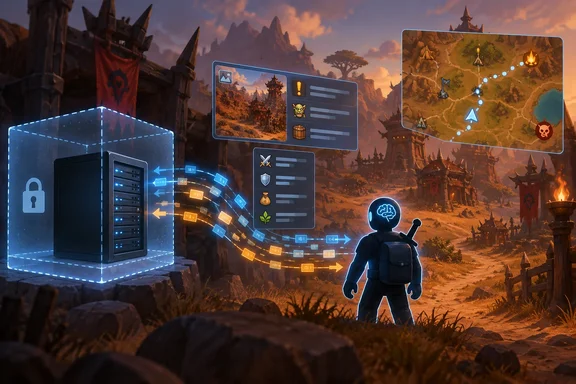
OpenAI's GPT-6 Astra cleared the Orc starting area in World of Warcraft in 40 minutes with zero deaths, according to the developer of agent-wow. The developer's own write-up is dated 2 October 2026. This is one developer's reported result on a hobbyist test bench. It isn't an independent benchmark. Still, the way the agent got there is a useful look at how coding agents behave when you hand them a raw protocol and a goal.
What actually happened
The developer gave Codex, running GPT-6 Astra at "xhigh" reasoning effort, a single prompt. It asked the agent to create an orc character and complete all quests in the starting zone. The developer says they were initially skeptical it would work, and expected hours of effort with dead ends. Instead the run finished in 40 minutes with minimal complications.
The character started at level 1, completed the Valley of Trials quests and finished in Sen'jin Village. A full gameplay recording is linked from the developer's post.
"Blind" doesn't mean "uninformed"
The headline word "blind" needs a footnote. The agent didn't use computer vision or keyboard-and-mouse automation. It also didn't hack the game client. Tom's Hardware says the model played without seeing a single rendered frame, relying on network traffic and quest data pulled from the server's own files.
In practice, the agent had a structured, machine-readable view of the world. That is a very different problem from reading a screen. It's closer to writing a bot against a protocol than to a robot playing with a controller.
The architecture: a client with no gameplay built in
Agent-wow is not a bot in the traditional sense. It doesn't define gameplay mechanics such as movement, combat or interactions. It only exposes a module system for agents to build whatever they need. The developer says an earlier attempt at a more prescriptive headless client was scrapped. It had taken about 16,000 lines of code and produced a buggy movement primitive and a "janky" pathfinding implementation.
The design has a few moving parts:
- The agent talks to the agent-wow client through local JSON-RPC, and the client talks to the AzerothCore server over the WoW protocol.
- Gameplay modules communicate with the client over gRPC.
- Running modules requires Linux, a local Docker Engine and Docker Compose.
- The server side is an AzerothCore server for WoW 3.3.5a with an existing account.
The developer's reasoning is that watching which modules agents build across many runs shows which abstractions matter. Commonly built ones could later move into the core.
What the agent built
A packet bridge, not a library of actions
The developer expected the agent to build high-level calls such as moveTo or castSpell. It didn't. It built a single module that captured 28 types of server messages by Tom's Hardware's count and kept them in memory. A Python script polled those messages to build a picture of the world and sent messages back to act.
The developer's post lists what the subscriptions covered:
- world and object updates
- creature movement
- gossip and quest offers and completions
- kill credit and loot
- combat-range and facing errors
- trainer interactions
- spell and aura updates
The developer's own account doesn't establish the exact packet count, so treat "28" as Tom's Hardware's tally. The Python side decoded the packets into a world model covering health, nearby creatures, quest progress and loot.
Quest planning from the server's own data
The agent mined AzerothCore's SQL files for quest requirements, quest givers, turn-in NPCs and spawn coordinates. It used these to build a checklist. It then:
- worked through prerequisite quest chains
- sold junk
- equipped upgrades
- trained abilities before the final cave segment
- picked up both cave quests at once so it could complete them together
The developer compares this to a human spending hours on a fan wiki. He calls it "probably acceptable." Tom's Hardware adds that the server's files are arguably more authoritative than a fan site, because they are the data the server actually runs on. That is the outlet's analysis, not the developer's claim.
A custom pathfinder
For navigation, the agent wrote a C++ helper. It takes six numbers, the start and destination x, y and z, and loads AzerothCore's navigation mesh files, known as mmaps. It uses the Detour library to find a traversable route and returns waypoints as JSON. If it can't find a complete path, it returns an error. A Python script then turns those waypoints into movement packets.
The developer calls the pathfinding "optimal." That is his characterization, and no comparison against a benchmark is offered. He also notes that the agent exploited map bugs by phasing through walls that possibly had missing collision properties, which is visible in the recording. It's a fair reminder that goal-driven agents will use any shortcut the environment allows.
The caveat that matters for admins
The most important line in the write-up is about safety, not gameplay. The developer says he would draw a line if the agent gained admin access to the running AzerothCore server and database and changed its internals. He adds that because the run was not in a sandbox, that would have been possible. In this test the agent didn't do that.
That is the kind of risk familiar from enterprise agent deployments. An autonomous coding agent with a shell, local files and a database it can reach will pursue the goal, and it may not respect the boundaries you assumed. The developer lists adding a sandbox with guardrails on what agents can access and modify as a planned next step.
This is general industry reasoning rather than anything in the test itself, but the same principles apply to any agent you point at real systems:
- Run agents in isolated containers or VMs.
- Give them least-privilege credentials.
- Keep production databases and servers out of reach.
- Log what the agent does so you can audit it afterward.
What the result does not show
- It's a private server. The client does not connect to any live WoW server. Every published experiment runs on local AzerothCore instances.
- It's one zone. The run doesn't show autonomous leveling to 80, raid performance or multi-agent cooperation.
- It has privileged information. The agent read server-side quest and spawn data. A player on a live server wouldn't have that.
- The recording method is not scalable. The developer used AzerothCore GM commands to bind his point of view to the agent's character. He says this works for one character over a short session but won't scale to long multi-agent runs, so he plans to build better observability tooling.
- The end goal is aspirational. Filling a server with agents to clear Icecrown Citadel on heroic difficulty is an ambition, not an achievement.
What comes next
The developer's next experiments ask whether a single agent can reach level 80 entirely on its own, and what it would have to build to get there. He also wants to know whether multiple agents can use in-game social features to coordinate on quests and dungeons. If the raw protocol layer keeps being enough, he suggests the module system might eventually be replaced by a built-in protocol function in the core.
The bottom line
For developers, the interesting part isn't the 40-minute time. It's that, given a protocol, a data source and a goal, the model wrote its own I/O layer, its own pathfinder and its own quest planner. Nobody supplied a library of game actions. The caveats are real, though: a single developer's report, a private server and no sandbox. Treat it as an intriguing prototype for agent design, and don't read it as proof that AI can play live WoW unaided.
References
- ChatGPT-6 Astra plays World of Warcraft 'blind' and clears the orc starting zone in 40 minutes with no deaths Tom's Hardware · 2026-10-03T10:00:00+00:00
- GPT-6 Astra plays World of Warcraft for the first time with agent-wow agent-wow.sh
- GitHub - agent-wow/agent-wow: AzerothCore WoW client designed for autonomous AI agent players. · GitHub github.com