

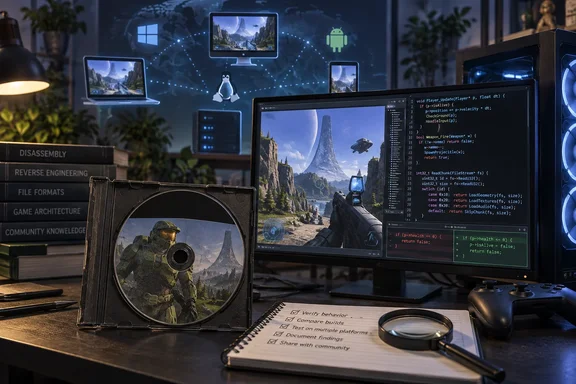
NoobFeed editor Adeela Tas has published an opinion piece arguing that AI-assisted tools are "lowering the barrier" to rebuilding older games. She says projects that once took years now reach playable builds in weeks or even days, and that Nintendo, PlayStation and Xbox will all have to respond. That thesis deserves a careful look. Parts of it hold up against the public evidence. Other parts are speculation, and at least one headline example needs correcting.
What NoobFeed is arguing
Tas's main points:
- The technical shift. She separates source-based porting from decompilation. With source code, a port is mostly a matter of rebuilding and adjusting. Without it, people have to reverse-engineer the finished game to reconstruct how it is structured and how it behaves.
- The list of projects. NoobFeed names recompilation or decompilation work on MediEvil, Dead or Alive, Halo, The Darkness, Star Fox Adventures, Rocket: Robot on Wheels, Super Mario Galaxy, Grand Theft Auto: Liberty City Stories, Conker's Bad Fur Day, Zelda, Sonic Free Riders, Fable II and Pilotwings 64.
- Native ports versus emulation. Using Star Fox Adventures as the example, she argues that a native PC executable removes much of the setup and configuration an emulator needs, and makes widescreen and upscaling easier.
- A Halo multiplayer claim. The piece says a version of the original Xbox Halo has "reportedly" run with more than 40 players, with cross-platform play across Windows, macOS, Android and Nintendo DS.
- Lower skill requirements. She describes a person with no formal programming training who turned a Game Boy WWF Superstars into a Game Boy Color version in a couple of days and tested it on an Analog Pocket and a flash cart.
- A prediction. Tas expects publishers to answer with lawsuits, copy protection and lobbying, and she argues that lawmakers will struggle to keep up.
Section summary: The piece is opinion built on a real trend. The project list, the WWF Superstars anecdote and the role of AI are NoobFeed's claims. This review could not independently verify any of them except Halo.
Halo: what the project documentation actually says
The Halo case is the most important one for Windows users, and it is the one claim with public documentation behind it.
The main community project is called halo-ce-universal. Its GitHub documentation describes it as a port of the Halo: Combat Evolved decompilation to Linux, Windows and Android, and says the decompilation is of the Xbox build 2342 (cachebeta.exe). The project's lineage is also documented: the port starts from the decompilation of bnunu/halo-1, and that project is a fork of punpckhdq/halo.
That documentation does not match NoobFeed's details:
| Claim | NoobFeed | Project documentation and coverage |
|---|---|---|
| Platforms | Windows, macOS, Android, Nintendo DS | Windows, Linux and Android. macOS and Nintendo DS are not listed |
| Player count | "More than 40 players" | System link of up to 128 players on up to 128 machines (a stated maximum) |
| Windows build | Not specified | 32-bit x86 executable, OpenGL 4.5, SDL3 |
WindowsForum's earlier coverage of the browser build confirms the scale: the project supports system-link games of up to 128 players on up to 128 machines, with Windows, Linux and Android machines able to join the same match. A stated maximum is not the same as tested performance, though. TechPowerUp noted that browser-port developer Mitchell Hynes listed multiplayer for up to 128 players, though he flagged the latter as untested. TheGamer also tried it and said the full campaign works excellently, along with a 128-player online multiplayer mode, which I've had less success with so far.
NoobFeed's line about other projects bringing games to browsers does hold up for Halo. TechPowerUp reported that Hynes has released a free, unofficial browser port of the original Xbox version of Halo: Combat Evolved, and that the port builds on the recent decompilation of the original Xbox game.
Section summary: The Halo port exists, targets Windows, and supports cross-platform multiplayer, but with different platforms and much larger stated limits than NoobFeed described. Treat the 128-player figure as a ceiling the developers claim, not one that has been proven.
"Fully decompiled" is a slippery phrase
The coverage tends to skip one important detail. A playable port does not mean the decompilation is finished. Held Games checked the project's own tracker and reported that decomp.dev, the tracker the decompilation's own README links to, reports the project at 7.17% of code matched and 36.93% of data, with 918 of 11,048 functions done. The outlet's conclusion fits this whole scene: the percentage on a tracker and whether a game runs are two different questions.
The upstream decompilation repository describes itself as a work-in-progress (99.5% byte matching) decompilation. That is not necessarily a contradiction. "Byte matching" and "functions matched" measure different things. Still, it shows how differently "done" can be defined in this field.
This also weakens the AI framing. Halo's port depends on a chain of earlier human reverse-engineering repositories. Nothing in the public documentation establishes how much AI was used, if any, or whether it shortened development time. The speed is real: TheGamer reported that within a few days, a fully playable version of Halo: Combat Evolved is available in your browser. But the speed came from work built up across several projects over time, not from a single prompt.
Section summary: Being able to play a game, being able to build it, and having a complete decompilation are three separate milestones. The "made in days" story usually leaves out the earlier groundwork.
How the Halo port works on Windows
For readers who want to see what a native port looks like in practice, the halo-ce-universal documentation describes the setup. Check the project's current instructions before you rely on any of this.
- Get the build. GitHub Actions builds the game for each commit, and release and debug zips are published for each platform. The project says to use the release build to play. The debug build stops at the first failed assertion and writes it to a log, so it is meant for reporting bugs.
- Supply your own game data. The port does not include it. You need an Xbox disc image of Halo: Combat Evolved in
.xisoor.isoformat, and the documentation says all versions of the game work. PAL maps are adjusted to play like the NTSC maps so players of both versions can play together. - First launch. The game asks for the disc image, extracts a
maps/folder, and then starts. On Windows,maps/goes next to the executable. - Updates. The game checks for a newer release at start-up and asks before installing it. The project keeps the last five releases, so you can roll back if a new build breaks something.
- Know the target. Windows (32-bit x86 executable, OpenGL 4.5, SDL3) is the documented configuration. If the game won't start, check your GPU's OpenGL 4.5 support and drivers first.
- Building it yourself. The documentation says you need Python and ninja. You don't need the Xbox SDK, because the port supplies the SDK declarations it uses. One trap for anyone sharing their own builds: without the
--portableoption, Windows builds use every instruction your build machine's processor supports, so the result may not start on someone else's PC.
Custom Edition .map and OpenSauce .yelo maps are an experimental, off-by-default feature, enabled with custom_edition = true in config.toml. The project says its Windows build was tested with only three maps and that Ogg Vorbis sounds do not play.
There are some good reasons for the enthusiasm. One HardForum commenter compared the port with the 2003 Gearbox PC release and said it works better with a controller. Compared with the Master Chief Collection, the same commenter saw probably nothing notable except for 4 player split screen coop. That is one user's opinion, not a benchmark.
Section summary: A native port changes how you launch and configure the game, but you still have to provide your own legally obtained game data. NoobFeed's point about removing emulator friction holds up in part. You avoid emulator configuration, but you do not avoid the question of where your game files come from.
Microsoft's position
Halo sits at the center of the trend NoobFeed describes, and Microsoft has an official product on the market. TechPowerUp notes that Halo: Campaign Evolved launched on July 28 for Xbox Series X|S, PC, and PS5, but it is a campaign-only remake without the original's competitive multiplayer. Fans are building the classic multiplayer experience that the official remake leaves out, and doing it at a scale the original hardware never supported. That is the tension Tas has in mind when she writes that publishers "can't ignore the implications."
Does that mean lawsuits are coming? Not on the evidence available. Nothing here shows Microsoft, Nintendo or Sony taking new legal or technical action against these specific projects. NoobFeed's warnings about lawsuits, copy protection and lobbying are predictions. They are reasonable ones given the industry's history, but they are not reported events.
The scene is also bigger than Microsoft's catalog. TheGamer reports that Super Mario Galaxy has been 100 percent decompiled, and a new PC port is in the works, which is one of the titles on NoobFeed's list.
The legal picture
NoobFeed rightly says copyright still applies. It is worth being more specific, based on U.S. Copyright Office materials:
- Anti-circumvention. Section 1201 of the DMCA prohibits circumventing technological measures that control access to copyrighted works. It also prohibits trafficking in circumvention tools. Exemptions are reviewed in a rulemaking every three years.
- Interoperability. The statute includes a narrow reverse-engineering provision for interoperability with independently created programs. It does not give general permission to distribute games, assets or derivative builds.
- The video game exemption. The current exemption in 37 CFR 201.40 covers lawfully acquired complete games whose rights holders have stopped providing a required authentication server. It allows restoring personal, local gameplay, plus preservation by eligible libraries, archives and museums under strict conditions. A separate preservation exemption covers games that are no longer reasonably available for sale. None of this authorizes sharing playable copies.
This is why projects like halo-ce-universal ship engine code and make you bring your own disc image. Whether any given project is lawful depends on its facts and jurisdiction. Neither "all decompilation is legal" nor "all decompilation is piracy" is accurate.
Section summary: The "bring your own data" model is a deliberate legal design choice. It is not a guarantee, and nobody should treat it as one.
What this means for Windows gamers
NoobFeed's essay is right about the direction. Native Windows builds of console-era games are arriving faster, and Halo shows the result: a 2001 Xbox shooter now runs as a Windows executable that can share matches with Linux and Android machines. The essay's specifics are weaker. The Halo details are wrong, its broader list of projects is unverified, and its claims about AI as the main driver are not backed by the documentation available.
If you plan to try one of these ports:
- Read the project's own documentation. It is the most reliable guide to supported platforms and requirements, and press coverage often gets those wrong.
- Assume no game content is included, and no publisher has approved it. Use your own legally obtained copy.
- Expect rough edges. Untested multiplayer limits, experimental features and partial decompilations are normal at this stage.
- Check before you download. Prefer builds from the project's documented repository and release pages over reuploads.
Is AI actually behind all of this? Possibly, in part. But the clearest public evidence points to communities of reverse engineers, years of earlier groundwork, and continuous build pipelines.
References
- How AI Retro Modding Impacts Nintendo, PlayStation & XBOX - NoobFeed NoobFeed · 2026-09-30T18:00:00+00:00
- Halo: Combat Evolved for Linux, Windows and Android github.com
- GitHub - bnunu/halo-1: Halo 1 decompilation · GitHub github.com