

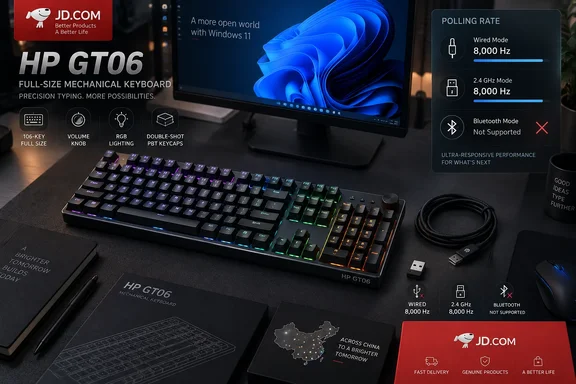
HP GT06 launches in China as a tri-mode, full-size keyboard with 8 kHz polling
The launch was first reported by the Chinese site IT之家 (ITHome) on September 22, 2026. ITHome said HP has launched the GT06 mechanical keyboard with a 106-key full-size layout, wired, 2.4G and Bluetooth tri-mode connectivity, priced at 310 yuan. The same report says the keyboard is already on sale at JD.com. TechPowerUp and XiaomiToday reported the launch in English later that day, and Chinese portals including 17173 and Phoenix (ifeng) republished ITHome's copy. Those reposts are one story, not several independent confirmations. The original report and the JD product listing it links to are the two records that matter.
XiaomiToday agrees on the basics. It describes the keyboard as supporting wired, 2.4GHz wireless, and Bluetooth connections, giving users the option to switch between gaming, work, and mobile setups. It also confirms the price and scope: the HP GT06 is currently available through JD.com in China for 310 yuan, equivalent to approximately $43 USD based on current exchange rates. International availability and pricing have not been announced.
HP is selling a full-size board at this price. That means a complete layout with a dedicated number pad, at a time when most gaming keyboards launch as 65%, 75%, tenkeyless or 98-key designs. The JD listing title, as quoted by ITHome, calls the GT06 a customizable tri-mode 106-key keyboard for gaming and office use with a number pad. It names the reviewed variant as "Starry Black" (星辰黑) with Seiya (星矢) switches, sold as the "tri-mode dual 8K" (三模双8K) version for 310 yuan.
The GT06 is not HP's first China-market board of this type. JD's HP keyboard listings already include the HP GT87 tri-mode wireless/wired/Bluetooth gasket customizable keyboard and a GT98 that is also listed as a tri-mode gasket model with a large battery. Both are offered with "Sundae" (圣代) switches. The GT06 looks like the full-size member of that GT family. The family shares naming and its core features, but it has little to do with HP's global HyperX line.
What 8,000 Hz polling on the GT06 actually covers
The headline number needs a clear scope. The polling rate is how often the keyboard reports its state to the PC. At 1,000 Hz, the usual rate for gaming peripherals, a report goes out every 1 ms. At 8,000 Hz the interval drops to 0.125 ms, which is simply 1 divided by 8,000. That is the theoretical ceiling on how quickly a keypress can be handed to Windows once the keyboard's firmware has registered it. It says nothing about switch actuation, firmware debounce time, wireless processing, the game engine or the display, so it is not end-to-end latency.
The sources disagree about which connection modes get 8 kHz. ITHome states it plainly: the keyboard supports an 8000Hz polling rate in wired and 2.4G modes. XiaomiToday's English write-up is narrower. It says the keyboard's 8,000Hz polling rate is available through its wired connection and does not mention 2.4 GHz. The retail listing supports ITHome. "Dual 8K" (双8K) is the usual Chinese retail shorthand for 8 kHz over both the cable and the wireless dongle, and the SKU carrying that label is the 310-yuan tri-mode version. The best-supported reading is that wired and 2.4 GHz both run at 8 kHz. Bluetooth is not part of the claim in any source, so treat Bluetooth as a lower-rate convenience mode.
The phrase "tri-mode dual 8K" also hints that the GT06 comes in other configurations. ITHome says the keyboard is equipped with up to a 12000mAh battery, and "up to" suggests other variants may have smaller batteries or different connectivity. That is an inference from the listing's wording. If you buy through a reseller, check that the SKU name includes both "三模" (tri-mode) and "双8K" (dual 8K) if you want the configuration in the headline.
The comparison with HP's own HyperX line shows how cheap 8 kHz has become. In March 2026, ITHome reported that the HyperX Origins 2 in its 65 and 1800 versions went on sale in China at 599 and 799 yuan, with 8000Hz polling rate over a wired single-mode connection. The Origins 2 has features the GT06's listing does not claim, including hot-swappable switch sockets and per-key ARGB. But it is wired-only and costs roughly twice as much or more. For 310 yuan, the GT06 advertises 8 kHz over both the cable and a wireless dongle.
Inside the GT06: gasket mount, seven-layer padding and switch choices
Most of HP's construction claims describe feel, and no hands-on review has tested them yet. ITHome describes a gasket soft-bounce structure with an even, soft feel and 7 layers of fill. XiaomiToday paraphrases HP's reasoning: the design is intended to provide a more consistent typing feel while reducing the impact and vibration generated when keys are pressed. In general, a gasket mount suspends the plate on compressible material instead of screwing it rigidly to the case, and the padding damps hollow case sound. HP has not published the plate material, the foam types or the gasket material. The seven layers are a count, not a spec.
The switch names have been garbled in translation. TechPowerUp lists the options as Kailh, Seiya and Feather. The Chinese listing names three switches: 凯华圣代 (Kailh Sundae), 星矢 (Seiya, the name of a character from the anime Saint Seiya) and 轻羽 (roughly "light feather"). The first is a Kailh-branded switch called Sundae, the same one on the GT87 and GT98 listings. The "Holy Panda" reading that has appeared elsewhere is a mistranslation. HP has not published actuation force, travel, linear versus tactile type or sound profile for any of the three. Neither source says whether the sockets are hot-swappable. The HyperX Origins 2 listing states hot-swap support explicitly, and the GT06's does not, so assume soldered switches until HP says otherwise.
The keycaps are double-shot PBT, which ITHome describes as wear-resistant and resistant to oil shine. Double-shot molding forms each legend from a second plastic shot, so legends do not wear off the way printed ones can. PBT resists the greasy shine that ABS picks up over months of use. On a budget board, that is one of the claims most likely to hold up after a year on the desk.
The 106-key count is worth checking. A standard full-size ANSI (US) board has 104 keys and ISO has 105. Neither report explains HP's count. It may include dedicated media or function keys, or the knob may be counted as a key. No legend map has been published, and some sellers photograph Chinese-market keyboards with US-style legends while others do not. Buyers outside China should look at the actual SKU photos for the Enter key shape and any extra keys before ordering.
Battery claims and the GT06's knob, lighting and software
The 12,000 mAh battery is unusually large for a keyboard, and the 30-day figure attached to it has no stated conditions. XiaomiToday says HP claims the GT06 can operate for up to 30 days on a charge, although actual battery life will depend on RGB lighting and usage. HP has not said whether that figure assumes 8 kHz or a lower polling rate, RGB on or off, 2.4 GHz or Bluetooth, how many hours a day of use, or which sleep settings. A 30-day claim tested with lighting off over Bluetooth tells you little about gaming over the 8 kHz dongle with 16-effect RGB running.
As general context rather than a GT06 measurement: sending reports eight times as often, and lighting every key, both draw power. It is reasonable to expect heavy 8 kHz gaming with lighting on to fall well short of 30 days. The large battery is the main reason HP can advertise a month at all.
The rest of the list is standard. A multifunction knob on the side adjusts volume and gives one-press mute. RGB backlighting has 16 effects plus the music-reactive "Music Rhythm Lighting Effect 3.0." ITHome describes the two-stage feet as part of an ergonomic design to match different typing habits. HP has not said whether the knob can be remapped, whether lighting can be turned off in wireless mode to save battery, or what angles the two feet give.
Configuration is the least documented area, and it matters most to Windows users. ITHome says the GT06 supports configuration through a web page or a client driver (网页/客户端驱动). The listing does not say which Windows versions the client supports, what languages it offers, whether the web tool needs a Chromium-based browser such as Edge or Chrome, whether settings are stored in onboard memory, or whether firmware can be updated. For a board sold only in China, the software may be Chinese-only and hosted in China. That is a practical risk, not a documented fact.
Why the GT06 matters outside China and what remains unconfirmed
TechPowerUp flagged the GT06 because a full-size tri-mode board with an 8 kHz claim at $43 would be unusual in the US or Europe. Nobody can buy it there through HP yet. In its Western markets, HP sells gaming keyboards mainly under the HyperX brand, while the GT line appears on JD as an HP-branded Chinese range. Nothing in the reporting says HP plans to bring the GT06 to other regions, and no reporting points to a Western GT87 or GT98 release either.
HP's own figures on the JD listing are the only record of the GT06's performance. No independent review, teardown, latency test or battery test has been published, including of the 8 kHz modes. The polling rate, the 30-day battery figure and the claims about gasket feel are all HP's. Reviews of other cheap 8 kHz keyboards have found the headline number and real-world behavior can differ, but that is general caution, not a finding about this model.
The table below separates what is confirmed from what is not.
| Detail | Status |
|---|---|
| 106-key full-size layout with number pad | Confirmed in retail listing and reporting |
| Wired, 2.4 GHz and Bluetooth modes | Confirmed |
| 8,000 Hz polling, wired | Confirmed as HP's claim |
| 8,000 Hz polling, 2.4 GHz | Stated by ITHome and the "dual 8K" SKU; omitted by XiaomiToday |
| 8,000 Hz polling, Bluetooth | Not claimed |
| Battery | Up to 12,000 mAh; 30 days claimed, conditions not stated |
| Switches | Kailh Sundae, Seiya, "light feather"; no specs published |
| Hot-swap sockets | Not stated |
| Software | Web and client driver; Windows versions, language and onboard memory not stated |
| Price and region | 310 yuan at JD.com, China only |
What this means for you
If you are in mainland China and want a numpad keyboard with a dongle for gaming and Bluetooth for a second device, the GT06 is a low-risk buy at 310 yuan. Pick the tri-mode "dual 8K" SKU. Everyone else should wait for reviews or a regional launch before importing. Shipping, the chance of a Chinese-legend layout and unknown software support can quickly cancel out a $43 price. If 8 kHz polling specifically matters to you, confirm that your SKU is the dual-8K version and use the wired or 2.4 GHz mode. Bluetooth is not covered by the claim.
- The HP GT06 is sold only in China, through JD.com at 310 yuan, and HP has announced no international price or release.
- The 8,000 Hz polling claim covers wired mode and, according to ITHome and the "dual 8K" SKU name, the 2.4 GHz dongle. It does not cover Bluetooth.
- The 30-day battery figure comes from HP with no stated test conditions, so expect much less at 8 kHz with RGB lighting on.
- Check the SKU name, switch type and legend photos before importing, because variants may differ in battery, connectivity and layout.
- Don't count on hot-swap sockets, remapping, onboard profiles or English-language software, because HP has confirmed none of them.
- HP's wired-only HyperX Origins 2 offers 8 kHz with documented hot-swap support but costs roughly twice as much or more in China.
The GT06 shows that 8 kHz polling, gasket mounts and huge batteries have reached a 310-yuan HP-branded board, only months after HP's HyperX Origins 2 brought 8 kHz to its wired boards at twice the price or more. For now, HP's listing is the only evidence for most of the spec sheet. Independent latency and battery testing, or a regional listing with English software, will show whether this keyboard is worth importing or only worth watching.
References
- 惠普推出 GT06 机械键盘:106 全键、三模连接,310 元 - IT之家 ithome.com