

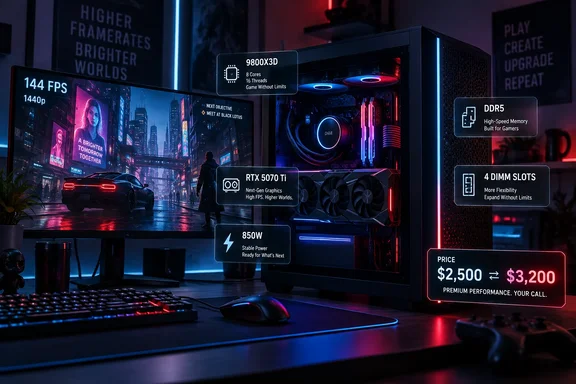
That is more than an obscure specification mismatch. In the review, the purported two-slot layout is used to argue that a future memory expansion would require replacing both installed 16GB sticks. HP’s U.S. product record instead says the GT17-0050m supports up to 128GB and has four DIMM slots. If that specification reflects the desktop that ships in the United States, an owner could expand beyond 32GB without automatically discarding the existing memory, provided the installed modules and desired memory speeds cooperate.
The practical verdict is straightforward: the Omen 35L is a capable, quiet gaming tower whose value hinges heavily on its actual checkout price and exact configuration. HP sells the Omen 35L under a family name with substantially different CPU, GPU, storage, memory, and regional options. Buyers should treat a review unit’s internals as a guide to its performance class, not as a substitute for verifying the model number in the cart.
The performance case is credible
The review unit has an unusually sensible high-end gaming pairing. The Ryzen 7 9800X3D is an eight-core, 16-thread AM5 processor with 96MB of L3 cache, while the RTX 5070 Ti supplies 16GB of GDDR7 graphics memory. That combination is aimed squarely at high-refresh 1440p gaming, with enough GPU memory to make demanding ray-traced titles and 4K settings more realistic than they are on lower-tier cards.
PC Gamer recorded 74 frames per second in Cyberpunk 2077 at 1440p with RT Medium settings before upscaling, 99 fps in Avatar: Frontiers of Pandora at 1440p Ultra, and 172 fps in Metro Exodus Enhanced Edition at 1440p Ultra. Those numbers should not be read as promises for every Omen 35L; games, patches, drivers, image-quality presets, and individual GPU boost behavior all move the result. They do establish that HP has not paired its premium graphics card with a CPU that drags it down in the games where the 9800X3D excels.
Tom’s Guide independently reviewed a 9800X3D and RTX 5070 Ti Omen 35L earlier this month and reached a similar broad conclusion: the system has ample gaming and general desktop performance, though it judged the asking price difficult to ignore. Its 4K High results were less flattering as a raw-frame-rate proposition, with 39 fps in Assassin’s Creed Shadows, 50 fps in Doom: The Dark Ages, and 31 fps in Black Myth: Wukong. That is the expected tradeoff for an RTX 5070 Ti-class system: 4K is viable, particularly with DLSS and frame generation where available, but 1440p is where this configuration makes the strongest uncomplicated case.
For Windows users who also edit video, compile projects, render in Blender, or run GPU-accelerated creative tools, the machine has useful headroom. The 9800X3D is primarily a gaming CPU rather than an all-core workstation flagship, so somebody whose day is dominated by CPU rendering or encoding should compare it with Ryzen 9-based systems. Still, a 32GB Windows 11 desktop with this CPU and GPU is far from a one-purpose gaming appliance.
Cooling is the 35L’s strongest non-spec-sheet feature
Prebuilts often lose their value proposition when they combine strong components with weak cooling, proprietary layouts, or aggressive power limits. On the evidence available, the Omen 35L avoids the first of those traps.
PC Gamer measured average CPU and GPU temperatures of 60°C during a gaming stress run, with reported maximums of 66°C for both. It also found the system comparatively quiet, describing fan noise under sustained load as a steady rush rather than an intrusive mechanical whine. Tom’s Guide likewise credited cooling as part of the system’s appeal after two weeks of testing.
HP’s U.S. specification for the GT17-0050m lists a 240mm LCD liquid cooler and an 850W, 80 Plus Gold, fully modular ATX 3.1 power supply. The power supply detail matters if the buyer’s eventual plan is a graphics-card upgrade: 850W is a reasonable baseline for the shipping hardware and several future GPU options, though it is not a blank check for every top-tier card HP or Nvidia may sell later.
The case is also genuinely smaller than the oversized showcase towers that dominate premium prebuilts. At roughly 8.27 by 16.06 by 16.14 inches, it is not a small-form-factor PC, and at nearly 32 pounds it is not portable. It is, however, a more manageable desk-side tower than HP’s OMEN Max 45L and similar full-size systems. That form factor, good temperatures, and low noise are legitimate reasons to choose it over a cheaper but bulkier home-built configuration.
The memory discrepancy changes the upgrade conversation
The most consequential finding in the review is also the one that needs the most caution. PC Gamer says its unit uses two 16GB DDR5-6000 modules in a motherboard with only two memory slots. It consequently frames a memory upgrade as an all-or-nothing replacement.
HP’s U.S. GT17-0050m product page says something materially different: 32GB of DDR5-5600 in a 2x16GB arrangement, four memory slots, and support for up to 128GB. The official listing also identifies an AMD B850 chipset, three M.2 slots in total—two for SSDs and one for WLAN—and two PCIe slots, x16 and x4.
There are several plausible explanations. The review sample could be a UK-specific board or an earlier production configuration; HP could use different boards across regions; or one of the published specifications could be wrong. What the record does not support is treating the two-DIMM limitation as a universal Omen 35L characteristic.
The same applies to memory speed. DDR5-6000 is often regarded as a favorable point for AM5 gaming systems, but HP’s current U.S. page specifies DDR5-5600 for this model. That does not make the shipped machine slow, and it is unlikely to transform the 9800X3D’s gaming standing. It does mean the buyer should not assume they are receiving the reviewed memory configuration merely because the CPU, GPU, capacity, and storage number match.
Before ordering, buyers should save the product page, confirm the exact GT17 model suffix, and inspect the listed memory speed and slot count. Do the same for the graphics card, power supply, Wi-Fi hardware, and storage: “Omen 35L” is a chassis and product family, not a single invariant bill of materials.
Ports and expansion remain the real compromises
The Omen 35L’s I/O is adequate, but it is not forward-looking for a $3,200 desktop. HP specifies two 10Gbps USB-C ports, four 5Gbps USB-A ports, four USB 2.0 ports, 2.5Gb Ethernet, and rear analog audio connections. PC Gamer correctly flags the absence of USB4, while the Type-C ports top out at 10Gbps.
For most gaming setups, this is enough: the RTX 5070 Ti provides three DisplayPort outputs and one HDMI output, so multi-monitor use is straightforward. A wired 2.5Gb network connection is a welcome inclusion for homes with compatible networking hardware or for large LAN game transfers. The four USB 2.0 ports are not useless—keyboards, mice, controllers, UPS management cables, and some audio devices do not need more bandwidth—but they do not make up for the absence of a faster USB4 or Thunderbolt-class connection.
Internal expansion is better described as limited but present than as wide open. A spare SSD-capable M.2 slot is useful, especially since the 1TB boot drive will fill rapidly once several modern games are installed. But the graphics card occupies much of the practical space around the lower PCIe slot, according to PC Gamer, and anyone planning capture cards, high-speed storage adapters, or additional networking should study internal clearance before assuming the second slot will be usable.
HP’s tool-less-access claim is valuable for routine maintenance, storage expansion, and potentially some component swaps. It does not erase the constraints created by a compact case, OEM BIOS choices, cooler clearance, cabling, or the physical dimensions of future GPUs. Tool-less entry is not the same thing as unlimited upgradeability.
Price, not raw power, is the deciding factor
The configured system reviewed by PC Gamer is listed at £2,599.99 in the UK and $3,199.99 in the U.S. The latter number was also HP’s stated list price when Tom’s Hardware reported an April promotion that dropped the same 9800X3D, RTX 5070 Ti, 32GB, and 1TB configuration to $2,499.99. HP’s current page for the GT17-0050m is presently showing no active price rather than confirming either figure.
That history establishes an important boundary. At around $2,500, this Omen makes a defensible purchase for someone who wants tested thermals, a ready-to-run Windows 11 machine, a strong 1440p gaming balance, and no interest in sourcing and assembling components. At $3,199.99 before a monitor, keyboard, mouse, headset, or extended warranty, the system needs more scrutiny against competing prebuilts and a comparable self-built PC.
The Omen 35L earns consideration because HP appears to have put its budget into the CPU, GPU, cooling, and power supply instead of a giant case or a gimmick-heavy exterior. But the mismatched published memory specifications underline the more important lesson: buy the specific GT17 configuration on the screen, not the benchmark charts attached to a similarly named review unit.