

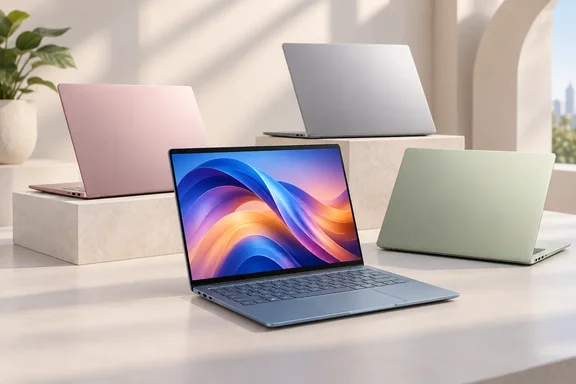
OLED is standard, but the best panel comes later
According to Tom’s Hardware, the entry configuration combines an Intel Core 5 320, 8GB of memory and a 256GB SSD with a 1920 × 1200 OLED touchscreen. Launch panels, offered in touch and non-touch versions, are rated at 300 nits. A sharper 2560 × 1600 OLED touchscreen rated at 620 nits is planned for March 2027.
That distinction matters more than the OLED badge alone. The practical buying implication is to compare the exact panel specification—not assume that the brightest screen advertised for the family accompanies the starting price.
HP’s announcement, reproduced by Technology Reseller, describes an aluminum chassis in Peony Pink, Starlit Blue, Smoke Silver and Soft Honeydew. It also specifies a 1.16kg design, an 11.77mm profile, a 180-degree hinge and two full-function USB-C ports. The FHD infrared camera supports Windows Hello facial recognition, a useful Windows convenience beyond the colorful exterior.
Wildcat Lake: what Intel’s specifications establish
Intel independently identifies the Core 5 320 as a Core Series 3 processor, formerly codenamed Wildcat Lake. Its specifications list:
- Six cores: two Performance cores and four Low Power Efficient cores.
- Six threads and a maximum turbo frequency of 4.6GHz.
- A 15W processor base power and 35W maximum turbo power.
- Integrated Intel Graphics and a 16-TOPS neural processing unit.
Those figures verify the platform, not the finished laptop’s speed. Intel explicitly cautions that processor numbers are not performance measurements and that system features depend on the manufacturer’s implementation. The OmniBook’s cooling, power settings and configuration still need to be evaluated before declaring it a performance winner—or loser—against competing machines.
Memory choices deserve attention
Tom’s Hardware lists a Core 7 350 option, soldered LPDDR5-6400 memory and PCIe Gen 4 storage. The initial choices are 8GB or 16GB RAM and 256GB or 512GB storage; 12GB RAM and a 1TB SSD are planned for November 2026. The reported battery capacity is 60Wh.
For buyers, soldered memory makes configuration selection a commitment rather than a future upgrade project. Our practical advice is to assess memory needs before ordering, particularly if the laptop is intended to remain in service for several years. A pleasing shade of honeydew cannot add RAM later.
The 42-hour claim needs its qualifier
HP advertises up to 42 hours of local video playback, alongside a compact 65W USB-C GaN charger. The test workload is essential context: this is not a promise of 42 hours spent mixing meetings, browsing and application work. Treat it as a manufacturer’s endurance claim under a specified workload, not a measured working-day result.
Availability is market-specific
The October timing and dollar starting price come from Tom’s Hardware. Technology Reseller’s account of HP’s announcement instead gives January 2027 availability and a £679 starting price for the UK-facing launch. The reports do not explain the timing difference, so neither date should be presented as a universal worldwide release schedule.
The OmniBook 5’s appeal is straightforward: a lightweight, colorful Windows laptop with OLED as a baseline feature. The sensible shortlist, however, should be built around the exact memory capacity, panel and regional shipping date. HP has made the exterior easy to choose; the configuration still deserves a closer look.
Update: Additional details (October 1, 2026)
Gizmodo reports that HP’s US store currently lists only the $699.99 Core 5 320 configuration with 8GB of LPDDR5-6400 memory and a 256GB SSD. It says the Core 7 350 option is not expected until October, while the 12GB-memory model remains scheduled for November; HP had not provided prices or availability for the higher-memory versions when Gizmodo asked.
References
- HP’s MacBook Neo Competitor Might Cost You More Than You Think - Gizmodo Gizmodo · 2026-10-01T17:25:06+00:00
- HP boards the MacBook Neo competitor train Tom's Hardware · 2026-10-01T13:00:00+00:00
- Intel® Core™ 5 processor 320 intel.com