

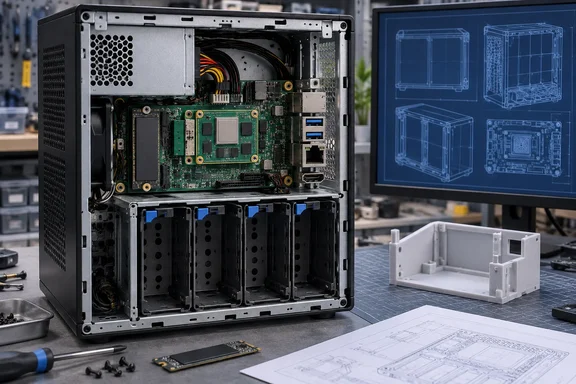
The creator’s September 11 project description details a chassis-specific design derived from Raspberry Pi’s CM5 IO Board reference design. Tom’s Hardware covered the build on September 21, highlighting its successful installation and boot. The important storage qualification comes from EastMakes himself: the original four drive bays remain unpopulated in the current build, although he describes a route to connecting them later.
Why build a motherboard for an old enclosure?
The N40L’s case and computing hardware have aged differently. Its enclosure, removable motherboard tray and drive-bay arrangement can still serve a useful purpose, while the original AMD Turion-based platform lacks the NVMe connectivity and USB 3.0 interfaces used in this conversion.
A conventional motherboard swap would have introduced mechanical compromises. EastMakes explains that the N40L does not have entirely standard motherboard mounting positions or a conventional removable rear I/O shield. He considered Mini-ITX, but fitting a normal board could have required cutting the rear panel and fabricating a replacement shield. His aim was to leave the machine as close to stock as possible.
That requirement explains the custom board’s size and connector placement. The project replaces the computing platform while preserving the surrounding enclosure, rather than upgrading the original motherboard’s processor or adding an expansion card.
For another N40L owner, this is the first useful decision point: retaining the exterior without case modifications was a design goal, and achieving it required substantially more engineering than simply finding a small computer that would fit inside.
How the CM5 board fits the server
The Compute Module 5 supplies the computing portion of the replacement. The custom carrier board provides the physical connections and power integration needed to turn that module into a usable machine.
EastMakes started with Raspberry Pi’s reference design and adapted the schematic, components and layout to the HP chassis. His project description lists Gigabit Ethernet, USB 3.0, HDMI and NVMe storage among the finished board’s interfaces, alongside continued use of the original power supply.
Mechanical checks came before manufacturing. According to Tom’s Hardware, EastMakes made a 3D-printed prototype to check screw-hole and port positions, retained one HDMI output, and selected a stacked connector containing Ethernet and two USB 3.0 Type-A ports. That arrangement allowed the new interfaces to fit the existing rear openings.
The less visible work was electrical. Hackster.io reports that the design required careful routing of HDMI, USB, Ethernet and PCIe signal pairs, including attention to trace lengths and timing differences. Those connections carry high-speed signals; placing a connector in the right location is only part of making it work reliably.
Manufacturing also went beyond a hand-soldered hobby board. EastMakes discloses that PCBWay sponsored the PCB fabrication, assembly and X-ray inspection. That support is relevant to reproducibility: the demonstrated result involved professional board production and inspection, not merely assembling retail Raspberry Pi accessories inside an HP case.
NVMe works, but the four-drive storage system is unfinished
The new board’s NVMe slot provides a modern system-drive connection that the original N40L motherboard lacked. However, retaining the drive bays does not mean the four-drive storage system is operational in the demonstrated configuration.
Tom’s Hardware notes that the board does not include the SFF-8087 connection used by the drive cage. EastMakes provides a more specific explanation than a missing connector alone: the bays have not been abandoned, and he says a suitable M.2/PCIe-to-SATA expansion controller can connect to the cage’s SFF-8087 Mini-SAS interface without modifying the chassis. He also says he has proved the storage interface works.
This separates three stages that prospective NAS builders should not conflate:
- The original drive bays remain physically present.
- EastMakes reports having proved the storage interface.
- The current build does not have the four original bays populated.
The distinction changes what the project demonstrates. It establishes a working replacement computing board with NVMe storage, but it does not establish a completed four-drive NAS configuration. The creator’s description also does not specify a finished arrangement for using an NVMe system drive alongside the proposed SATA expansion controller. Readers should therefore avoid assuming that every storage feature is available simultaneously.
What the testing establishes
Hackster.io reports that EastMakes booted Raspberry Pi OS on the bench and demonstrated working Gigabit Ethernet. It attributes approximately 500 MB/s of NVMe throughput and around 90 MB/s from an external USB drive to the project’s testing.
Those are reported measurements from the creator’s build, rather than independent laboratory results. Tom’s Hardware also describes successful booting and USB and Ethernet checks, but does not supply a second set of measured results. The available reporting therefore supports functional operation, not independently reproduced performance figures.
Likewise, the reports do not provide a measured whole-system power comparison against the original N40L. The new platform may be attractive for an always-on server, but the evidence does not establish a particular electricity saving or a universal performance advantage across server workloads.
The demonstrated operating system is also worth keeping in view: Hackster.io identifies Raspberry Pi OS. This project provides no demonstrated Windows installation or migration procedure for an existing Windows-based N40L.
A useful design example, not a manufacturing recipe
EastMakes explicitly calls the board a showcase prototype designed and tested for his own N40L. He is not publishing its Gerber PCB fabrication files, bill of materials or manufacturing files, so other owners cannot simply download this revision and have it reproduced.
He identifies several possible changes for a second revision: reducing cost and board area, improving integration with the original front I/O, and making the design more reproducible. These are potential refinements, not an announced release schedule.
The project’s practical value is the engineering example it provides: a custom CM5 carrier can preserve an unusual server enclosure while replacing its aging compute hardware and adding newer interfaces. For an N40L owner seeking an immediately usable four-drive server upgrade, however, this particular board remains a demonstration rather than a ready-to-build solution.