

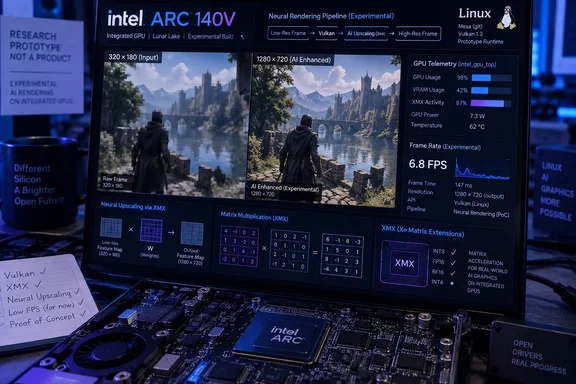
The important correction comes before the performance numbers: the hardware is Intel Arc 140V, the Xe2 integrated GPU used in Lunar Lake systems, not an “Arc 140T” as some early coverage has described it. The repository’s author, using the handle Uzbekunknown, says the work was developed and tested under Linux on an Arc 140V. It can process frames from Windows games running through Proton, but it does not currently provide a native Windows implementation.
Tom’s Hardware first highlighted the project, while Germany’s PC Games Hardware independently described the same core result: an outside developer rebuilt the neural-rendering inference pipeline in Vulkan shaders and dispatched it to Intel’s XMX matrix hardware. That is a substantial technical result. It is also much narrower than the headline version of “DLSS 5 on Intel” suggests.
It is a reimplementation, not NVIDIA’s DLSS runtime
The project does not load NVIDIA’s NGX runtime, use CUDA, or claim to make Intel hardware compatible with the official DLSS 5 feature. Instead, its author says they reconstructed the inference graph used by DLSS Neural Rendering, including a 71-block U-Net model, then implemented the surrounding image-processing work and GPU dispatch path independently.
That distinction is more than legal housekeeping. NVIDIA’s official DLSS 5 implementation is a product feature with its own supported hardware, game integrations, driver path, tuning, and quality controls. This project is a Vulkan layer that intercepts a game frame at presentation, sends it to a separate process holding the neural model, then composites the model’s generated output back onto the game image.
In practical terms, it behaves more like an experimental post-processing injector or photo-mode tool than a normal in-game DLSS setting. The repository says it can attach to Vulkan titles directly and to DirectX games routed through Proton translation layers. Its listed demonstrations use Tekken 7, Dead or Alive 5 Last Round, and Mortal Kombat 1.
The code repository also makes a conspicuous constraint clear: it ships no NVIDIA binary or model weights. Users must obtain a DLSS Neural Rendering DLL themselves and extract the logical weights before the project can run. That avoids redistributing NVIDIA files, but it does not make this a frictionless consumer install—or settle any question about whether NVIDIA considers such extraction and use supported under its software terms.
The Arc 140V result is about matrix support, not gaming performance
The experiment works because Intel’s Xe2 architecture exposes matrix operations through Vulkan’s VK_KHR_cooperative_matrix extension. Cooperative matrices let groups of shader invocations execute matrix multiply-and-accumulate work through hardware designed for AI-style workloads, rather than treating every neural-network operation as conventional graphics arithmetic.
The author reports using FP16 inputs with FP32 accumulation because the Arc 140V’s Xe2 configuration does not offer the FP8 path used by the original model. That is the central performance handicap. Neural Rendering is an enormous image-generation workload compared with ordinary temporal upscaling, and moving from compact FP8 weights to FP16 raises bandwidth and compute pressure considerably.
Still, the technical achievement should not be understated. The project reports that the model’s major matrix operations run on Intel XMX units and that the full graph remains resident on the GPU rather than bouncing intermediate tensors through system memory. A Vulkan compute path capable of doing that is exactly what makes a cross-vendor experiment possible.
But possible is the operative word. The Arc 140V is a capable integrated GPU for its class, yet it is not designed to run a full-frame generative rendering pass at real-time resolutions. The project’s own benchmark table puts the result in perspective:
- At a 512×288 swapchain, the fastest listed configuration reaches about 10.1 frames per second.
- At 640×360, the listed result is about 8.6 frames per second.
- At 854×480, performance drops to about 5.6 frames per second.
- At 1920×1080, even with the neural pass rendered at a reduced scale, the project reports roughly 1.2 frames per second.
Those figures are more sobering than the “360p at 10 FPS” headline. They describe the cost of running the neural renderer on a very small output image, often with the game frame held between updates. The repository explicitly describes its live mode as a slideshow: it processes every Nth present and retains the generated result on intervening frames.
That is useful for evaluating image output. It is not a viable solution for competitive fighters, fast action games, or ordinary desktop gameplay.
The project’s own numbers show where the bottleneck sits
The repository estimates a 17-millisecond base cost plus roughly 488 milliseconds per megapixel for the neural work on its tested Arc 140V system. At 720p, it identifies matrix multiplication as the largest single component, consuming 216 milliseconds of a 488-millisecond graph time. That explains why resolution dominates every other setting.
Rendering the neural pass at a reduced scale can help, but it does not solve all costs. According to the project documentation, several full-frame operations still follow the output swapchain’s dimensions. A game running at a tiny internal resolution but presenting a 1080p frame therefore remains much slower than a game genuinely presenting a smaller 512×288 or 640×360 surface.
This is why the project’s best-case setup is effectively a low-resolution window stretched by the desktop compositor. It is also why readers should be skeptical of any framing that compares its 10 FPS result with conventional GPU performance in Tekken 7. The game itself is not the workload being tested. The neural rerendering pass is.
NVIDIA’s own DLSS 5 research describes generative rendering as an additional stage that can synthesize lighting, material appearance, and other visual details from learned appearance priors. The Intel experiment demonstrates that the model can be made to execute outside NVIDIA’s usual stack. It does not demonstrate that Intel integrated graphics can absorb the feature’s intended real-time cost.
Image quality changes are the feature—and the problem
The screenshots are a reminder that Neural Rendering is qualitatively different from a conventional sharpening filter. The project reports increased high-frequency texture energy in several test regions, and its output can visibly add texture-like detail to clothing, skin, and backgrounds. Yet it also changes brightness, color, and facial appearance.
That is especially evident in Dead or Alive 5 Last Round, whose stylized art direction does not match the photorealistic tendencies the model appears to have learned. The generated output can make characters look older and alter the intended anime-influenced presentation. In Mortal Kombat 1 and Tekken 7, whose character rendering is closer to photographic realism, the effect can appear more natural—but it still changes the developer-authored image rather than merely recovering missing pixels.
The repository deserves credit for documenting these tradeoffs rather than presenting every extra edge or pore as a quality win. It measures local texture changes and color shifts, and notes that brightness changes can make generated detail look more convincing than it is. That is a more useful standard than screenshot comparisons alone.
For players, the consequence is simple: even if this becomes faster on a discrete Arc GPU or another vendor’s hardware, “more detailed” will not necessarily mean “truer to the game.” Neural Rendering is capable of imposing a visual prior on an image. The result may be striking, but it can also conflict with a game’s art direction.
AI-assisted development is part of the experiment’s evidence problem
Uzbekunknown says Claude Opus 5 and OpenAI’s GPT-6 Astra produced the project’s code, measurement tooling, and development notes after the author supplied the hardware, binary, objectives, and decisions. The repository is unusually candid about that process, including a documented false lead involving a supposed driver bug that influenced multiple development phases.
That candor is valuable, but it changes how outside observers should treat the project. A public repository, repeatable build instructions, benchmarks, and test code are stronger evidence than an AI-generated explanation of what happened. The author effectively acknowledges this by directing readers to the tests and measurement programs rather than asking them to trust the prose.
For developers and graphics researchers, that means the relevant question is not whether an AI agent “ported DLSS 5.” It is whether the implementation faithfully reproduces the relevant model behavior, handles the input and output path correctly, and can be independently built and measured on other hardware. The available work is promising on the first point, but it remains early research, not a broadly validated compatibility layer.
Windows users should wait for a native port before treating this as actionable
The repository currently lists Linux as a requirement, with Vulkan, Mesa’s Intel driver stack, Python and NumPy, a compiler toolchain, and manually supplied model weights among the prerequisites. It can process some Windows games only because Proton translates those games into a Linux Vulkan environment.
A Reddit user cited by Tom’s Hardware has said they intend to adapt the work for Windows, but no native Windows release, supported hardware list, performance target, or public delivery date has been established. There is likewise no demonstrated Arc B-series desktop result in the submitted project record.
The immediate takeaway for Intel users is therefore precise: an Arc 140V has run an independently rebuilt DLSS 5 Neural Rendering pass through Vulkan, but only at proof-of-concept speeds and only under Linux today. The work establishes that NVIDIA’s model architecture is not inseparable from NVIDIA hardware. It does not yet establish a practical alternative to NVIDIA’s supported DLSS 5 path.
Update: 720p testing highlights a sizeable shared-memory requirement (September 19, 2026)
Wccftech reports that the Arc 140V prototype can require roughly 2.3GB of device-buffer memory at 720p. Because Arc 140V is an integrated GPU, that allocation comes from shared system memory rather than dedicated VRAM.
That raises the practical cost beyond the already low frame rates: on Lunar Lake laptops with limited memory capacity or heavier background workloads, the experiment may face additional contention and less headroom for the game itself. Wccftech also characterizes 720p performance as roughly 3–5 FPS, reinforcing that the project remains useful for technical validation rather than interactive play.
References
- Intel Arc 140V Runs DLSS 5 Neural Rendering Without CUDA, But Frame Rates Collapse To Just 3-5 FPS Wccftech · 2026-09-19T12:24:35+00:00
- AI developer vibe codes DLSS 5 onto Intel CPU's integrated graphics — Intel Arc 140T runs neural rendering in 360p at 10 frames per second Tom's Hardware · 2026-09-18T13:15:00+00:00