

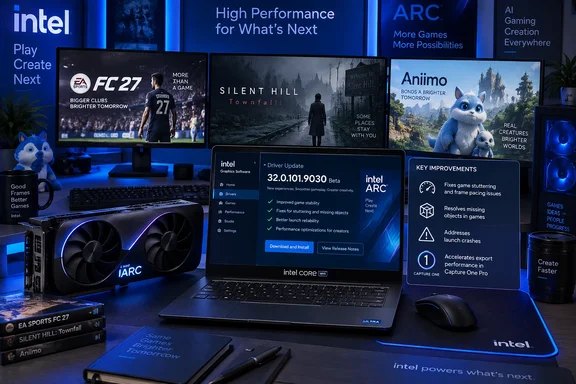
The catch is distribution. TechPowerUp reported the release on September 18, while Intel’s main Arc Graphics download listing was still presenting version 32.0.101.8993 when checked the same day. GameGPU separately reported the 32.0.101.9030 package and its release notes. That leaves Arc owners with a familiar beta-driver problem: the package appears to have been published, but Intel’s ordinary download path had not yet caught up for every visitor.
For users affected by one of the named bugs, 101.9030 is a meaningful update. For everyone else—particularly on work PCs or laptops whose manufacturers maintain customized graphics drivers—the prudent move is to wait for Intel’s public download page or the system maker’s support channel to surface the build.
The fixes are split across Arc cards and Core Ultra iGPUs
Intel’s release notes, as summarized by TechPowerUp and GameGPU, do not describe one universal repair pass for every Arc-supported machine. The fixes are tied to particular GPU families, which matters when deciding whether this beta is relevant.
The Dragon’s Dogma 2 fix applies to DirectX 12 stuttering on Intel Core Ultra Series 2 and Series 3 processors with built-in Arc graphics. That specifically points to modern Intel laptops and compact desktops relying on the processor’s integrated GPU, rather than owners of an Arc A-Series or B-Series add-in card. Players who were troubleshooting the same game on an Arc A770 or Arc B580 should not assume the release notes promise a cure for their configuration.
The reported Call of Duty: Modern Warfare III correction—objects failing to populate in DirectX 12—is aimed at Arc B-Series hardware. So is the Palia launch-crash fix. Those are more concrete than a generic performance claim: a missing-world-object bug and a game that will not open are defects users can verify immediately after installation.
Capture One Pro is the broadest production-workflow item in this release. Intel says hardware acceleration during export is restored across all supported products. That includes both discrete Arc systems and Core Ultra machines using integrated Arc graphics, at least where the application and operating system otherwise meet Intel’s driver support requirements. Photographers and imaging teams who disabled GPU acceleration as a workaround should re-test exports rather than assuming the setting is still unsafe.
“Game On” support does not mean benchmark gains are promised
The headline additions are support for EA SPORTS FC 27, SILENT HILL: Townfall, and Aniimo. Intel’s Game On branding normally means the driver includes game-specific launch readiness work, such as compatibility fixes, tuning, or validation around a new title. It does not amount to a stated frame-rate increase, image-quality improvement, or stability guarantee for every Arc product.
Neither the TechPowerUp report nor GameGPU’s coverage identifies performance figures for the three games, compares 101.9030 with the preceding 101.8993 build, or says which graphics settings were validated. Intel also has not publicly attached a performance chart to this beta release. Owners should therefore treat it as a compatibility-oriented package, not evidence that a particular Arc GPU has received a measurable day-one uplift.
That distinction is especially relevant for laptops. A Core Ultra notebook may receive the driver’s game profile, but actual results can still depend on its memory configuration, power limits, cooling profile, BIOS version, and whether the game is running on the integrated Arc GPU or a separate discrete GPU. “Supported” is useful; it is not a substitute for system-specific testing.
The remaining defect list is extensive enough to justify caution
Version 101.9030 arrives as a beta and retains a lengthy list of known issues, including several crashes in games and creator benchmarks. Intel still lists Mafia: The Old Country DirectX 12 gameplay crashes on certain Core Ultra Series 3 systems, while EA SPORTS FC 27 itself can crash on certain Series 2 platforms. NBA 2K26 may also crash on first launch.
The issue list is not confined to games. PugetBench for Adobe Lightroom Classic can crash when run with its extended preset, and PugetBench for DaVinci Resolve Studio may crash intermittently during a benchmark run. Intel’s workaround for the DaVinci test is unusually specific: increase the PugetBench timeout slider to 1,500 seconds or more so each test can finish. That is a viable benchmark workaround, but it is not a correction for a production workflow that needs predictable unattended rendering.
Intel also lists failures in Procyon’s AI Image Generation and AI Text Generation benchmarks. IT departments and reviewers using those tools to compare local AI performance should record the driver version with their results and avoid interpreting an incomplete run as a hardware result. A benchmark that fails before completion cannot be fairly compared with a successful run on a different driver.
Other unresolved issues include a crash in Arena Breakout Infinite when Terrain Surface Subdivision is enabled, visual corruption in Gamble With Your Friends with anisotropic filtering, and Intel Graphics Software display-management quirks. The latter include monitor blanking with Combined Display, a nonfunctional three-dot menu on the Display page, and an inaccurate value for the Shared GPU Memory override.
Multi-GPU tuning remains a bad place for experimentation
Intel continues to label Performance Tuning in Intel Graphics Software as beta software, and 101.9030 does not change that status. The company warns that performance and features can behave unexpectedly. More specifically, systems containing two tuning-capable devices may see settings applied to more than one GPU at once instead of only the GPU selected in the interface.
That warning deserves more attention than its placement in a driver changelog suggests. On a desktop with an Arc card alongside a supported integrated GPU, or on a system used for separate rendering, encoding, and AI tasks, unintended tuning changes can complicate stability troubleshooting. Users should document existing settings, avoid applying overclock or power adjustments until they confirm the target device, and be ready to restore defaults after updating.
For managed endpoints, the issue reinforces Intel’s own standing guidance around generic graphics packages: OEM-supplied drivers can contain machine-specific changes for display panels, power behavior, docking, and hybrid graphics. A generic beta package may overwrite that customized driver. Corporate support teams and laptop owners should favor the manufacturer-certified driver unless 101.9030 resolves a reproducible issue that outweighs the risk.
What Arc users should do now
Users affected by the corrected Dragon’s Dogma 2, Modern Warfare III, Palia, or Capture One Pro issues have a defensible reason to install 101.9030 once it appears through an official Intel channel. Before doing so, create a restore point or otherwise preserve a known-good driver path, then test the specific workload that motivated the update rather than changing several graphics settings at the same time.
Users who only want support for the three new games can install the beta if they are comfortable troubleshooting driver regressions, but should not expect published performance gains from this release. Anyone using PugetBench, Procyon, multi-GPU tuning, or a laptop with an OEM-customized driver should hold off unless the new package addresses an immediate operational problem.
The practical story behind 101.9030 is less about its three Game On titles than its targeted fixes and its unfinished edges. Intel has addressed several visible failures, particularly for Core Ultra integrated Arc graphics and Arc B-Series cards, but it is still shipping a beta with unresolved crashes in new games, creator benchmarks, and the software used to tune the GPU itself.
Update: Intel’s official download portal now lists Arc driver 32.0.101.9030 (September 18, 2026)
Contrary to the earlier distribution uncertainty, Intel Arc graphics driver 32.0.101.9030 is now available through Intel’s official download portal, according to Neowin’s September 18 report. That means affected users no longer need to wait for the ordinary Intel download path to catch up before obtaining the beta package.
The availability change is most relevant for users seeking the listed fixes for Dragon’s Dogma 2, Call of Duty: Modern Warfare III, Palia, or Capture One Pro export acceleration, as well as players preparing for EA SPORTS FC 27 and SILENT HILL: Townfall. The package remains a non-WHQL beta driver, however, so its known crash and benchmark issues still apply.
For managed PCs and OEM-customized laptops, the recommendation remains unchanged: use the Intel package only where its targeted fixes justify replacing a manufacturer-certified graphics driver.
References
- Intel Arc GPU Graphics Drivers 101.9030 Beta Released TechPowerUp · 2026-09-18T16:29:30+00:00
- Intel Arc driver adds Silent Hill: Townfall and EA FC 27 support Neowin · 2026-09-18T22:44:01+00:00