

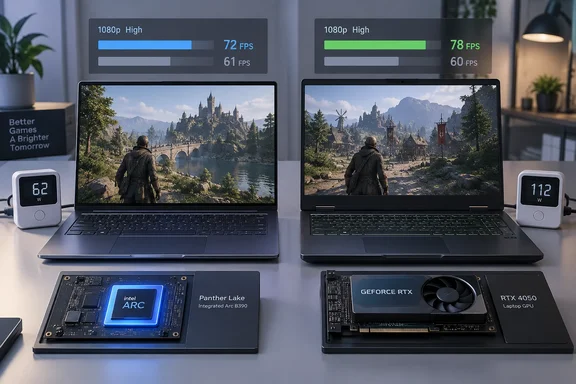
Panther Lake's Arc B390 lands only in three Core Ultra Series 3 chips
Intel introduced Core Ultra Series 3, codenamed Panther Lake, at CES on January 5, 2026. It calls the platform its first client processor family built on the Intel 18A process. Intel said preorders for the first consumer laptops would open January 6, with global availability from January 27 and more designs through the first half of the year. For the new Core Ultra X9 and X7 tier, Intel claims up to 12 Xe cores and "over 77% faster gaming performance" than Lunar Lake. The footnote defines that as a geometric mean across 45 games at 1080p High with 2x upscaling, comparing the Core Ultra X9 388H with the Core Ultra 9 288V on Intel reference platforms.
The Arc B390 uses Intel's Xe3 graphics architecture. It replaces the Xe2-based Arc 140V from Lunar Lake and the older Xe-based Arc 140T from Arrow Lake. Notebookcheck's analysis, based on Intel's specifications, lists 12 Xe3 cores in two render slices of six, with 16MB of L2 cache, twice the previous amount.
The detail that matters most for buyers is that "Panther Lake" does not always mean "Arc B390." Notebookcheck reports that only the Core Ultra X9 388H, Core Ultra X7 368H and Core Ultra X7 358H get the B390. The Core Ultra 5 338H gets an Arc B370 with 10 Xe cores. The rest of the lineup uses plain "Intel Graphics" with four or two Xe cores, which Notebookcheck expects to be much slower. Wccftech has separately reported that the Arc B300 family runs from 2 to 4, 10 and 12 Xe3 cores, with Arc B390, B380, B370 and B360 variants.
The gap shows up inside a single laptop line. Notebookcheck notes that the Asus Zenbook Duo UX8407's base model, priced at €2,299, uses the Core Ultra 9 386H with a much weaker iGPU. The B390 comes only in the €2,599 top configuration with the Core Ultra X9 388H.
The Arc B390 beats low-power RTX 4050 laptops but trails full-power ones
Notebookcheck's January analysis gave the story its headline: the B390 "trades blows" with the RTX 4050 Laptop GPU. The figures behind that phrase need care. The RTX 4050 Laptop GPU is a discrete chip that laptop makers can configure at very different power limits (TGP, or total graphics power). Notebookcheck compared the B390 against its stored results from several RTX 4050 laptops, not against one Nvidia machine tested side by side.
The Time Spy scores in some coverage are actually Fire Strike scores. Several write-ups, including one of the most widely shared summaries, report the B390 at 17,054 points in 3DMark Time Spy, between a 30W RTX 4050 at 13,591 and a 60W RTX 4050 at 19,853. Those three numbers come from Notebookcheck's Fire Strike Graphics chart. The 17,054 is the Asus ExpertBook Ultra B9406CAA, and the Zenbook Duo UX8407AA scored 17,498. Notebookcheck's Time Spy Graphics chart has a smaller scale but the same order:
| Laptop | GPU (configured power) | Time Spy Graphics | Fire Strike Graphics |
|---|---|---|---|
| Lenovo IdeaPad Pro 5 16IMH G9 | RTX 4050 (90W) | 8,574 | 23,210 |
| Lenovo Yoga Pro 7 14IMH9 | RTX 4050 (60W) | 7,342 | 19,853 |
| Asus Zenbook Duo UX8407AA | Arc B390 | 7,190 | 17,498 |
| Asus ExpertBook Ultra B9406CAA | Arc B390 | 6,679 | 17,054 |
| Dell XPS 14 2024 OLED | RTX 4050 (30W) | 5,107 | 13,591 |
On both tests the B390 clearly beats the 30W RTX 4050 in the 2024 Dell XPS 14 and sits just below the 60W version. Notebookcheck's summary is that RTX 4050 variants up to 60W land in the B390's range, and that a 90W design such as the Lenovo IdeaPad Pro 5 is needed for a clear lead. The same analysis puts the B390 at roughly twice AMD's Radeon 890M, with AMD's Strix Halo graphics (Radeon 8050S and 8060S) noticeably faster but using much more power.
The game results tell the same story with more variation. In Notebookcheck's Zenbook Duo review, at 1080p Ultra with no upscaling, the B390 averaged 47.7 fps in Cyberpunk 2077 against 50.8 fps for the 60W RTX 4050 Yoga Pro 7 and 35.8 fps for the 30W XPS 14. In Baldur's Gate 3 at 1080p Ultra it scored 44.6 fps against 49.8 and 48.3. Older or differently optimised titles are less kind. In GTA V at its highest 1080p settings, the B390 managed 45.1 fps against 84.9 fps for the Yoga Pro 7. The B390's gaming result was about 70% above the previous Zenbook Duo's Arc 140T, but that uplift applies to one device and one test suite.
Dell's XPS 14 comparison shows where 3DMark overstates the Arc B390
Notebookcheck's February follow-up is the most useful single data point for a buyer. It compared two retail laptops from the same product line: the 2026 Dell XPS 14 with a Core Ultra X7 358H and Arc B390, and the 2024 XPS 14 with a 30W RTX 4050. In 3DMark, the Intel machine led by 30 to 40%. Notebookcheck argued that "better than RTX 4050" headlines probably came from synthetic results like these.
In games, that lead mostly disappeared. Cyberpunk 2077 and Baldur's Gate 3 ran 5 to 15% faster on the B390 XPS. At 1080p Ultra in Cyberpunk without FSR, for example, it scored 40.9 fps against 35.8. Older titles went the other way. In X-Plane 11.11 at 1080p high settings, the 2024 RTX 4050 XPS scored 77.1 fps against 40.3. In GTA V at highest settings, it led 62.7 fps to 43.3.
Compared with the average RTX 4050 laptop in Notebookcheck's database rather than Dell's power-limited one, the B390 XPS trailed by about 20 to 25% in several Cyberpunk presets. Notebookcheck warned that thicker RTX 4050 laptops with higher power ceilings "can run laps around" the B390 XPS. It added that turning on DLSS versus XeSS upscaling would widen the gap in Nvidia's favour.
Creative work shows a bigger gap. In Blender's Classroom scene, the 2024 XPS 14 finished in 37 seconds using Nvidia OptiX. The B390 XPS took 106 seconds using oneAPI, a margin of more than 2x. Anyone whose workload depends on CUDA or OptiX rendering should treat the gaming comparison as irrelevant to their decision.
Wccftech's CES session: nine games on an Intel-supplied IdeaPad Pro 5
The widest spread of game results comes from a CES hands-on, not a retail review. Wccftech says that during Intel's Core Ultra Lounge Tour, Intel provided it with a Lenovo IdeaPad Pro 5 laptop featuring the top Core Ultra X9 388H CPU with the full 12 Xe3 core "Arc B390" iGPU. The laptop was configured at a base TDP of 25W, with PL1 set to 85W and PL2 set to 95W, yet in gaming it hardly breached 50W and stayed very quiet. This was a short, vendor-arranged demo session. Wccftech's figures are early impressions from an Intel reference machine, and some summaries describe them as an independent retail review, which they are not.
Wccftech's native-rendered results, with XeSS upscaling but no frame generation, were:
| Game | Settings | Average fps |
|---|---|---|
| Cyberpunk 2077 | 1080p Medium, XeSS Balanced | 99.45 |
| Forza Horizon 5 | 1080p High, XeSS Quality | 111 |
| Forza Horizon 5 | 1080p Ultra, XeSS Quality | 68 |
| F1 25 | 1080p High, XeSS Balanced | 104 |
| F1 25 | 1080p Ultra High, XeSS Quality | 44 |
| Doom: The Dark Ages | 1080p High, XeSS Balanced | 58.4 |
| Assassin's Creed Shadows | 1080p Medium, XeSS Balanced | 58 |
| Ghost of Tsushima | 1080p High, XeSS Balanced | 53 |
| Borderlands 4 | 1200p High, XeSS Balanced | 50.2 |
| Battlefield 6 | 1080p High, XeSS Balanced | 47.5 |
Some republished versions of this chart show only one Forza Horizon 5 row, labelled High, and one passage elsewhere calls the 111 fps result Medium. Wccftech's report lists two separate runs, at High and at Ultra. For Ghost of Tsushima, Wccftech's text also says gameplay went above 60 fps while cutscenes pulled the average to about 50, so the 53 fps figure understates actual play.
In Cyberpunk, Wccftech set the 99.45 fps result against other systems. It listed 111.92 fps for a GMKtec EVO X2 with AMD's Radeon 8060S (Strix Halo) at 54W, 59.72 fps for the Radeon 890M, 58.12 fps for the Arc 140T, and 55.64 fps for an Asus Zenbook S14 with the Arc 140V. That works out to roughly a 66% uplift over Lunar Lake in this one test, and it is not a same-lab comparison across every system.
Other outlets that got time on the same reference system reported similar results. Tom's Hardware says it tested an IdeaPad Pro 5 running the top-end Core Ultra X9 388H with 32GB of memory, and notes that the system sat on a stand for better airflow and ran games from an external PCIe Gen 4 NVMe SSD over USB-C. OC3D's run of Cyberpunk 2077 at 1080p Ultra ray tracing gave an average of 37.91 FPS at native 1080p, rising to 81 FPS with XeSS Balanced and 2x frame generation. These results agree with Wccftech's, but they were all captured on hardware Intel prepared, on Intel's schedule.
Arc B390 frame-generation numbers do not measure raw GPU speed
Wccftech's frame-generation figures are the ones that tend to get repeated, so they need to be kept separate. With XeSS 3 frame generation on, Cyberpunk 2077 went from 99.45 to 165.74 fps at 2x, Doom: The Dark Ages from 58.4 to 97.8 fps at 2x, Assassin's Creed Shadows from 58 to 118 fps at 2x, and Battlefield 6 from 47.5 to 192 fps at 4x.
Notebookcheck explains the mechanism. XeSS 3 adds multi-frame generation (MFG), which inserts GPU-generated frames between rendered ones in a similar way to Nvidia's version. The multiplier is set in the Intel driver: 2x adds one generated frame, 3x adds two, and 4x adds three. The 192 fps Battlefield 6 figure is therefore mostly generated frames. The game itself was rendering about 47.5 frames per second.
Frame generation makes motion on screen look smoother. None of these tests show that it makes the game respond faster to input. The fair comparison is always native frame rate against native frame rate, at the same resolution, preset and upscaling mode. Tom's Hardware's headline also mentions "XeSS quirks" found in its hands-on, which is a reminder that upscaler behaviour varies by game.
Arc B390 efficiency: the 52W versus 95W result
Performance per watt is where the B390 wins without qualification. In the Zenbook Duo, which runs at 64W PL2 and 46W PL1, Notebookcheck measured the B390's GPU cores drawing about 38 to 40W at full performance. That corresponds to roughly 52W of total package power. For comparison, the Arc 140T peaks at around 32W, so part of the new generation's gain comes from simply using more power.
The system-level figures are the most striking. In Notebookcheck's XPS 14 comparison, the B390 XPS drew 52W while running Cyberpunk 2077. The Lenovo Yoga Pro 7 14 with an RTX 4050 drew 95W and produced about 20% more frames before any AI upscaling. Notebookcheck concluded that the Intel iGPU is the much more efficient option. The two numbers are whole-laptop power draw, not GPU-only power, and should not be mixed up with the 38–40W GPU figure above.
Other testers have looked at even lower power limits. According to VideoCardz, Digital Foundry ran Alan Wake 2 on the same IdeaPad Pro 5, and the laptop averaged 29.54 fps at a 30W limit, reported as about seven percent ahead of the Xbox Series S. With PS5-equivalent settings, PS5 scored 55.25 fps while the Panther Lake laptop averaged 28.91 fps. VideoCardz also reports that PC Games Hardware found the Arc B390 beats the GTX 1060 and RX 580 but trails the RTX 2060 and RX 6600, while averaging about 26.8 W (peaking around 31 W). These are single-scene, single-game results. Together they put the B390 at roughly the level of an older mid-range desktop card, running in a power budget typical of a handheld.
Chassis and cooling still limit all of this. The tested machines were a 1.7kg, 23mm-thick Zenbook Duo, a Dell XPS 14, an Asus ExpertBook and an IdeaPad Pro 5 reference unit on a stand. A laptop that cannot sustain around 50W of package power under load will perform below these figures. This is an inference from the power measurements, not a measured result for any cheaper model.
What the Arc B390 means for laptop buyers and IT fleets
If you want 1080p gaming on a thin laptop, a B390 machine is a real alternative to an entry-level RTX 4050 laptop. That holds only if the alternative is a thin, low-TGP RTX 4050 design and your games are modern titles that run well on Intel's drivers. If you want the highest frame rates in older games, play at higher resolutions, or depend on CUDA, OptiX or Nvidia's toolchain, a properly powered discrete GPU is still the better choice. For IT buyers standardising on thin-and-light fleets, the efficiency data means a B390 SKU can handle occasional GPU work without a discrete-GPU chassis. The Blender results show that GPU rendering pipelines built on Nvidia will not transfer.
- Confirm the exact processor before buying. The Arc B390 comes only with the Core Ultra X9 388H, Core Ultra X7 368H and Core Ultra X7 358H. The Core Ultra 5 338H gets the 10-core Arc B370, and other Panther Lake chips have much weaker Intel Graphics.
- Find the RTX 4050's configured power when comparing laptops. Notebookcheck's data shows the B390 beating a 30W design, close to a 60W design, and clearly behind a 90W design.
- Compare native frame rates without frame generation. Wccftech's 192 fps Battlefield 6 result is a 4x frame-generation figure built on about 47.5 rendered frames per second.
- Expect synthetic benchmarks to flatter the B390. Notebookcheck measured a 30–40% 3DMark lead over a 2024 XPS 14 with RTX 4050 that shrank to 5–15% in some games and reversed in GTA V and X-Plane.
- Keep Nvidia hardware for creative or compute work that relies on OptiX or CUDA. Blender's Classroom scene took 106 seconds on the B390 against 37 seconds on the RTX 4050 XPS.
- Treat reference-unit results as a best case. The Wccftech, Tom's Hardware and OC3D numbers came from an Intel-supplied IdeaPad Pro 5, while Notebookcheck's retail-review figures come from specific, well-built premium laptops.
The Arc B390 has earned its reputation for efficiency more clearly than its reputation as an RTX 4050 rival. At about 52W for the whole laptop it delivers most of what a 95W RTX 4050 system does in modern games, and it beats the power-limited Nvidia designs thin laptops used to rely on. Whether it replaces an RTX 4050 therefore depends on the specific laptop more than on the chip. Because Intel is spreading Panther Lake across more than 200 designs through 2026, including many without the 12-core B390, buyers will mostly win or lose on the processor model printed on the spec sheet.