

That is the important correction to MakeUseOf’s broad comparison. AMD has shipped an ML-based upscaler, frame generation, ray-tracing denoising, and a preview of radiance caching through its FSR “Redstone” work. Intel has shipped XeSS 3 with multi-frame generation. Neither fact means the three vendors now offer equivalent features on equivalent hardware, in equivalent numbers of games, or with equivalent implementation maturity.
For Windows PC gamers and admins supporting gaming fleets, the practical decision remains more mundane than the marketing names suggest: start with the upscaler a game implements well, keep the rendered frame rate high enough before turning on frame generation, and treat high frame multipliers as a smoothness tool rather than as free performance.
Intel’s XeSS 3 has passed AMD on shipped frame multiplication
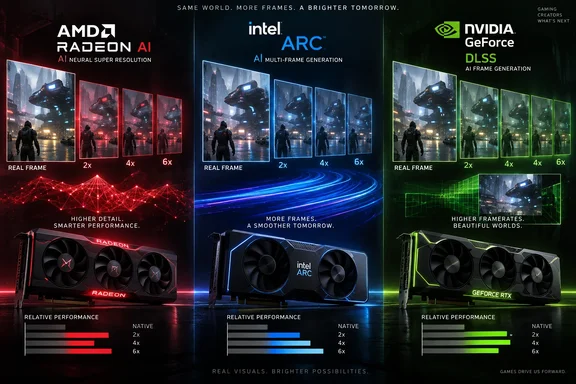
Intel’s XeSS 3 is the clearest new development in this contest. Intel’s developer documentation says XeSS Multi-Frame Generation can insert up to three AI-generated frames between two conventionally rendered frames. In the terminology used in game menus and Intel’s own materials, that amounts to 4x frame generation: one rendered frame plus three generated frames.
AMD’s currently shipping FSR Frame Generation 4.0, by contrast, creates one intermediate frame between two rendered frames. That is conventional 2x frame generation. AMD’s own recent technical material describes the feature as one that effectively doubles output frame rate, which is fundamentally different from the 3x and 4x choices Intel now exposes on supported Intel hardware.
So Intel does have a defensible lead over AMD in one narrow but visible category: it has a released multi-frame-generation implementation rather than merely conventional frame generation. XeSS 3 also requires Intel’s Xe Low Latency component when frame generation is enabled, an acknowledgement that presenting more generated frames without managing pacing and latency creates a worse experience than the FPS counter suggests.
The limitation is hardware. Intel documents XeSS Super Resolution as cross-vendor technology, including a fallback path for compatible AMD and Nvidia GPUs. XeSS Multi-Frame Generation, however, is available only on Intel devices. A Radeon or GeForce owner may be able to use XeSS upscaling, and in some cases XeSS’s standard frame-generation path, but cannot use the headline 3x or 4x XeSS modes.
That makes the “Intel took the lead” framing accurate only if the comparison is AMD versus Intel’s presently shipping frame multipliers. It is not a declaration that Arc has displaced GeForce as the best-supported platform for AI-assisted PC rendering.
Nvidia still has the higher production multiplier
Nvidia’s DLSS 4.5 supports Dynamic Multi Frame Generation and a 6x mode on GeForce RTX 50-series hardware. At maximum, that mode produces five AI-generated frames for each traditionally rendered frame. It is a higher output multiplier than Intel’s 4x option, and it is a released part of Nvidia’s current DLSS 4.5 stack.
More importantly, Nvidia has spent years turning DLSS into a developer integration and distribution system, not merely an image-processing model. Its DLSS 4.5 Super Resolution update is available across GeForce RTX hardware through the Nvidia app, while the company’s newer Ray Reconstruction model is intended to work across RTX generations in supported ray-traced and path-traced titles.
There is no single universal scorecard for image quality between FSR 4.1, XeSS 3, and DLSS 4.5. Output changes with the game engine’s motion vectors, anti-aliasing, post-processing chain, input resolution, driver revision, and whether the game has a native integration or is using a driver-level replacement. Claims that one option looks “more natural” or another is universally sharper are useful starting impressions, not a substitute for title-specific testing.
The reliable technical point is that all frame-generation systems depend on sufficiently strong real frame rates. A game rendering at 30 fps can display 120 fps after 4x multi-frame generation, but its input latency, CPU bottlenecks, simulation cadence, and many visual artifacts still originate from a 30-fps base. Frame generation improves perceived motion; it does not make input, physics, or CPU-limited game logic run four times faster.
For that reason, users should aim for a stable native or upscaled baseline before enabling 3x, 4x, or 6x modes. In fast competitive games, a lower multiplier or no frame generation may remain preferable. In single-player titles with demanding ray tracing, the extra display smoothness can be worthwhile if the base rate is already healthy.
AMD’s FSR Redstone is broader than a simple DLSS clone
AMD has made the more consequential architectural catch-up on image reconstruction and ray-traced rendering. FSR Upscaling 4.1 is an ML-powered successor to the earlier FSR approaches and uses dedicated machine-learning acceleration on Radeon RX 9000-series GPUs. AMD says the 4.1 update improves detail, dynamic-resolution behavior, temporal stability, and ghosting handling over earlier FSR 4 releases.
FSR Redstone’s more important expansion is that it extends beyond upscaling. The SDK includes FSR Frame Generation 4.0, Ray Regeneration 1.1, and Radiance Caching 0.9 in preview. Ray Regeneration is AMD’s neural denoiser for noisy ray-traced output, serving a role comparable to Nvidia’s Ray Reconstruction: it attempts to transform limited ray samples into a stable, clean final image rather than leaning entirely on conventional hand-tuned denoisers.
This is meaningful progress, but availability remains the dividing line. AMD’s own developer material identifies Crimson Desert as the first game to ship with both FSR Upscaling 4.1 and Ray Regeneration 1.1, released March 19, 2026. Radiance Caching is still designated as a preview component. That is a very different position from declaring that the entire Redstone feature set has already become a broadly interchangeable replacement for Nvidia’s production DLSS path.
AMD’s other limitation is hardware scope. The current ML-powered FSR Upscaling implementation is built around the Radeon RX 9000 series and RDNA 4’s improved AI acceleration. AMD has made older FSR versions broadly usable, and its software can upgrade some FSR 3.1 integrations, but buyers should not assume that purchasing an older Radeon card will deliver every FSR 4.1 or Redstone capability.
AMD’s rumored 8x mode is not a released feature
MakeUseOf points to reports of AMD testing FSR Multi Frame Generation settings as high as 8x. VideoCardz reported in July that RadeonTuner, a third-party utility, surfaced experimental Radeon driver properties containing ratios from 1x through 8x and identifying the feature as FSR Multi Frame Generation.
The crucial fact is that the feature did not work in the outlet’s testing. VideoCardz reported that the experimental settings appeared on RDNA 4-or-newer hardware but did not enable working multi-frame generation across several tested games. AMD has not announced an 8x FSR Multi Frame Generation feature for current Radeon cards.
That changes how readers should interpret the discovery. It is evidence that AMD may be preparing higher-ratio frame generation, not evidence that Radeon owners can use it now or that AMD has surpassed Nvidia’s 6x mode. Driver strings and experimental controls often appear before a feature has working code, game support, quality tuning, or a public release plan.
AMD has confirmed that its future FSR Diamond direction includes ML-based multi-frame generation, but it has not tied that roadmap to an 8x maximum or a shipping date. Until it does, Intel—not AMD—holds the released multi-frame-generation advantage outside Nvidia’s platform.
DLSS 5 is a future product, not today’s benchmark
The source material also treats DLSS 5 as if it were already the central product against which FSR and XeSS must compete. As of September 19, 2026, Nvidia’s own announcement says DLSS 5 will arrive this fall. Nvidia has published technical details about its generative neural-rendering approach and named future game support, but that is an announced product, not a shipping baseline for Radeon or Arc comparisons.
DLSS 5 also represents a different technical argument from DLSS 4.5. Nvidia says the new system will generate aspects of final displayed appearance—such as lighting and materials—rather than only reconstructing a higher-resolution image from conventional rendering. That raises legitimate questions about artistic control, predictable output, performance cost, and whether players want AI-generated appearance changes in a game designed around authored assets.
Those questions cannot be settled by promotional demonstrations or by comparing feature lists. They will require shipping games, reproducible testing, and controls that let players and developers judge the effect against the intended rendering. Nvidia itself describes the launch timing and partner support as forward-looking, which means the details can still change.
For now, the competitive picture is clearer than the rhetoric: FSR 4.1 gives RDNA 4 Radeon owners a substantially more complete neural-rendering toolkit; XeSS 3 gives Intel hardware the only shipping 4x alternative to Nvidia’s multi-frame generation; and DLSS 4.5 retains the broader, higher-multiplier production lead. AMD’s rumored 8x option and Nvidia’s DLSS 5 are the next milestones—but neither belongs in a present-tense buying recommendation yet.
References
- AMD and Intel finally have answers to Nvidia's DLSS and one just took the lead MakeUseOf · 2026-09-19T18:30:13+00:00