

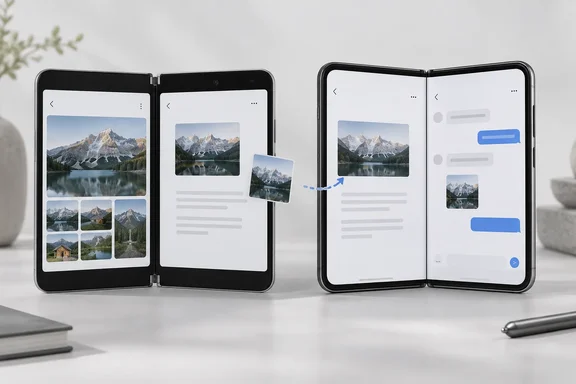
So is Apple finishing what Microsoft started? Partly. The details matter more than the headline, though, so here's what the record supports.
Two answers to the same question
The question is simple: how do you get a bigger workspace into a phone that still fits in your pocket?
Microsoft's answer was two separate screens. Microsoft's own spec sheet for the first-generation Surface Duo lists:
- Two 5.6-inch AMOLED panels, each 1800x1350 (4:3)
- An 8.1-inch combined workspace when opened (2700x1800, 3:2)
- A 360-degree hinge
- 250 grams, a Snapdragon 855 and Android 10
Microsoft pitched it as a productivity device. It came with Office, Outlook, Teams, OneDrive, Edge, OneNote and even the Intune Company Portal preinstalled. Its core interface features included dual-screen windowing, adaptive modes, App Groups and Link to Windows.
Apple's answer is a foldable iPhone. Apple's product page describes it this way:
- A 7.6-inch Super Retina XDR inner display
- The same aspect ratio on the inner and outer displays
- An outer display with more than 90 percent of the screen area of the iPhone 18 Pro
- A titanium frame and hinge cover, IP68 rating, and 3,000 nits peak brightness
Apple calls it the first foldable iPhone and its largest iPhone display ever. Gadget Flow's comparison gives the outer screen as 5.4 inches and the weight as 254 grams, almost the same as the Surface Duo's 250. Apple's pages that I could inspect didn't confirm either number, so treat them as Gadget Flow's figures.
That's the core hardware difference. The Surface Duo had a physical hinge running between two panes of glass. The iPhone Duo has one continuous folding display inside and a usable screen outside. The original Surface Duo had no outer display at all, so checking the time meant opening the phone.
Summary: the hardware is different, but both companies wanted the same thing: a phone that opens into a real workspace.
The multitasking similarity people keep pointing to
This is where the comparison gets interesting. Most foldables treat the unfolded screen like a small tablet. Apps open full screen, and you need a gesture or a special mode to put two side by side.
Windows Central's Zac Bowden has called the Surface Duo the best multitasking phone you could buy since 2020. He argues that in multiple demos, Apple shows the iPhone Duo opening an app, and letting users split it side by side with another app by dragging the app up and docking it to the left or right of the screen. He also notes that when you do this, the iPhone home screen appears on the other side, just like Surface Duo.
Digital Citizen describes the same behaviour. It says Apple's software lets apps sit independently on either side of the folding display, links can open beside the current app instead of replacing it, and apps can be moved between the two halves with simple drag gestures. That link behaviour is pure Surface Duo. On Microsoft's phone, tapping a link while the second screen was free could open the browser on that display. The original app stayed visible on the first screen.
Here's what Apple itself confirms on its product page:
- Split View in landscape, with an example of dragging a photo from Photos into Mail
- Pinning a video to the top of the screen in portrait while you use another app
- StandBy on the outer display, even when the phone isn't charging
- Hands-free FaceTime, with the phone standing on its own
Some claims come from reviewers or other outlets, not Apple. That includes saved app pairs (which would be Apple's version of App Groups), Apple Pencil support "later this year," and exactly how content moves between screens. Treat those as reported until the phone is in buyers' hands.
Windows Central also spotted something fun. In a video demonstrating the multitasking capabilities of the iPhone Duo, Apple chose to have an article from Surface Magazine appear on the screen. That piece is not just a mockup made by Apple, it's a real article that was published in 2018. Was it a wink or a coincidence? Windows Central argues that in a keynote video edited as carefully as Apple's, nothing appears by accident.
Summary: the evidence supports "Apple's multitasking model looks a lot like Microsoft's." It doesn't support "Apple copied the Surface Duo." Bowden's claim that Apple borrowed Microsoft's whole design approach is his opinion. It's well argued, but it's still opinion.
Side-by-side comparison
| Surface Duo (1st gen) | iPhone Duo | |
|---|---|---|
| Launch | September 2020 | Announced Sept 9, 2026; ships Oct 23 |
| U.S. starting price | $1,399 | $1,999 (256GB) |
| Inner workspace | 8.1" across two 5.6" AMOLED panels | 7.6" continuous folding display |
| Outer display | None | Yes, over 90% of iPhone 18 Pro's screen area |
| Hinge | 360-degree | Foldable, titanium hinge cover |
| OS at launch | Android 10 | iOS 27.1 |
| Pen | Surface Slim Pen, Surface Pen, Hub 2 Pen | Reported, not confirmed by Apple sources |
| SIM | One eSIM + one nano SIM | eSIM only (U.S. models) |
| Status | Past end of servicing | Not yet on sale |
Apple's store lists the other storage tiers at $2,199 (512GB), $2,599 (1TB) and $3,199 (2TB). At the top end, the iPhone Duo costs more than twice what the original Surface Duo did.
Why the Surface Duo stumbled
Being early is part of the story, but not all of it. Engadget sums up its own verdict at the time: our reviewer called it adequate as a phone and "pretty bad" as a tablet. Gadget Flow cites Tom's Guide saying the double-tap to switch screens was unreliable. It also cites The Verge's Dieter Bohn, who wrote that Microsoft "may have bitten off more than it can chew" with software that was famously glitchy.
My take, as a veteran of too many "this changes everything" launches: Microsoft got the idea right and the basics wrong. You can't sell a productivity phone that struggles to be a phone. The Surface Duo 2 followed in 2021. There was never a third model, while Samsung went on to build its Galaxy Z Fold line year after year.
Not everyone thinks Apple has solved all of this, either. Windows Latest points out that Apple's marketing seemed to avoid showing the keyboard on the outer display. It suggests that's probably to prevent showing the difficulty of using a superwide keyboard. The same site says Microsoft's 2020 work went well beyond "two screens are cool," covering research into cognitive load, app switching and workflows across devices. That's a fair reminder that Microsoft thought hard about this problem before Apple showed up.
The developer catch
One thing that often gets lost in keynote excitement: a foldable is only as good as the apps on it. Apple's developer news page says the iPhone Duo will ship with iOS 27.1, which adds features built for the foldable design. Xcode 27.1 will add iPhone Duo support, including updated SDKs and a simulator for the device's poses and orientations, with a beta promised later this month.
That should sound familiar to anyone who remembers Microsoft's dual-screen SDK push. Apps built on standard layouts that resize properly should adapt well. Apps with rigid layouts may not. Microsoft learned the hard way that "works on two screens" and "designed for two screens" aren't the same thing. Apple has much more developer leverage, but the rule still applies.
If you still own a Surface Duo
Microsoft's support pages say both the Surface Duo and Surface Duo 2 have reached their end-of-servicing date. That means no newer Android versions and no more security updates. You can still install any update that's already waiting:
- Connect to a Wi-Fi network you trust.
- On the Home screen, tap Settings.
- Tap System > System update > Check for update.
- When the update finishes installing, tap Restart now.
If that finds nothing, your phone is as up to date as it will ever be. This part is general IT advice, not Microsoft guidance: an Android phone that no longer gets security patches is a poor place for work email, MFA prompts or company data. If your organisation uses Intune, compliance policies that set a minimum patch level may already be flagging these devices. Keep the Duo as a nostalgic e-reader or second screen if you like. It's no longer a safe choice for work.
Bottom line
The Surface Duo failed as a product, but the idea behind it has lasted. Microsoft bet that people want two apps side by side on a phone without fiddling with menus. Six years later, Apple seems to be making a version of that bet at $1,999 and up.
Whether Apple actually pulls it off is still unknown. As of now, nobody outside the press has used an iPhone Duo. What we can say is that the Surface Duo's ideas about windowing, opening links next to the current app and pocket-sized productivity have come back on the world's biggest phone platform.
Tell us in the forums what you think: is Apple bringing back Microsoft's best phone idea, or just a similar name and a demo that looks familiar?
References
- iPhone Duo vs Surface Duo: Apple is finishing what Microsoft started Gadget Flow · 2026-09-28T18:34:52+00:00
- iPhone Duo vs Microsoft Surface Duo: One name, two very different devices - Engadget engadget.com
- iPhone Duo apple.com