

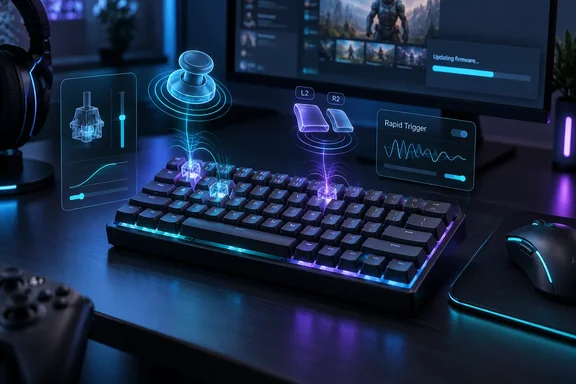
The change was reported by TechPowerUp on September 16 and announced the same day by IQUNIX’s official Reddit account. It closes a real feature gap in the EV63’s software: a ProSettings review published before this update specifically identified controller use as something the keyboard could not do, even while rating its Rapid Trigger, remapping, SOCD, Mod Tap, and multi-action key settings highly.
For EV63 owners, this is more consequential than another latency claim or lighting adjustment. Hall Effect switches can measure travel continuously; controller emulation is the software layer that can turn that measured travel into a variable input a game can interpret. Without it, an analog-capable keyboard remains principally a very configurable digital keyboard.
Gamepad Mode turns switch travel into a usable game input
IQUNIX says Gamepad Mode lets users assign controller bindings to keys and adjust an analog curve that controls how switch travel is translated into the output sent to a game. In practical terms, that should allow a key to behave more like a joystick direction or analog trigger than a conventional keyboard key.
The clearest use cases are driving and walking. A normal W key offers two states: pressed or released. An analog mapping can theoretically allow a lightly pressed key to request slower movement, then increase the requested value as the key moves farther through its travel. The same model is useful for acceleration, braking, steering, crouch or throttle controls in games that accept controller input.
That is the capability that helped distinguish Wooting’s Hall Effect keyboards from many rivals. Other manufacturers have since brought similar modes to their boards, but feature parity on paper has often concealed meaningful implementation differences: how many keys can be mapped, whether the keyboard and virtual controller can operate together, whether profiles save to onboard memory, and whether Windows recognizes the output as the controller type a particular game expects.
IQUNIX has not published those implementation details with this update. Its announcement does not identify the firmware version carrying Gamepad Mode, the virtual controller standard used by HyperCore, whether the feature works over wired and wireless connections alike, or whether keyboard keys and emulated controller inputs can be sent simultaneously. Those omissions matter more than the marketing name. Compatibility can change substantially depending on whether a Windows game sees a generic HID gamepad, an XInput-style controller, or separate keyboard and controller devices.
For now, prospective buyers should treat Gamepad Mode as a new option for EV63 owners rather than proof that it behaves identically to Wooting’s established controller mapping. No independent outlet has yet published hands-on testing of IQUNIX’s new mode.
The update fixes a Windows shortcut failure, too
Gamepad Mode is the headline addition, but the firmware also addresses a more ordinary Windows problem: IQUNIX says it fixed an issue where Ctrl+Shift+Esc did not open Task Manager. That shortcut is a staple for troubleshooting a hung application, checking startup impact, killing an unresponsive process, or seeing whether a game is saturating CPU, memory, storage, or GPU resources.
A broken three-key shortcut may sound minor beside analog game controls, but it illustrates why firmware updates deserve attention on performance keyboards. Modern Hall Effect boards can intercept, layer, remap, or condition inputs before Windows sees them. When that processing goes wrong, it can affect standard operating-system behavior as readily as it affects an in-game setting.
The update also changes the EV63 Performance page so users can view both custom actuation distance and Rapid Trigger values at the same time. IQUNIX has separately described HyperCore V3 as a major firmware rebuild focused on switch adaptation, filtering, calibration, and Rapid Trigger behavior. Viewing the two settings together should make it easier to spot configurations that invite accidental presses or inconsistent-feeling movement.
The distinction is worth making: actuation distance determines how far a switch must travel before a key press registers; Rapid Trigger changes how dynamically the keyboard resets that press as the key moves back upward. Both can be set aggressively on Hall Effect hardware, but they solve different problems. A very shallow actuation point can make a key fire quickly; an overly sensitive Rapid Trigger setting can make the same key chatter between pressed and released states during normal finger movement.
What EV63 owners should do before enabling it
The feature requires the current HyperCore firmware, according to IQUNIX’s announcement. The company’s existing EV63 documentation directs users to its browser-based EV software page, where connecting the keyboard to a PC should prompt the update flow if newer firmware is available. IQUNIX says a firmware installation can require the keyboard to reconnect once or twice, and advises keeping it connected throughout the process.
Before upgrading, owners should record or export any profiles that matter to them. IQUNIX’s HyperCore V3 materials say settings are preserved after firmware updates, but a newly introduced input mode and a changing web configurator are precisely the conditions where checking profiles afterward is prudent. Verify the active profile, actuation points, Rapid Trigger behavior, remaps, macros, and lighting rather than assuming an old configuration remains intact.
After the update, start with a single analog mapping in a game that already has reliable controller support. Avoid rebuilding an entire movement layout before confirming three basics: Windows detects the expected device behavior, the game accepts the mapped input, and the analog curve feels predictable across the key’s travel. A gradual curve is generally the safer starting point for throttle or walking controls; a sharper curve can make sense where fast access to full output matters more than fine adjustment.
Users should also test each game’s input settings carefully. Many PC games switch their on-screen prompts between keyboard and controller icons when controller input appears. Some games also prioritize the most recently used device. That is normal game-side behavior, but IQUNIX has not said how HyperCore handles mixed keyboard and gamepad output, so the practical results will need to be tested title by title.
Firmware has become part of the EV63 purchase decision
The EV63 is a compact 63-percent Hall Effect gaming keyboard with dedicated arrow keys, a format that appeals to players who want more physical controls than a 60-percent board without moving to a larger tenkeyless layout. ProSettings found the board competitive on responsiveness and customization before this update, but also called out its lack of controller emulation. IQUNIX has now removed that particular objection through software rather than a hardware revision.
That matters because Hall Effect keyboards increasingly compete on firmware depth. Adjustable actuation, Rapid Trigger, SOCD-style directional cleaning, macro layers, and multiple actions on one key have become common enough that the feature a buyer notices may be less about switch sensing itself and more about what the configuration software permits the hardware to emulate.
IQUNIX’s update is therefore a useful expansion for existing EV63 owners, particularly people who play racing games, third-person games, or titles with variable movement. But the company still needs to document the practical boundaries: supported mappings, controller protocol, connection-mode support, profile behavior, and known incompatibilities. Until that arrives, Gamepad Mode is best approached as a promising firmware feature that needs per-game verification on Windows, rather than as a blanket replacement for a dedicated controller.
References
- Iqunix Adds Controller Emulation to EV63 Gaming Keyboard TechPowerUp · 2026-09-16T14:59:55+00:00