

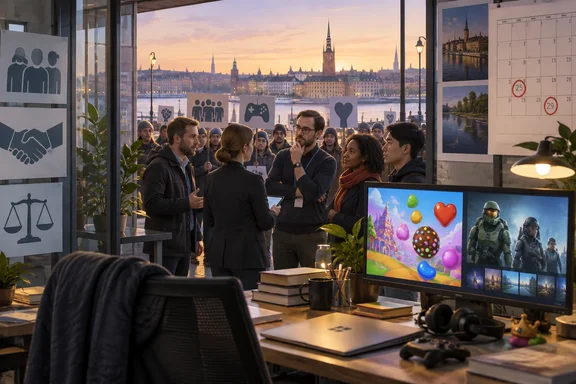
Engadget first reported the looming action this week, following statements from Unionen and Sveriges Ingenjörer, the Swedish Association of Graduate Engineers. The basic account now has stronger official backing: Sweden’s National Mediation Office, Medlingsinstitutet, confirmed on September 15 that the two unions have notified Midasplayer of both a strike and a blockade, and that state-appointed mediator Kurt Eriksson is handling the dispute.
There is also a development missing from the first wave of coverage. The dispute has already moved beyond the two original unions: Medlingsinstitutet said on September 17 that Naturvetarna, DIK, and Akademikerförbundet SSR have issued notices for sympathy actions beginning September 29 if there is still no deal. That does not make a work stoppage inevitable, but it raises the cost of allowing the September 25 deadline to pass.
The dispute is over a Swedish collective agreement
Unionen says the campaign for an agreement has been under way for just over a year and is backed by a large share of King’s white-collar workforce. Sveriges Ingenjörer has joined the action, meaning the conflict spans both general professional staff and graduate engineers at a company whose work includes live-service game development, data operations, product management, art, design, engineering, player support, and publishing.
The unions are not publicly presenting this as a narrowly defined wage fight. Unionen says its members want a collective agreement that improves job security and gives them more influence over workplace terms. In Swedish labor practice, such agreements can establish common frameworks for compensation, working time, pensions, insurance, consultation, and other conditions that otherwise remain governed by individual contracts and company policy.
That distinction goes to the heart of King’s resistance. According to Kotaku’s earlier reporting, King President Todd Green told staff in a June email that management had decided not to sign the requested agreement after a year of discussions, arguing that King’s existing benefits were better for employees. MobileGamer.biz subsequently reported that the company maintained that position despite the union push.
A benefits package and a collective agreement are not interchangeable simply because both can include favorable terms. Company-provided benefits can be altered through internal policy decisions; a negotiated agreement sets a shared baseline and gives workers and their representatives a formal role in its enforcement and renewal. King’s position, as reported, is that its current global approach is preferable. The unions’ position is that Swedish staff need binding, collectively negotiated protections.
September 25 is a deadline, not a completed strike
Readers should be careful with headlines saying King developers “are going on strike.” As of Thursday, September 17, the verified event is a strike notice, not an active work stoppage. The National Mediation Office has entered the case specifically to try to produce a settlement before the action begins.
Unionen says it submitted its notice on September 15, after negotiations failed to produce an agreement. Medlingsinstitutet confirms that the planned industrial action will take effect on September 25 if no settlement is reached beforehand. The agency’s involvement matters because Swedish labor disputes often move through formal mediation once notice has been given; the notice creates leverage while preserving time for a negotiated resolution.
The public record still leaves important operational questions unanswered. Neither King nor the unions have published a full breakdown of which teams would be called out, how many workers would stop work, how long a strike might last, or whether contractors and overseas teams would be able to cover particular functions. MobileGamer.biz reported that the action would affect King’s Stockholm and Malmö offices, but neither Medlingsinstitutet nor Unionen’s English-language announcement specifies the exact internal teams or products involved.
That gap is significant for anyone trying to forecast an effect on Candy Crush Saga. A live mobile game is not maintained by one office or one discipline, and a strike affecting Swedish employees would not automatically mean the game disappears from Windows, Android, iOS, or the web. Existing servers, automated systems, scheduled events, and work carried out outside Sweden could continue operating. Conversely, a sustained action could affect new content, experimentation, bug triage, analytics, player communications, release approvals, or local business operations depending on who participates.
There is no confirmed player-facing outage, update delay, or service interruption at this point. Players do not need to reinstall the game, change payment settings, or take any action based on the strike notice. The deadline is a labor negotiation milestone, not a technical advisory.
Sympathy action makes this more than a two-union dispute
Akademikerförbundet SSR’s September 17 notice is the clearest sign that the dispute is widening rather than quietly winding down. Its members at Midasplayer would join a sympathy strike at 5:00 a.m. on September 29 if no collective agreement is in place, four days after the initial action scheduled by Unionen and Sveriges Ingenjörer.
The union describes the measure as support for an already lawful industrial action and says its affected members would be prohibited from performing work duties while the strike is in force. It also says workers would receive strike compensation. Medlingsinstitutet separately lists Naturvetarna and DIK alongside Akademikerförbundet SSR in the newly announced sympathy measures, though the public notices do not yet provide a consolidated headcount or role-by-role scope.
That escalation changes the practical calculation for King. The company originally had a dispute with unions seeking a local agreement. It now faces the prospect that professional groups outside the initial bargaining parties will support the action, adding disruption risk even if the original group of strikers is limited. The leverage is not merely a threat to game production; it is pressure on the normal operation of a Swedish employer that has declined to sign an agreement widely used across the country’s labor market.
The company’s argument that its benefits are already superior may still be persuasive to some employees, but it does not resolve the unions’ core demand for a collectively enforceable framework. Nor has King publicly explained why a Swedish agreement would prevent it from retaining those benefits while formalizing the conditions workers say they need.
Microsoft owns the business, but the bargaining party is Midasplayer
Microsoft completed its acquisition of Activision Blizzard on October 13, 2023, bringing King into Xbox alongside Activision and Blizzard. Microsoft’s own announcement explicitly identified Candy Crush Saga and King as part of the acquired portfolio, while the company’s filings placed Activision Blizzard’s financial results in Microsoft’s More Personal Computing segment.
That ownership makes the dispute relevant to Microsoft watchers, but it does not mean Microsoft Corp. is the named employer in the Swedish action. The bargaining target identified by the unions and the National Mediation Office is Midasplayer AB, King’s Swedish operating company. That legal detail matters: the dispute is occurring under Swedish labor rules and at a specific subsidiary, even though the strategic and reputational consequences reach Microsoft Gaming.
Microsoft has previously made labor relations a visible part of its gaming expansion, including neutrality commitments that were closely scrutinized during the Activision Blizzard acquisition process. The King conflict puts a harder edge on that history. A neutral stance toward worker organization is not the same as a local company agreeing to a collective agreement, and the current dispute shows the difference in concrete terms.
Neither Microsoft nor King had publicly detailed a settlement proposal, a revised benefits guarantee, or a plan for the Swedish workforce by the time of the latest union notices. The public discussion therefore remains asymmetric: the unions have specified that they want a collective agreement and have set dates for action, while King’s known position is the earlier assertion that its own benefits model is better.
For now, the practical date is September 25, with a second escalation date of September 29. If mediation succeeds, Candy Crush Saga players may notice nothing at all. If it fails, Microsoft will have a labor dispute at one of its largest mobile-game businesses that cannot be dismissed as a routine studio scheduling problem: it is a test of whether King will accept a binding Swedish collective agreement after more than a year of negotiations.
References
- Candy Crush developers are planning a strike for next week Engadget · 2026-09-17T18:58:17+00:00