

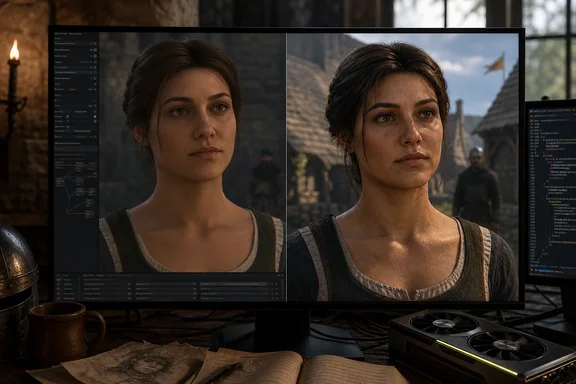
As reported by Wccftech and independently summarized by Gameguru Mania, Vávra posted a four-image comparison of Katherine, the character based on Czech actor Kristýna Leichtová. His sequence contrasts a photograph of Leichtová, the game’s standard rendering, a DLSS 5 configuration he considers appropriate, and an exaggerated version with settings pushed to their limits. Vávra argues that the restrained DLSS 5 image better reveals facial contours, hair, eye detail, neck shadows, and surface texture that already exist in the scanned model and its texture data.
The claim is consequential because it cuts directly into the central dispute around generative rendering: whether the technology preserves a studio’s authored work or replaces it with a plausible-looking approximation. Vávra’s answer is unusually blunt. In his view, the conventional rendering path is the compromise, constrained by the lighting budget available when Kingdom Come: Deliverance II was built; the neural-rendered image better matches the character he and Warhorse intended to present.
NVIDIA’s own description of DLSS 5 supports part of that case, but not all of it. The company says its 3D-Guided Neural Rendering uses the game’s rendered frame and engine-provided data, including motion information and scene attributes, as grounding for a final generative rendering stage. Yet NVIDIA also says the model adds lifelike lighting and material information using learned appearance knowledge. That means DLSS 5 is not simply uncovering pixels that were hidden in a conventional renderer. It is producing a new final image informed by the game’s assets, the engine’s data, and a trained neural model.
For PC players, that distinction is more than theoretical.
An Unofficial Experiment, Not a KCD2 Feature
NVIDIA formally debuted DLSS 5 in NBA 2K27 in early September, alongside a GeForce Game Ready driver. The company’s announcements describe that title as the first released game with DLSS 5 3D-Guided Neural Rendering, and its public material emphasizes developer tuning as a requirement for achieving the desired result.
There is no corresponding Warhorse Studios announcement confirming native DLSS 5 support for Kingdom Come: Deliverance II. Wccftech’s report says the technology reached other games after a DLSS 5 library was leaked from NBA 2K27 and subsequently tested or injected by enthusiasts. Czech outlet Zing likewise reported that modders had been experimenting with the leaked technology in Kingdom Come: Deliverance II.
That leaves Vávra’s comparison in a different category from an official implementation. An official integration gives a studio control over per-scene tuning, quality assurance, performance targets, compatibility testing, fallback behavior, and the user interface exposed to players. An injected library running through third-party tools gives users settings that were never necessarily designed for the game’s renderer or art pipeline.
Vávra’s fourth image is evidence of the gap. He calls the maximum-setting result “slop,” arguing that it occurs when someone drives the technology beyond an appropriate configuration. But the image also demonstrates the practical problem with treating a leaked renderer as a consumer feature: the controls and guardrails that would normally be set by the developer are now in the hands of users, mod tools, and unofficial wrappers.
A screenshot can show a striking improvement in a chosen scene. It cannot establish that the same configuration remains stable during motion, works across interiors and weather conditions, avoids artifacts around foliage and transparency, or maintains acceptable performance during combat and dense city scenes.
Vávra’s “Original Vision” Argument Has a Technical Catch
Vávra’s core argument is that DLSS 5 allows Katherine to resemble Leichtová more closely because it draws out information already embedded in the model: normal-map detail, skin texture, hair structure, and subtle shadowing. That is a credible description of why a neural renderer could make a scanned face appear more dimensional than a real-time lighting setup with tighter performance constraints.
But it should not be confused with a claim that the neural model merely restores a lost original image. There is no single neutral, fully “real” version of an in-game character waiting beneath the existing renderer. Katherine’s final appearance was already the product of scanning, manual changes, texture work, lighting choices, post-processing, animation constraints, and the hardware budgets of a commercial game.
Vávra acknowledges some of that process himself. He says the scanned actor was adjusted because the scan was performed without makeup and the game model had to satisfy other requirements. The vanilla image is therefore an authored presentation, not a raw technical failure. His preferred DLSS 5 rendering is another authored preference—one that shifts more of the final appearance into a neural stage.
That does not invalidate his position. A game director is entitled to say the available renderer forced concessions he disliked and that a newer tool gets closer to his intended look. It does, however, undermine a broader claim that critics are objecting to a technology which changes nothing. DLSS 5 is designed to change the displayed result. NVIDIA markets it precisely on the ability to generate richer lighting and materials than conventional real-time methods can afford.
The relevant question is whether those changes remain under the developer’s control and serve the game’s visual language. NVIDIA says its system is deterministic and grounded in the game engine’s frame, which is intended to prevent the free-form drift associated with text-to-image generation. Its model does not begin with a prompt and invent an entire scene. Still, the final image is generated rather than conventionally rendered pixel for pixel, and the degree to which that generation feels faithful will vary by game, scene, configuration, and player tolerance.
The Hardware and Performance Question Is Still Open
The official DLSS 5 material identifies GeForce RTX 50-series hardware as the platform for the new 3D-Guided Neural Rendering stage. NVIDIA’s launch messaging has focused on artist-guided visual gains, rather than presenting DLSS 5 as a universal drop-in improvement for prior RTX generations.
That matters for an unofficial Kingdom Come: Deliverance II experiment. Vávra’s screenshots are about visual character rendering, not frame-time cost. NVIDIA says DLSS 5 was engineered to run inside strict real-time budgets, but that statement applies to developer-supported implementations that have been integrated and tuned around the technology. It does not establish that a leaked DLL operating in an unsupported game will be efficient, stable, or practical at typical PC settings.
A user report on Reddit claimed severe performance losses when testing DLSS 5 in Kingdom Come: Deliverance II, though isolated community testing is not a substitute for a controlled benchmark and should not be treated as a general performance verdict. More important is what has not been published: neither NVIDIA nor Warhorse has released official DLSS 5 performance numbers, image-quality analysis, supported settings, or compatibility guidance for Kingdom Come: Deliverance II.
Players should therefore be wary of treating viral 8K showcase videos as a buying or configuration guide. High-resolution captures using Complete RT shaders, aggressive mod stacks, or multiple neural passes can demonstrate the upper end of an effect, but they do not answer whether the configuration is playable on a normal RTX 50-series gaming PC—or whether it behaves correctly across the full game.
DLSS 5 Makes the “Artist Intent” Debate More Concrete
The useful part of Vávra’s intervention is that it moves the DLSS 5 argument beyond generic accusations of AI-generated “slop.” His comparison identifies a specific artistic goal: more convincing scanned faces under lighting that exposes small-scale material and shape detail. If DLSS 5 can reliably preserve geometry, character identity, composition, and temporal stability while improving that presentation, it gives developers another rendering tool rather than a replacement for artists.
His own bad-example panel also supplies the strongest counterargument. The same technology can be pushed toward an overly smooth, over-lit, or uncanny output that changes the emotional tone of a character and makes a historical RPG look less grounded. Vávra compares that danger to television motion smoothing’s soap-opera effect, an apt comparison because both technologies can make an image seem technically more immediate while making it feel aesthetically wrong.
For now, Kingdom Come: Deliverance II is a revealing but unofficial test case. Vávra has shown why a game creator may see neural rendering as a path back toward an intended aesthetic; he has not established that players can safely or consistently reproduce that result through leaked components and third-party injection tools.
The concrete takeaway is simple: DLSS 5 may eventually give Warhorse a way to revisit lighting and material presentation in Kingdom Come: Deliverance II, but until the studio ships and supports an integration, the impressive Katherine comparison remains a controlled demonstration—not a recommended PC graphics setting.
References
- Daniel Vávra Maintains That NVIDIA DLSS 5 Is the Future, as It Allows KCD2 to Reach the Intended Aesthetics Wccftech · 2026-09-14T13:30:00+00:00