

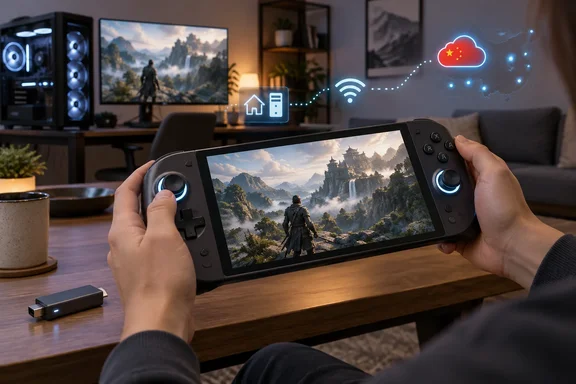
What Lenovo actually launched
TweakTown summed up the idea well: this is a thin, lightweight device built specifically for game streaming rather than powerful onboard silicon. It also noted that the C700 is not a Windows handheld. It is expected to ship running Android, making it more comparable to the Logitech G Cloud than the Legion Go series.
According to Gizmochina's launch report, the handheld is priced at 2,199 yuan ($327), with an early promotional price of 1,999 yuan ($297), and will be available starting September 8. IT之家 later reported that the price on sale day was ¥1,799, and that education and repeat-buyer discounts could bring it lower. All of these are Chinese prices, not U.S. prices.
The core specs are consistent across Lenovo and the press:
- Display: a 7.82-inch IPS LCD screen with a 1920 x 1080 resolution and a standard 16:9 aspect ratio. It includes a 120Hz refresh rate, a 180Hz touch sampling rate, and a peak brightness of 500 nits. Lenovo's FAQ says you can set it to 60Hz or 120Hz.
- Chip: a MediaTek Dimensity 7400 processor
- Software: Android 16, with Wi-Fi 6E and Bluetooth 5.3
- Size and weight: 14.9mm thick and 556 grams, making it nearly 300 grams lighter than standard Windows-based gaming handhelds. Basic Tutorials compared it with about 730 grams for the Legion Go S and 678 grams for the ROG Ally X.
- Battery: 8,000mAh. Lenovo says it lasts up to nine hours, measured under specific conditions: continuous cloud gaming or PC streaming, Balanced mode, medium brightness and volume, Wi-Fi on, and the fan at medium speed.
The RAM configurations are disputed. Geeky Gadgets says up to 12GB RAM, 256GB storage (expandable to 2TB). Gizmochina's launch report instead lists configurations with 6GB of RAM and 128GB of storage or 8GB of RAM and 256GB of storage, both of which support microSD expansion. Lenovo's Chinese sales coverage only mentions the 8GB/256GB model. Until Lenovo confirms a 12GB version, don't count on one. Lenovo's FAQ does confirm that the microSD slot takes cards up to 2TB.
In short: the C700 is a light, low-power Android device built for streaming. Some of the memory claims in the hands-on coverage haven't been confirmed.
Controls: TMR sticks and Hall-effect triggers
The controls get the most praise. Gizmochina reports TMR magnetic-resistance joysticks with RGB lighting rings and Hall-effect linear triggers. Alongside the standard ABXY face buttons and an eight-way D-pad, the device features additional customizable rear and shoulder buttons (LC1/RC1 and LC/RC) for mapping complex controls. It also has dual rotor motors for vibration feedback and a six-axis gyroscope.
Geeky Gadgets says the TMR sticks are "designed to prevent stick drift." That claim needs a caveat. TMR is a contactless magnetic sensor, so it avoids the worn-out potentiometers that cause drift in older controllers. As Android Headlines put it, TMR sticks will help drastically reduce the risk of stick drift issues compared to thumbsticks that use potentiometers. Reducing the risk is not the same as eliminating it, and Lenovo's own rating of two million cycles is a manufacturer figure.
Lenovo's FAQ also gives two procedures you're unlikely to find in English yet:
Recalibrating the controller
- Rotate both sticks two full turns clockwise and two counterclockwise, then press each trigger twice.
- Hold LT + RT + D-pad Left + A for one to three seconds.
- Let go when the device vibrates. That means calibration is done.
Remapping the back and custom buttons
- With the screen on, press HOME to open the quick-settings window.
- Open the controller tab and scroll to the bottom, where the back-button and custom-key settings are.
- Pick the button you want to change, then choose the input to assign from the list.
In short: the input hardware is modern, and you can recalibrate and remap it on the device. Treat "drift-proof" as marketing, not a guarantee.
PC streaming: the part Windows owners should read
This is the main reason the C700 matters to PC gamers. It is also where the hands-on coverage and Lenovo's documentation disagree the most.
Lenovo's version: the C700 will ship with a dedicated USB streaming dongle and companion PC software, promising local streaming latency as low as 10ms. TweakTown pointed out the context for that number: that 10ms figure comes from lab testing using a Legion Y9000P laptop with an RTX 4060 running at 1080p and 120Hz. Real-world results will depend on the strength of the local network and the host PC. The dongle enables one-click streaming from a connected Windows PC, and Lenovo says the handheld can stream locally stored games even in an offline environment when paired with the host machine.
Lenovo's Chinese support FAQ adds several limits that the hands-on coverage doesn't mention:
- The dongle is required. Lenovo says plainly that you can't use its streaming feature without the dongle. The dongle was bundled for first-batch buyers, and Lenovo says it will announce any change to that policy. A lost dongle has to be bought separately through customer service.
- Integrated graphics don't work. Lenovo says integrated GPUs don't support Legion Stream. That rules out many thin-and-light Windows laptops.
- NVIDIA is recommended. Lenovo says the feature isn't tied to the PC's brand, only the graphics card. It recommends NVIDIA 30-, 40- or 50-series GPUs and warns that other brands' PCs may have compatibility problems.
- Legion Stream only works with PCs. For a PS5 or other platforms, Lenovo points to third-party Android apps such as Steam Link and PS Remote Play. It also confirms that open-source clients like Moonlight can be installed.
Geeky Gadgets described a "6GHz dongle" with a 35-foot range that "seamlessly supports" Steam and Xbox. None of Lenovo's documents we reviewed confirm the range or a specific Xbox integration. The Wi-Fi 6E radio in the handheld itself is real, and Gizmochina notes that it allows the device to use the 6GHz band, which generally provides a more stable connection for streaming. Since the C700 runs Android and can sideload apps, you may be able to reach your Steam or Xbox library through third-party clients. That depends on the apps you install, not on anything Lenovo has certified.
In short: if your gaming PC has a recent NVIDIA card, Legion Stream could be a good fit. If you're counting on integrated graphics, or on a Radeon card without testing it first, be cautious.
Cloud gaming works best inside China
Lenovo built the cloud side around Tencent. ComputerBase explains that the Legion C700 seems like it will be a China-exclusive device, since Tencent START is available in China, only. Gizmochina adds that Lenovo says that under optimal network conditions, end-to-end latency can be kept under 10ms. That figure is for a cloud service running in ideal conditions, not something every buyer will see.
For anyone outside China, the headline feature doesn't really apply. The C700 is then an Android handheld that relies on PC streaming, native Android apps and emulators.
Android games and emulation: tester reports, not Lenovo promises
Geeky Gadgets, based on ETA Prime's testing, says Fortnite and Asphalt ran at medium to high settings and lists PSP, Dreamcast, GameCube and Wii emulation. Those are one reviewer's results, and they will vary with the game, the emulator and your settings. Lenovo's own FAQ is more cautious. It names PPSSPP, AetherSX2, NDS emulators and MAME as installable. It also warns that some Android games don't natively support controllers, so you may have to use key mapping.
Keep the hardware in perspective. Lenovo's FAQ puts the C700's maximum power draw at 8W and maximum charging at 15W. Once you've read that, the "demanding native games" framing is hard to take seriously. The hands-on also recommends the Aurora Store because Google Play access is limited. Aurora is a third-party Play Store client, not a Lenovo-endorsed channel, so whether to use it is your call.
Hardware limits PC users will notice
According to Lenovo's FAQ:
| Item | What Lenovo says |
|---|---|
| USB-C | USB 2.0, typically 15–25MB/s |
| Video output | Not supported |
| Charging | 18W+ PD adapter needed for the 15W maximum while powered on |
| 3.5mm jack | No microphone support |
| Standby | Up to 21 days in power-saving mode |
| OS updates | Settings → About device → System update, with more than 50% battery |
Because there's no video output, you can't dock the C700 to a TV the way you can a Legion Go. Lenovo also advises keeping the battery at about 40% if you store the device for a long time, and not charging it in extreme temperatures.
Should you import one?
Official availability is still limited. Nokiamob reported that Lenovo has not confirmed whether the device will receive a wider international release. Import sellers have moved in anyway. Retro Handhelds reports it is now available for purchase on the Giztop website, and Gizmochina listed a $399 price there. That is a gray-market route, with the usual uncertainty around warranty and support.
My take, based on the specs rather than hands-on testing: the C700 is an interesting bet for anyone with a strong Windows PC with an NVIDIA card who wants a lighter, longer-lasting device than an x86 handheld for couch streaming. It is not a Legion Go replacement. Outside China, cloud gaming is mostly missing, and its low-power chip can't run heavy games locally. The price gap versus a Windows handheld is real. So is the list of things it can't do: no integrated-GPU hosts, no video out, and streaming that depends on a dongle.
If Lenovo launches it internationally with a cloud service that works outside China, this could get more interesting quickly.
References
- Lenovo Legion C700 Pairs MediaTek Dimensity 7400 with Android 16 - geeky-gadgets.com geeky-gadgets.com · 2026-09-28T06:43:00+00:00
- Cloud-Gaming-Handheld: Lenovo Legion C700 mit 7,82-Zoll-Display startet in China - ComputerBase computerbase.de
- Lenovo's Legion C700 is a thin Android handheld built just for local game streaming tweaktown.com