

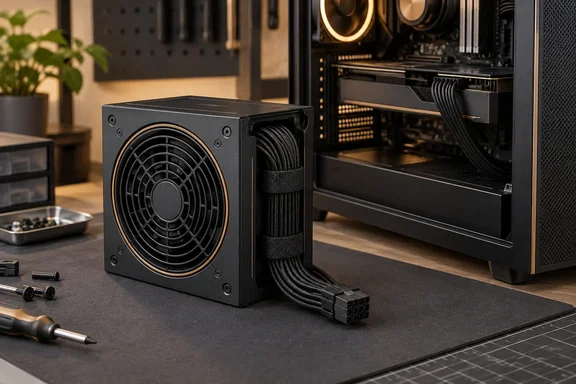
Lian Li RB750B: a 750W ATX 3.1 unit built around cable management
The RB750B is the top model in Lian Li's RB series, which launched in late 2025. At that launch, Lian Li introduced the RB Series PSU in 550 W, 650 W, and 750 W models with 80 Plus Bronze certification for up to 85% efficiency, according to TechPowerUp's coverage. Back2Gaming's launch report describes the same lineup separately, so the basic positioning isn't in question.
Lian Li's specification sheet gives the essentials. The unit is a standard ATX box measuring 150 × 86 × 150 mm, with Active PFC (power factor above 0.95 at full load on 115V) and an input rating of 100–240V AC at 10A. The full 750W is available on a single +12V rail, and the 3.3V and 5V rails share a combined 100W. Protections cover over-power, over-voltage, short-circuit, over-current, under-voltage and over-temperature (OPP, OVP, SCP, OCP, UVP and OTP). The 150 mm depth counts for something: Lian Li pitches the unit as a fit for most ATX cases, making it a great choice for space-conscious or minimalist builds.
The feature that sets it apart is the housing. The RB Series differs from typical Bronze-tier PSUs by building a cable management system directly into the housing. A dedicated groove along the side of the unit lets users tuck in and secure excess cables, aided by Velcro straps on three sides of the chassis. TweakTown calls this the unit's "hidden feature" and treats it as Lian Li's answer to the main complaint about fixed-cable power supplies.
TweakTown's 88.4% figure rests on an estimated DC load
The headline claim is that a Bronze-rated unit came close to Silver efficiency. TweakTown ran the PSU for almost 13 hours under AIDA64 Engineer's System Stability Test in a room held at 17°C, logging telemetry with HWiNFO64, GPU-Z and CPU-Z. To hit a target near half load, it locked a 16-core CPU at 1.12V and 4.3GHz, averaging 152W. It capped an RTX 3090 at a 40% power target, averaging about 140W, and allowed roughly 40W for the motherboard and drives. That adds up to an internal DC draw of 332W. A Kill-A-Watt P3 meter at the wall read 372–377W, averaging 375W, and 332 divided by 375 gives the 88.4% result.
This method is looser than a PSU test bench, and the difference affects how you should read the number. The 332W isn't measured at the PSU's outputs. It's a sum of software-reported CPU and GPU power plus a rounded guess for everything else. If that 40W allowance is off by 10W, the result moves by more than two points in either direction. A consumer plug-in meter also isn't a lab instrument. There's a load-level problem too: 332W is about 44% of 750W, while the review describes the test as a 50% load and elsewhere calls 375W the target. The 375W figure is the wall reading.
The review also gets the certification bar wrong. It says 80 PLUS Silver requires 89% at half load. The current 80 PLUS table from CLEAResult, which runs the program, sets the 115V internal non-redundant thresholds at 82%, 85% and 82% for Bronze at 20%, 50% and 100% load, and 85%, 88% and 85% for Silver. The 89% half-load figure applies to the 230V/277V redundant data-center category, not desktop PSUs. By the correct desktop threshold, TweakTown's reading actually lands just above Silver's 88% mark at one load point. Given the estimated DC side, that's still a single rough measurement. It doesn't count as Silver-level performance, and it says nothing about how the unit behaves at 20% or full load.
The reasonable conclusion is that TweakTown found no sign of efficiency trouble at a mid-range gaming load, and the unit appears to beat its Bronze minimum comfortably there. That is useful. It doesn't justify the verdict's "rock-solid voltage stability" wording, because the review publishes no voltage-regulation, ripple or transient-response data.
Two test rigs and two warranties
The review has two internal inconsistencies worth knowing about. Its test-system table lists an MSI Z790 Project Zero board, an Intel Core i5-12600K, an RTX 3090 and, oddly, an Enermax PlatiGemini 1200W as the PSU. The testing narrative, however, says the RB750B went into an AMD Ryzen 9 7950X and RTX 3090 rig, and the 16-core, 1.12V settings only fit the Ryzen chip. The table looks like a reused template. The narrative is the more plausible description of the efficiency run, but the review doesn't settle the question.
The warranty conflict matters more to buyers. TweakTown's specification table says 10 years. Lian Li's own product page lists a five-year warranty in both its marketing copy and its spec table, and the retail listing agrees: Newegg's product title reads "5-Year Warranty" and its description promises 5 years hardware protection. Plan on five years. The 10-year figure in the review appears to be an error.
Fixed cables, modular peripherals, and a naming mix-up
Coverage is split on whether the RB750B is fully fixed or semi-modular, and the answer affects how you plan a build. Lian Li's spec table labels the DC output "Non-Modular", and Finnish retailer Multitronic says all cables are permanently attached. The same Lian Li product page, though, has a "Modular for Peripherals" section saying SATA and peripheral cables can be connected only as needed. TechPowerUp describes a semi-modular layout that lets users connect SATA and peripheral cables only when needed. TweakTown's list of box contents includes separate "SATA/PATA connectors", which fits that description.
The most likely reading is that the main 24-pin, EPS, PCIe and 12V-2x6 leads are hardwired, and at least some SATA/peripheral leads plug in separately. Where anything detaches, this article can't say which specific connectors do so on the 750W unit. If that matters for your case layout, check the physical unit or the manual before relying on it.
TweakTown lists this cable set:
| Cable | Connector | Length |
|---|---|---|
| Motherboard | 20+4-pin | 600 mm |
| CPU (×2) | EPS 4+4-pin | 650 mm |
| GPU | 2× PCIe 6+2-pin | 600 mm + 150 mm |
| Storage (×2 groups) | 3 or 2 SATA + 1 PATA (Molex) each | SATA 400/150 mm, PATA 150 mm |
| GPU | 12V-2x6 (450W) | 600 mm |
| GPU adapter | 12V-2x6 to PCIe 6+2-pin | 100 mm |
The name itself also causes confusion. Lian Li markets the unit as "RB 750B" with model number RB0750B, using a zero. TweakTown's headline uses the letter O. Some Russian-market units are sold as BX0750B. Search for RB750B or RB0750B when shopping.
Native 12V-2x6 plus a third 8-pin for AMD cards
For GPU buyers, the main point is that no adapter is needed for modern Nvidia-style connectors. Under Intel's ATX 3.1 specification, the 650 W and 750 W units include a native PCIe Gen 5.1 12V-2x6 connector (up to 450 W), according to TechPowerUp. Lian Li adds a short converter aimed at the other camp: the RB 750W includes an extra 100mm 12V 2×6 to PCIe 6+2 pin cable, delivering a total of three 8-pin connectors for high-end AMD GPUs. In practice, the 12V-2x6 socket does double duty. It can power a 16-pin card directly or, through the adapter, supply the third 8-pin that some Radeon boards need.
Lian Li gives one specific handling instruction. The 12V-2x6 plug has a two-tone housing, and the company tells users to make sure the blue part is fully inserted. UK retailer Scan says the two-tone design means that if you plugged in your GPU slightly wrong, you'll know before any damage is done. Treat that as a visual check, not a guarantee. Push the connector until no blue is visible at the seam on both the PSU and GPU ends.
A native connector rated at 450W doesn't mean any card on that connector suits a 750W system. The whole system's load still has to fit within 750W, and Lian Li's claim that the unit can handle high transient loads is a manufacturer statement. TweakTown didn't test it.
Cooling, capacitors and the Helly Technology platform
TweakTown identifies the internal platform as a Helly Technology design using active PFC, a half-bridge LLC resonant converter and DC-to-DC secondary conversion. The primary-side bulk capacitor is a single Toshin Kogyo 420V/470µF electrolytic, which TweakTown describes as a 105°C part and calls a tier-2 brand. Lian Li's page separately advertises 105°C capacitors, a single high-amperage +12V rail and DC-to-DC architecture, and dependable reliability even under continuous operation at up to 40°C. Scan's listing repeats that claim, but it reads as manufacturer copy, not a separate confirmation.
The fan is a 135mm Hong Hao hydraulic-bearing unit with 11 blades. Lian Li rates it at 1,600 RPM and 40.1 dBA maximum for the 750W model. For comparison, the RB650B is rated at 39.3 dBA and the RB550B at 33.2 dBA with a slower 1,300 RPM fan. TweakTown's note that the fan stayed "practically silent" through the 13-hour run is a subjective impression inside a closed case at a cool 17°C room temperature. It didn't take a sound-level reading, and warmer rooms or heavier loads will push the temperature-controlled fan harder.
What this means for you
If you're building a budget or mid-range gaming PC that draws well under 750W and you don't mind fixed main cables, the RB750B deserves a spot on your shortlist. If you want custom-sleeved cables, independent lab data on voltage regulation, or a longer warranty, you should keep looking. TweakTown's own view is that $30–$50 more buys a fully modular 80 PLUS Gold unit, though it argues that money usually does more good going toward the GPU or CPU.
- Budget for a five-year warranty, which Lian Li and Newegg both list, not the 10 years printed in TweakTown's spec table.
- Treat the 88.4% efficiency result as one estimated reading at about 44% load. It's encouraging, but it doesn't make this a Silver-certified or Silver-level unit.
- Shop for the unit as RB750B or RB0750B, and expect prices to move around the $69.99 MSRP. TweakTown's price tracker showed $64.99 at Amazon when it was captured.
- Seat the 12V-2x6 connector until no blue housing shows, and make sure your GPU plus the rest of the system fits within 750W total.
- Use the three-sided Velcro straps and routing groove to bundle unused leads, especially in cases built for back-connector motherboards, which Lian Li specifically designed the cable exits for.
The RB series shows Lian Li putting its budget-tier effort into physical design, not certification level. Its answer to the old non-modular mess is to strap the spare cables to the PSU itself. TweakTown's review supports the basic case: at about $70 you get ATX 3.1, a native 12V-2x6 connector, a cool-running Bronze platform and decent cable handling. Proper bench testing with measured regulation, ripple and multi-load efficiency is what would turn a sensible buy into a proven one.