

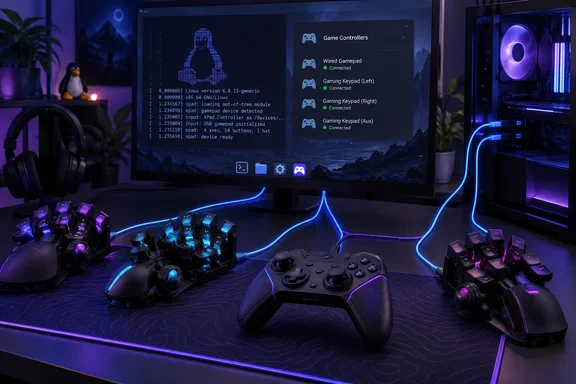
Phoronix first reported the incoming input-subsystem pull on September 20. The underlying Linux kernel patch record confirms that the Victrix entry adds one specific hardware identifier—PDP vendor ID 0e6f, product ID 024c—and classifies it as an Xbox One-type controller. Separately, Linux input maintainer Dmitry Torokhov replied that the Azeron patch had been applied, placing the broader keypad and controller support on firmer ground than a speculative compatibility claim.
For PC gamers, especially those using Linux alongside Windows, the immediate result should be simpler: connect the supported hardware over USB and let the standard in-kernel gamepad driver identify it. The more important limitation is equally clear: this is controller recognition, not a Linux configuration suite. It does not establish that every vendor-specific button mapping mode, lighting control, firmware updater, wireless mode, or companion application feature is supported.
The Victrix change covers a precise wired Xbox device
The XPad change is narrowly targeted at the device Linux identifies as the “PDP Victrix Pro BFG Wired Controller for Xbox.” The submitted patch adds it to XPad’s table as XTYPE_XBOXONE, alongside other PDP-made Xbox controllers. In practical terms, that tells the kernel to bind the controller to its established Xbox-compatible input path rather than leaving the USB device unclaimed or treating it as an unknown peripheral.
That distinction matters for owners shopping by product name. “Victrix Pro BFG” has been used across more than one platform-oriented product and revision. The Linux change does not amount to blanket support for every Victrix controller, nor does the patch prove compatibility for a PlayStation-focused Pro BFG model, a wireless receiver, Bluetooth mode, or a future hardware revision with another USB product ID.
The primary patch’s description is blunt: the controller “doesn’t currently work via USB-cable.” The proposed fix is one line. That is often how Linux hardware support works when a device already speaks a protocol XPad understands but its exact USB identity is absent from the driver’s allowlist. The controller did not need a bespoke driver; it needed the kernel to recognize that it belongs to a compatible class.
That should make the fix relatively low-risk. It is not adding a new protocol parser, a background service, or an experimental userspace daemon. The driver already handles Xbox One-style devices, and the new entry is an identification rule. Still, it is a pre-release kernel change as of September 20, not a promise that every game will expose every physical control in the same way.
Azeron support arrives through the Xbox 360 path
The Azeron addition is broader. The patch names the Cyro, Cyborg, Classic/Compact, Cyro Lefty, Cyborg II, and Keyzen as devices that present a standard Xbox 360 controller interface. Once their USB IDs are listed in XPad, the kernel can attach the existing Xbox 360 handling rather than requiring users to inject IDs manually after boot.
This is particularly useful for Azeron’s unusual hardware category. Azeron products blur the usual divide between a controller, keypad, mouse replacement, and analog movement device. A gamer may configure a device to behave differently depending on its onboard profile and the game being played. The kernel patch is concerned only with the mode that appears as a standard Xbox 360-compatible controller; it does not convert every Azeron input profile into an Xbox gamepad.
The patch also answers a potential concern about its vendor ID. Azeron uses USB vendor ID 16d0, which is a shared allocation rather than an identifier reserved solely for Azeron. The patch author said XPad will bind only to interfaces that match the Xbox 360 signature, and Torokhov accepted that rationale when applying the patch. That interface check is the safeguard against XPad attempting to seize unrelated USB equipment merely because it shares the vendor-ID range.
The patch author tested the change with an Azeron Keyzen. That is meaningful validation for the Keyzen, but it is not a public compatibility certification for every firmware revision across the full Azeron list. Owners of a Cyro, Cyborg II, or older Classic should treat the first 7.3-rc4 builds as a good opportunity to test, not as a reason to discard a known working setup before confirming their preferred game and profile behavior.
What this removes—and what it leaves in place
Before this kernel work, technically inclined Linux users could sometimes force XPad to accept an unsupported device by supplying its vendor and product identifiers through sysfs or a boot-time rule. Those workarounds were fragile: they could disappear after a reboot, depend on distribution-specific udev rules, and create a support burden for anyone trying to reproduce a controller problem.
Mainline recognition removes that repeated setup for the listed hardware once distributions ship a kernel containing the patches. It also means Steam, SDL-based games, desktop environments, and other software that rely on the Linux input stack should see a normal gamepad device rather than requiring a per-user kernel tweak.
The change does not eliminate higher-level input questions:
- A game may still have its own controller-layout assumptions, dead-zone handling, or remapping limitations.
- Steam Input may present different mapping options from a game that reads Linux input devices directly.
- An Azeron device configured to behave as a keyboard and mouse will remain a keyboard-and-mouse device from the game’s perspective; XPad support applies to its Xbox-compatible controller interface.
- Vendor configuration utilities, macro programming, RGB control, firmware flashing, and profile management are separate from kernel recognition and are not covered by these patches.
That last point is where Windows remains materially different for these devices. Windows vendor software often handles configuration and firmware maintenance even when the game itself sees an ordinary XInput device. Linux 7.3 improves the input baseline, but it does not replace those vendor tools.
Linux 7.3-rc4 is the first expected landing point
The timing also deserves care. Phoronix reported that the input changes were sent for Linux 7.3-rc4, which was expected later on September 20, 2026. That makes this a change headed into a release candidate, not necessarily a feature available in the stable kernels shipping with current distributions today.
Users who want to verify the improvement should first check that they are actually running Linux 7.3-rc4 or a later kernel carrying the same XPad commits. A distribution can backport the small device-ID additions to an older kernel, but it may also hold users on a previous branch for weeks or months. The kernel version shown by uname -r, rather than a distribution’s marketing version, is the useful check.
After connecting the controller by USB, the practical signs of success are that the xpad module binds to it, the kernel logs an input device, and the device appears in the desktop’s controller settings or Steam’s controller interface. If it is recognized but a particular title behaves incorrectly, that is likely a game, Steam Input, or mapping-layer issue rather than a failure of the USB-ID patch itself.
For owners of the exact wired Xbox Victrix Pro BFG and the listed Azeron models, the upgrade path is straightforward: wait for a Linux 7.3-based distribution kernel or test a 7.3 release candidate if they are already comfortable running pre-release kernels. The useful change is not a new controller feature. It is the removal of an unnecessary compatibility barrier between specialized PC gaming hardware and the standard Linux input stack.