

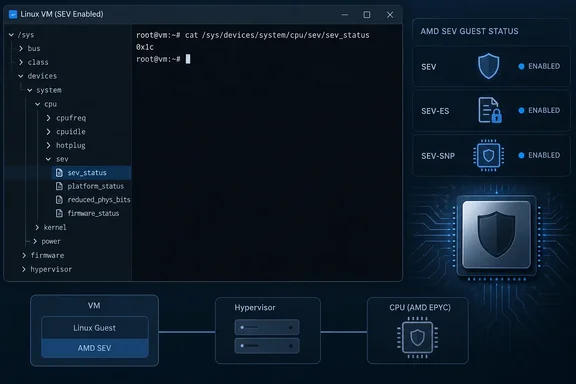
Linux’s sev_status file narrows access to AMD SEV state
The proposed interface is a single file:
/sys/devices/system/cpu/sev/sev_status
It exposes the value of AMD’s SEV_STATUS model-specific register, or MSR, which records enabled features in an SEV environment. In his August 3 patch, kernel developer Joerg Roedel explains that userspace tooling currently obtains this information through the MSR module. He describes exposing that broader interface as a security risk in trusted execution environments and proposes the sysfs file as a targeted alternative.
Sysfs is the kernel-facing filesystem interface used here to present the status as a readable file. The proposed implementation does not give the reader arbitrary register access: it returns the kernel’s stored sev_status value. Its read handler formats that value as hexadecimal, with a 0x prefix and a trailing newline.
The patch also explicitly declares the attribute read-only. Reading it observes the guest’s existing configuration; writing to it is not a way to enable SEV, select a different protection mode, or change the virtual machine’s security settings.
For monitoring software, the practical improvement is separation of responsibilities. A program needing this one status value can obtain it through a purpose-built interface instead of depending on general MSR access. That is a concrete least-privilege improvement, although the patch supplies no measurement of risk reduction and should not be presented as fixing a demonstrated exploit.
AMD SEV detection must look beyond the directory name
The revised patch series covers SEV, SEV-ES and SEV-SNP guests. Roedel’s cover letter says the revision responds to a review comment asking why status reporting was restricted to SEV-SNP. The updated design creates the sev_status file for the other two guest modes as well.
That expansion includes the parent directory, /sys/devices/system/cpu/sev/. The earlier interface treated that directory as specific to SEV-SNP guests; the revised series broadens its creation to all supported SEV guest modes. This creates a small but meaningful compatibility issue for scripts that use directory presence as a shortcut for identifying SEV-SNP.
After this change, the SEV directory alone cannot distinguish SEV-SNP from other SEV guest modes. A detector that previously interpreted its presence as “SNP enabled” could misclassify an SEV or SEV-ES guest. Software should interpret the relevant status features rather than assume that every guest exposing the directory has the same protections.
The adjacent vmpl attribute retains a narrower scope. The patch’s ABI documentation describes it as reporting the virtual machine privilege level at which an SEV-SNP guest runs and says that file is present only in an SEV-SNP guest. Broadening the directory does not make every attribute inside it applicable to every SEV mode.
This is where a seemingly minor kernel interface deserves attention from enterprise administrators: the new file simplifies future inventory collection, while the directory change gives maintainers a specific existing assumption to audit.
Raw SEV status helps tools without replacing their interpretation
The interface returns a number, not a decoded description such as “SEV-SNP enabled.” The kernel source identifies separate status features for SEV, SEV-ES and SEV-SNP, along with additional features such as Secure TSC and restricted injection. A consumer must interpret the appropriate bits to answer a more specific policy question.
The choice of raw output has a documented history. In a March 2025 kernel mailing-list discussion, developers debated whether the interface should print feature names as well as the register value. The discussion noted that existing userspace tools already parse the bits and can consume the raw register value more easily.
Consequently, the sysfs file may remove the need for a specialised utility when the task is simply collecting the value. It does not make higher-level tools such as snpguest redundant. Decoding, policy evaluation and other functions remain separate from retrieving a hexadecimal number.
There is also an important trust boundary. The documented output is the kernel’s stored status value, not an attestation report or a complete assessment of the deployment. A successful read establishes that this status interface is available and returned a value; deciding whether the guest meets a workload’s security requirements still requires interpreting that value in the appropriate validation process.
The same boundary applies to location. This is a guest-side Linux interface. Reading it in one guest does not inventory every virtual machine on its host, and this patch does not add a corresponding Windows setting or host-wide management command.
Prepare SEV inventory scripts before changing production kernels
Administrators should prepare their detection logic now, while treating Linux 7.4 availability as a reported development target rather than a released guarantee. Phoronix’s September 22 report places the patch in the x86/sev branch of tip/tip.git ahead of a kernel cycle expected to begin in October. The mailing-list evidence establishes the proposed interface, but does not independently establish that branch placement or release timing.
Once a guest runs a kernel containing the change, the basic read is straightforward:
cat /sys/devices/system/cpu/sev/sev_status
Successful output should be a hexadecimal value beginning with 0x. The implementation uses an unpadded hexadecimal format, so consumers should not require a fixed-width string. The read itself does not change guest security settings and needs no configuration rollback.
A missing file requires more care. Because kernels without this interface cannot expose it, absence alone is not sufficient evidence that SEV is disabled. During adoption, inventory systems should distinguish an unavailable status interface from a successfully read value whose decoded features fail a policy requirement.
The practical checklist is short:
- Audit scripts that treat
/sys/devices/system/cpu/sev/as proof of SEV-SNP, because the revised series also creates it for SEV and SEV-ES guests. - Check for the actual
sev_statusfile rather than relying solely on a Linux version label. - Preserve the hexadecimal value and use feature-aware interpretation when a policy requires a particular SEV mode.
- Treat a missing or unreadable file as an unsuccessful observation, not automatically as a finding that encryption is disabled.
- Keep existing validation and attestation workflows separate from this status read; the new attribute supplies one input, not their replacement.
For Linux guest administrators, this patch offers a useful reduction in the machinery needed to answer a routine security-state question. The next operational decision comes when a supported kernel includes it: adopt the narrower read path, update directory-based detection, and keep the distinction between collecting SEV status and proving a workload’s security requirements intact.
References
- Linux Adding New Interface For Reporting AMD SEV Status Phoronix · Tue, 22 Sep 2026 10:21:43
- Linux-Kernel Archive: (PATCH 3/3) x86/coco/sev: Make SEV_STATUS available via SYSFS lkml.rescloud.iu.edu
- arch/x86/coco/sev/core.c - linux/torvalds/linux - Git at Google code.googlesource.com