

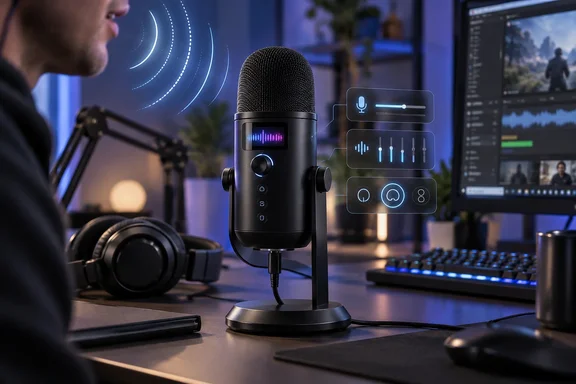
The Logitech G Yeti 2 lets a 3D proximity sensor set gain, EQ and pickup pattern
The main change is what Logitech calls an intelligent voice proximity sensor. In its official launch announcement, Logitech says Yeti 2 introduces an intelligent voice proximity sensor that tracks the speaker's position in 3 dimensions and dynamically adjusts gain, EQ, and pickup patterns in real time. The stated goal is to help creators keep consistent, broadcast-quality sound without manual adjustment.
Each of those three settings solves a different problem. Gain is how much the mic amplifies your voice, so leaning back makes you quieter and leaning in makes you louder. EQ shapes the tone, which changes with distance because close-up speech picks up extra bass. Pickup pattern (or polar pattern) decides which directions the capsules listen in. On the old Yeti, you set all three yourself with physical controls or software. The Yeti 2 says it adjusts all three continuously.
The Verge, which broke the US launch, frames this as making the Yeti 2 a more beginner friendly USB microphone than the original, as you don't need to have any knowledge or experience with manually tweaking those settings. It also points to a long-running problem with the Yeti design: the new model still retains a similar design to the OG Yeti which confused people into incorrectly speaking into the top of it, an issue this new sensor should address. The original Yeti is a side-address mic, meaning you speak into its front rather than its tip, and plenty of new owners spoke into the top and got thin, distant audio.
Italy's TuttoTech adds one practical detail. It reports that Auto Gain and Auto Tracking are already switched on in the initial configuration, so you can plug in and start recording. The official announcement doesn't mention defaults, so treat this as a single-outlet report. If it's right, most buyers will use the automation without ever touching a setting.
The Verge also published a Logitech image suggesting you can still set gain and other audio settings manually. Logitech's own announcement promises direct integration with G HUB for deep settings control. Automation appears to be the default, and manual control is still available.
The move from the 2009 Blue Yeti's four manual modes to Pattern Steering
The Yeti 2 changes more than the sensor. According to Clubic, the original Yeti required users to set the amplification themselves and choose among four pickup modes, and its successor aims to make some of those decisions for you. Logitech's European specifications, as republished by Aroged, list automatic and customizable modes with pattern steering technology, including stereo, cardioid, supercardioid/supercardioid, omnidirectional and bidirectional.
TuttoTech reports that the hardware uses three condenser capsules, one more than the classic Yeti's layout. That extra capsule is presumably what lets the mic steer its directivity on the fly. Logitech hasn't published a technical explanation of how Pattern Steering blends the capsules, so this link between the capsule count and the steering is our inference.
Capture resolution goes up from 16-bit/48 kHz on the original model to 24-bit/48 kHz, according to Clubic. Clubic also notes that the higher bit depth gives audio processing more headroom but doesn't guarantee a nicer-sounding voice. In practice, 24-bit mainly gives you more room before clipping and quiet-signal noise, which suits a mic that's constantly changing its own gain.
These physical details were reported by TuttoTech and other European outlets, and Logitech's broader specifications back most of them up:
| Item | Yeti 2 (as reported) |
|---|---|
| Capsules | Three condenser capsules (TuttoTech) |
| Capture | Up to 24-bit / 48 kHz |
| Patterns | Stereo, cardioid, super/hyper-cardioid, omnidirectional, bidirectional, plus auto mode |
| Display | 1.3-inch color LED screen |
| Controls | Front control wheel, capacitive mute, up to five presets, 10-band EQ (TuttoTech) |
| Connection | USB-C, 3.5mm headphone monitoring output |
| Mounting | Desk stand, 5/8-inch boom-arm thread |
| Cable | 3-meter USB cable (TuttoTech) |
| Colors | Black, white |
The connection works the same way as before. Logitech's specifications call it USB-C, no external audio interface or XLR setup required. For a Windows PC, that means one cable and no mixer or audio interface. Logitech hasn't published operating-system requirements for the Yeti 2 in the sources available, so it isn't yet clear which features depend on G HUB being installed on Windows 10 or 11.
On-device Blue VO!CE DSP and the AI de-noiser are meant to make G HUB optional
The second big idea is doing the processing on the microphone itself. The Verge describes built-in digital signal processing meant to improve voice clarity without extra software, plus AI noise removal aimed at background sounds, including computer fan noise and mouse clicks. Logitech's specifications say that BLUE VO!CE technology performs digital signal processing and artificial intelligence-based noise reduction (AI Denoiser) directly on the device.
On a Windows machine, this changes a lot. Voice processing on older Logitech and Blue mics has largely run through G HUB on the PC. If the de-noiser and Blue VO!CE chain run in the mic's firmware, the cleaned-up signal should reach OBS, Discord, Teams or any other app as ordinary USB audio. That would also cover machines where you can't install G HUB, such as a locked-down work laptop. This follows from Logitech's "on the device" wording, but nobody has shown it working yet.
G HUB still has a role. Logitech says the mic connects to it for deep settings control, community-powered Blue VO!CE profiles, and custom avatar upload. Clubic reports that the front wheel lets you pick presets and adjust the EQ without always going through G HUB. The picture is that the hardware controls cover day-to-day use and the software handles deeper customization. None of the launch coverage lists exactly which controls exist only in G HUB.
The 1.3-inch display is what makes the automation visible. The Verge says its "Yeti character" gives visual feedback on gain levels and polar patterns. Clubic adds that the animated Yeti warns you when gain is too low or too high, or when the signal clips. That warning is arguably as useful as the automation itself: a mic that changes its own settings is only trustworthy if you can see what it did.
At $159.99, the Yeti 2 sits between the old Blue Yeti and the Shure MV7, and next to the Shure MV6
The Verge puts the US price at $159.99, comparatively cheaper than Shure's popular MV7 series USB microphones, which are the current choice for podcasters and start at $299. It's also just $10 more than the original Blue Yeti's launch price 17 years ago. These are list-price comparisons, not current street prices, and they don't compare sound quality.
In Europe the listed price is €169.99, but the two outlets disagree on timing. TuttoTech says the mic is available from today. Clubic says it arrives by the end of September. US buyers can go by The Verge's report that it's launching today. European buyers should check local stock before assuming it's on shelves.
The closest competitor is the Shure MV6. Clubic reports that it also automatically adapts its gain to the distance and volume of the voice, while reducing background noise, and it also names the Elgato Wave:3 MK.2, which helps with level setting and limits clipping. Clubic's view is that Logitech's real point of difference is the 3D sensor and its claimed ability to change the mic's directivity as you move. Auto gain alone isn't new at this price. Automatic pattern switching based on your position is the part that nobody else in this class offers.
Logitech's announcement goes further, calling the Yeti 2 the first-of-its-kind microphone to integrate an intelligent proximity sensor with AI-driven noise suppression. That's marketing language from a press release, and no independent source has checked it.
The branding is a bit awkward, and it explains why some outlets say "Blue Yeti 2" and others say "Yeti 2". Logitech acquired the Blue audio production company for $117 million in 2018 and later killed the Blue brand entirely in 2023, folding it into Logitech G. The product is officially the Logitech G Yeti 2. The Blue name survives in its processing technology, Blue VO!CE, and in how most people still refer to the mic.
Launch coverage confirms the Yeti 2 feature list, not its sound quality
Every source for the Yeti 2 so far is either Logitech itself or a report built on Logitech's briefing. That's enough to confirm what the product is, what it costs, and what Logitech says it does. It isn't enough to judge how well it does it.
Clubic's editor-in-chief saw the mic at a press presentation in mid-September, just before the Logitech G PLAY event in Warsaw. He reported that the prototype wasn't finished enough to judge its sound or give a first impression. In other words, the only outlet that describes seeing the Yeti 2 before launch explicitly declined to comment on its audio.
This matters most for the automatic pattern switching. A mic that changes pattern mid-sentence could sound smooth, or you could hear the tone of the room shift as it switches. The launch material doesn't show which. The same goes for the AI de-noiser: fan and mouse-click removal is a common feature, and results vary widely depending on how aggressively the processing clips the voice along with the noise.
What this means for Windows streamers and podcasters
If you're buying your first USB mic, or you're replacing an aging Yeti and don't want to learn gain staging, the Yeti 2 goes straight onto the shortlist, but wait for hands-on reviews before you pay. If you already have a well-positioned setup on a boom arm with gain dialed in, the sensor fixes a problem you've already solved. If you record several people around one mic, check whether the automatic pattern selection behaves sensibly with more than one voice. None of the launch coverage addresses multi-speaker use.
People who move around while recording get the most from the design on paper: streamers who lean back between rounds, podcasters who turn to notes, or anyone whose desk chair rolls. Buyers who want every stage of their processing under manual control can apparently switch the automation off through G HUB or the device controls. How fine-grained that control is will only become clear once people have the mic in hand.
- The Logitech G Yeti 2 costs $159.99 in the US in black or white, and European outlets list it at €169.99 with conflicting dates for when stock arrives.
- Logitech says its 3D proximity sensor changes gain, EQ and pickup pattern in real time, and TuttoTech reports the automation is on by default.
- Blue VO!CE processing and the AI de-noiser run on the mic itself according to Logitech, which should give cleaner audio in any Windows app without extra software.
- It connects over USB-C with no audio interface, and has a 3.5mm monitoring jack and a standard 5/8-inch thread for boom arms.
- The Shure MV6 already offers distance-aware auto gain, so the Yeti 2's real distinguishing feature is automatic pattern steering.
- No outlet has published a sound-quality evaluation yet, and Clubic's pre-launch prototype was too unfinished to judge.
Logitech has taken the Yeti's familiar body and tried to design out the mistakes beginners made with it. The confirmed specifications and price make it a serious rival to the MV6 and Wave:3 MK.2 on paper. Whether the Yeti 2 earns the reputation the original had will depend on the first independent reviews of its automatic pattern steering and AI de-noiser, now that it's shipping in the US.