

What Logitech actually announced
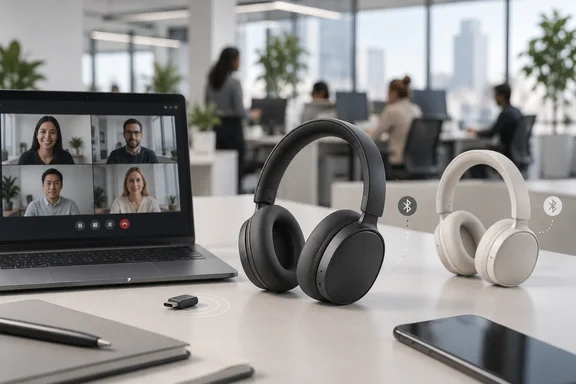
This is a two-product launch sharing one design:
- Zone Vibe Pro is the consumer headset. It is sold through Logitech's store and comes in Graphite, Black, Off-White and Lilac.
- Zone Vibe Pro for Business is the enterprise version. It comes in Graphite, Off-White and Rose, in two editions: one bundled with a Zone USB-C Receiver, and a "Native Bluetooth Edition."
Logitech's launch material describes a boomless design meant to move between work and personal use. It also lists multipoint Bluetooth, which Logitech says gives smooth switching between devices and operating systems. The announcement includes no compatibility matrix and doesn't explain how multipoint handles simultaneous calls, so treat "seamless" as Logitech's word until testing says otherwise.
Joseph Mingori, Logitech's VP and General Manager of Mobile and Audio Solutions, said the idea is to give employees good sound everywhere while giving IT teams "reliable, certified hardware."
Logitech's launch framing leans on a 2026 DHR Global Report figure that 79% of employees now work hybrid. The release doesn't give the report's sample, methodology or definition of "hybrid," so take that number as marketing context, not as a basis for a purchasing decision.
Section summary: Two SKUs, one chassis. The consumer model is a lifestyle headset, and the Business model adds certification and fleet management.
Pricing at a glance
| Model | Americas (AMR) | EMEA | APJC |
|---|---|---|---|
| Zone Vibe Pro | $259.99 | €259.99 | $289.99 |
| Zone Vibe Pro for Business (with Zone USB-C Receiver) | $279.99 | €279.99 | $309.99 |
| Zone Vibe Pro for Business Native Bluetooth Edition | $259.99 | €259.99 | $289.99 |
These are the regional prices from Logitech's announcement, which gave a global launch date of September 30, 2026. Logitech's U.S. product page for the standard model shows $259.99 and lists the Graphite color as in stock. In other words, the Native Bluetooth Business edition costs the same as the consumer model, and the USB-C receiver adds $20 (or €20).
The Teams certification: what "Premium Microphone for Open Office" means
This label is the most important detail for enterprise buyers. Logitech says the Business model is certified for Microsoft Teams with the Premium Microphone for Open Office designation, and also for Zoom and Google Meet.
Every Teams-certified headset has to pass Microsoft's audio testing. The open-office label is a stricter tier. Microsoft's own device documentation puts it this way: "All headsets are tested to provide clear audio, but open office and other noisy environments pose a greater challenge." When Microsoft introduced the tier, it described it as an enhanced requirement for headsets that offers the best possible performance for use in noisy environments or open offices where nearby sounds or voices are present.
The boomless design matters here. Headset reseller Simply Headsets notes that most headsets in this category use multiple microphones arranged in a beamforming array, along with a well-positioned boom arm, to focus on your voice. If a boomless headset earns the open-office tier, that is a real engineering claim, not just a pleasant feature. Logitech credits its AI-powered voice isolation. On its product page, Logitech says the system cuts "noticeable background noise" by 93%. The footnote shows this comes from a 2026 Logitech acoustic lab test using simulated noise types, with and without the algorithm turned on.
That figure is Logitech's own test, not an independent measurement, and the product page doesn't publish the full method. Microsoft's certification is the stronger third-party signal. Your own open-plan floor on a busy Tuesday is the final test.
Some history: Logitech has been in this program for a while. When Microsoft announced a batch of Teams-certified devices in 2020, it noted that Zone Wired meets Microsoft's premium microphone for open office requirement. The Zone Vibe Pro for Business extends that lineage into a design that looks less like a call-center headset and more like consumer headphones.
Section summary: The open-office tier is Microsoft's stricter noise-handling certification. Getting it without a boom mic is notable. Logitech's 93% figure is a vendor lab number.
USB-C receiver vs. Native Bluetooth: the decision IT teams actually face
The announcement names the two Business editions and gives their prices. It doesn't explain how they differ beyond the included receiver, and it doesn't say whether certification or Sync management depends on which one you buy. Don't assume either way.
Microsoft's documentation does explain why the choice matters in general. Microsoft runs a separate certification path for dongle-free devices. According to Microsoft Learn, native Bluetooth-certified devices, including headsets and speakerphones, are supported on Windows PCs (macOS may be supported in the future). These devices are tested for audio performance, call control, and Teams button integration, both with and without the use of a USB dongle.
Microsoft also warns that native Bluetooth depends on the PC it is paired with: performance in native Bluetooth mode is impacted by the Bluetooth radio on the host PC, so we recommend installing the latest firmware updates for both devices and Bluetooth radio. It adds that a small portion of users may need to continue to use the USB dongle, such as when working in a high-density radio environment, if their PC Bluetooth is heavily used by multiple paired devices, or with certain PCs that have poor-performing Bluetooth radios.
Logitech's announcement doesn't say whether its Native Bluetooth Edition holds Microsoft's native Bluetooth certification specifically. The edition's name matches the program, but the paperwork isn't in the release. Microsoft's guidance still gives you a sensible way to choose:
- Look at the floor, not just the laptop. A dense open office with dozens of Bluetooth mice, keyboards and phones is exactly the "high-density radio environment" Microsoft flags. The receiver edition is the cautious choice there.
- Audit your Bluetooth radios. Mixed fleets with older or budget laptops are where native Bluetooth performance varies most.
- Check your endpoint policy. Some organizations restrict Bluetooth pairing, and others restrict USB peripherals. The edition you choose has to fit the policy you already have.
- Confirm the certification and management details with Logitech for the exact edition before you standardize, including whether Logitech Sync management works the same on both.
- Plan for firmware on both ends. Microsoft recommends updating the headset firmware and the PC's Bluetooth radio, so put Bluetooth drivers in your Windows 11 update cycle, not just headset firmware.
Section summary: The $20 receiver is basically insurance against congested radio environments and weak laptop Bluetooth. Microsoft's own guidance explains when you might need it.
Logitech Sync and fleet management
Logitech says administrators can use Logitech Sync to remotely monitor the headsets, push updates and deploy firmware settings across an organization, which should mean fewer helpdesk tickets. For shops that already use Sync for Logitech meeting-room hardware, putting headsets on the same console is attractive.
The launch material leaves out the details: supported Sync versions, licensing, deployment prerequisites, reporting fields and specific firmware controls are all missing. Treat the Sync claim as a direction to evaluate in a pilot, not as a finished deployment guide.
Battery, charging and comfort claims
Logitech's figures:
- With ANC on: up to 30 hours of listening or 18 hours of talk time
- With ANC off: up to 66 hours
- Quick charge: five minutes of USB-C charging gives up to one hour of call time
- Charging while in use: full audio keeps working while the headset charges over USB
The product page adds that battery life varies with user and computing conditions, which is the standard caveat, and it applies here as it always does.
For comfort, Logitech redesigned the soft headstrap to spread pressure more evenly. The product page says it cuts the highest pressure points by 29%. That figure comes from a 2026 Logitech lab study of 30 participants that measured peak pressure during a 90-second test. Ninety seconds is a short window for an "all-day comfort" claim. The number shows the strap redistributes pressure, but it can't tell you how your head will feel at 4 p.m. after eight hours of meetings.
Adaptive ANC also depends on software. The product page says adaptive ANC mode is enabled through Logi Tune, which is available for mobile and desktop and also handles ANC levels and Transparency Mode. On managed Windows machines, that means deciding whether Logi Tune goes into your software catalog.
Repairability and materials
Logitech says the headstrap, earpads and batteries are replaceable. For fleets, that is more useful than it sounds: worn earpads are one of the most common reasons headsets get retired early. The catch is Logitech's own footnote that spare parts may not be available in all areas, so check local parts availability before you count on it in lifecycle planning.
On materials, Logitech says the plastic parts contain at least 29% certified post-consumer recycled plastic, the magnets use 100% post-consumer recycled rare-earth metals, and the battery uses 100% recycled cobalt. Paper packaging comes from FSC-certified forests and controlled sources. The announcement gives no lifecycle assessment or carbon figure, so these are material-sourcing claims, not measured environmental outcomes.
The bigger picture: can one headset do both jobs?
The "one headset for work and life" idea runs into a real tension. Enterprise headsets have usually been built around the microphone: boom arms, beamforming, certification tiers. Consumer headphones are built around the listening experience. Logitech is trying to do both in one boomless design, and the open-office certification suggests it hasn't cut corners on the microphone.
IT departments may have their own reasons to hesitate. A headset that employees also use on the commute and for weekend playlists will wear out faster, is more likely to get lost, and will be paired with a stack of personal devices. The replaceable parts help with the first problem. Nothing really solves the lost headset left on a train.
Bottom line
For individual buyers, the Zone Vibe Pro is a $259.99 ANC headset, and most of its claims are still Logitech's own. For IT teams, the Zone Vibe Pro for Business is more notable. It pairs Microsoft Teams open-office certification (claimed in a boomless design), Logitech Sync management and replaceable parts, and it comes in two editions. Choose between them the way Microsoft's own Bluetooth guidance suggests: the receiver for crowded RF floors and inconsistent laptops, native Bluetooth where your fleet's radios can handle it. Run a pilot first and let independent testing confirm or disprove the rest.
References
- New Zone Vibe Pro: Logitech's All-Day Headset That Shifts Between Work and Life - Lelezard Lelezard · 2026-09-30T00:00:00+00:00
- Zone Vibe Pro logitech.com
- New Zone Vibe Pro: Logitech's All-Day Headset That Shifts Between Work and Life | FOX47 fox47.marketminute.com