

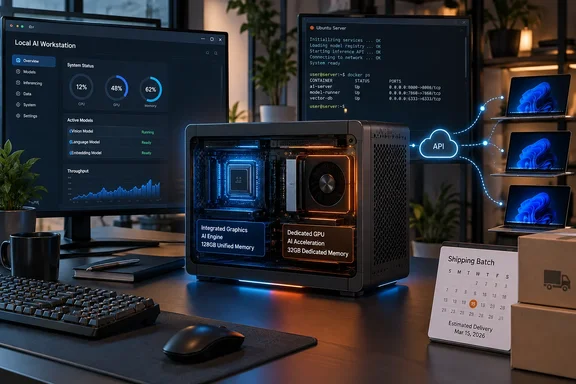
Notebookcheck reported the direct-order opening on September 22, describing a previous process that required customers to submit their workloads and quantity requirements, speak with Lucebox, and wait for production confirmation before receiving a purchase link. Lucebox’s storefront now lists the machine at $5,999 with shipping included and identifies the Ryzen AI Max+ 395, 128 GB of unified memory, and 32 GB Radeon accelerator as the production configuration.
The hardware is only part of the proposition. Lucebox supplies its own inference engine, tuned model profiles, and browser-based management, with compatible applications connecting over the network. That makes this relevant to Windows developers without making it a Windows workstation: the documented software image is Ubuntu Server.
Lucebox direct ordering removes the allocation interview, not the delivery wait
The new checkout route lets an individual buy the Developer configuration without first qualifying a workload with the company. Lucebox’s detailed purchasing information allows up to five machines in one checkout; larger orders still require a conversation and a consolidated quote. That is a narrower and more useful description than assuming unlimited retail availability.
Two packages are listed, and Lucebox’s component page says both contain the same hardware.
| Purchase option | Listed US price | Included software and service | Purchase route |
|---|---|---|---|
| Developer | $5,999 | Open-source Lucebox Engine, tuned models, and a one-year parts-and-labor warranty | Direct checkout |
| Business | $7,999 | Everything in Developer, plus 12 months of Lucebox Engine Pro, installation and onboarding, and direct engineering chat support | Contact Lucebox |
Lucebox lists worldwide shipping and taxes as included in those package prices. Engine Pro is described as a service tier around the open-source engine, with custom model tuning, implementation assistance, security hardening, and support among its benefits. Its separately listed price is $199 per month per machine. Buyers should therefore evaluate the additional $2,000 for Business as a support and deployment purchase, rather than an upgrade to the processors or memory.
Direct ordering does not mean immediate shipment. The detailed ordering page identifies Batch 3 as sold out and gives November 2026 as the estimated shipping date for Batch 4, matching Notebookcheck’s report. A separately retrieved Lucebox search result still describes Batch 4 delivery as approximately three months after ordering, with the window confirmed on a call. Those descriptions are not interchangeable for a September purchase, so a buyer working to a deployment deadline needs a confirmed shipping window attached to the order.
There is also a reported warning about future pricing. According to Notebookcheck, co-founder Alessandro Puppo said a price increase was coming, without giving an amount or an effective date. That establishes no usable deadline for a purchasing decision. The present checkout price, shipment commitment, and cancellation terms are firmer grounds for approval than an unspecified future increase.
Strix Halo and Radeon R9700 give Lucebox two different kinds of memory
The machine’s differentiator is its combination of a high-memory AMD integrated-graphics platform and a separate professional graphics card. Lucebox specifies 128 GB of LPDDR5X-8000 memory shared by the Ryzen AI Max+ 395 and its integrated GPU, alongside a Radeon AI PRO R9700 carrying 32 GB of GDDR6. Both the company’s site and storefront identify that pairing.
The often-repeated “128 GB of combined GPU-accessible memory” description needs unpacking. AMD’s Ryzen AI Max announcement describes support for up to 128 GB of unified memory, with up to 96 GB available for graphics. Notebookcheck’s combined figure adds that 96 GB graphics allocation to the R9700’s separate 32 GB. Physically, the listed system contains 128 GB of unified memory plus 32 GB of dedicated video memory; it is not a workstation with a single 128 GB graphics card.
| Memory region | Listed capacity | Published bandwidth | Documented role |
|---|---|---|---|
| Ryzen AI Max+ 395 unified memory | 128 GB shared by CPU and integrated GPU | 256 GB/s | Larger models, long-context workloads, and a second resident model |
| Radeon AI PRO R9700 video memory | 32 GB dedicated GDDR6 | 640 GB/s | The engine’s faster processing path and models that fit on the discrete GPU |
Those bandwidth figures explain the design more effectively than adding the capacities together. The R9700 has the smaller but faster memory region. Strix Halo contributes the larger shared-memory region. Lucebox’s software is intended to assign work across them so that the capacity of the integrated platform can complement the discrete card’s processing path.
Lucebox calls its model-splitting approach asymmetric parallelism. In its description of the 284-billion-parameter DeepSeek V4 Flash workload, the R9700 handles the “hot path,” while Strix Halo holds the remaining experts. The practical point is that placement is a software responsibility. Buying these two AMD devices does not, by itself, turn their separate memory regions into one uniform pool that every application will use automatically.
The company also documents a simpler arrangement: keeping one model resident in the R9700’s memory while another occupies unified memory, with its command-line software handling loading and request routing. That could suit a developer switching between models as well as someone running a single large model. It remains important to distinguish those two uses when discussing capacity with the vendor: keeping two models available and accelerating one model across both devices are different workloads.
AMD’s primary announcements support the underlying hardware roles. Its January 2025 Ryzen AI Max announcement describes the high-capacity shared-memory platform, while its May 2025 Radeon AI PRO R9700 announcement positions the 32 GB card for local inference, fine-tuning, and other professional workloads. Lucebox’s contribution is the assembled machine and its software integration; the direct-order announcement does not introduce new AMD silicon.
Lucebox’s 86-token result is a workload measurement, not a universal speed rating
Lucebox advertises 86 tokens per second during decoding for DeepSeek V4 Flash, with the model divided between the R9700 and Strix Halo. Its performance page also lists 788 tokens per second for prefill at a 2K prompt length. These are company-published measurements, and their usefulness depends on keeping the workload and measurement phase attached to the numbers.
Prefill is the processing of the input prompt; decode is the subsequent generation of output tokens. A strong generation rate therefore answers only part of the responsiveness question. Someone feeding a large codebase or lengthy document into a model also cares about the time spent processing that input before the response begins.
The company’s comparison illustrates why those phases should remain separate. Its displayed DeepSeek results put Lucebox at 86 tokens per second for decoding against a published single-DGX-Spark result of 35.3. For prefill, however, the displayed figures are 788 for Lucebox and 1,076.8 for the DGX Spark run. Even before accounting for test differences, the table tells a more specific story than a blanket claim that one machine is faster.
Lucebox explicitly warns that the comparisons use different test setups and quantization methods and are separate reported results, not a controlled comparison. Quantization changes the numerical representation used for a model, so buyers should keep the exact model format attached to any performance promise. The company’s displayed results support interest in its implementation, but not a guaranteed speed advantage across unrelated models and tools.
For a purchasing evaluation, the useful request is therefore a demonstration of the intended model and workflow: the model version and quantization, a representative input length, response-generation performance, and the expected number of simultaneous users. Lucebox itself says memory becomes the first constraint when multiple users run very long contexts. A single reported decoding figure cannot size a shared development service on its own.
Ubuntu Server makes Lucebox a network appliance for Windows developers
The documented deployment model is headless Ubuntu Server: no monitor is required for normal setup or use, and management takes place through a browser. The inference engine, model profiles, and OpenAI- and Anthropic-compatible application programming interfaces arrive installed. Windows users would ordinarily interact with those interfaces from their existing computers rather than replace the workstation’s operating system.
Here, an API-compatible interface is the address and request format that a supported application uses to send work to the local model. Lucebox says tools that accept a custom base URL can connect directly to its OpenAI-compatible endpoint, and it lists coding tools and agent clients including Claude Code, Codex, and OpenCode. That preserves a familiar client workflow while moving inference to the local machine; it does not make the locally loaded model identical to a hosted OpenAI or Anthropic model.
Lucebox documents the following onboarding sequence:
- Open Lucebox’s browser-based setup page from a nearby laptop or Android device. The company says this stage requires no additional application or command-line installation.
- Pair with the workstation. The setup page transfers Wi-Fi, account, and optional Tailscale settings over encrypted Bluetooth.
- Continue in the local Manage dashboard. It checks the machine, installs the qualified model profile, and starts the private API.
- Enable Lucebox Connect and open a supported application from Manage. Applications configured manually need to point to the workstation’s compatible API address.
The documented success state is a running model and a private API available to supported applications, with the dashboard displaying recent requests, usage by app and model, and live machine meters. The available setup description does not establish a browser-and-Windows-version compatibility matrix or a recovery procedure for failed Bluetooth pairing. Those particulars should be resolved before an organization treats the setup flow as a standard deployment procedure.
Remote access is optional. Lucebox documents signing in to Tailscale during setup, approving the workstation, and using the same Tailscale account on the client laptop or phone. Applications then connect through the private network address over an encrypted tunnel, without opening a router port. Skipping Tailscale leaves the local-network workflow available.
The supplied operating system is Ubuntu Server. There is no documented Lucebox-specific Windows installation path in the available product material, nor a promise that reinstalling Windows preserves its model-splitting behavior and tuning. A team that needs a Windows-hosted inference stack should obtain that support commitment before ordering; a team that only needs Windows clients to reach a local API is evaluating the product in its documented role.
Lucebox buyers need to budget for operation and a costly change of mind
Choose the Developer package if the documented Linux appliance and its included engine meet the workload, and consider Business when deployment assistance and ongoing engineering access justify the premium. The hardware is the same, so the decision turns on who will configure, validate, and operate it. For a team without capacity to do that work internally, support can matter more than the convenience of direct checkout.
The compact enclosure does not make this a low-power mini PC. Lucebox specifies an approximately 11.97-liter chassis, a 1,000 W Platinum-rated power supply, roughly 500 W consumption under full inference load, and approximately 40 W at idle. The power-supply rating is its capacity, not a claim that the system constantly consumes 1,000 W. Using the vendor’s load estimate, eight hours at 500 W works out to about 4 kWh; continuous full-load operation would be about 12 kWh per day, before any associated networking or cooling costs.
Placement also belongs in the purchasing decision. The component page describes separate airflow paths for the compute board and GPU, with exhaust leaving through the rear, and acknowledges that the R9700 cooler becomes audible under sustained inference. Ethernet at 5 Gbps and Wi-Fi 7 provide network access options, allowing the workstation to sit away from the user’s desk. Those connections support the appliance model, though their listed speeds are not AI-throughput measurements.
Ownership gives the administrator substantial control. Lucebox provides full root access over SSH and says inference can run fully offline once a model is loaded; updates and optional cloud fallback require internet access. For sensitive workloads, the actionable boundary is to keep the application pointed at the local endpoint and make a deliberate choice about optional cloud fallback. Buying local hardware alone does not determine every client application’s data path.
The return policy deserves particular attention before payment. Lucebox says orders can be canceled for a full refund before shipment by contacting support with the order number. After delivery, its stated policy permits returns within 15 days in original condition and packaging, minus a 25% restocking fee. At the Developer list price, that percentage is approximately $1,500. The company separately says damaged, dead-on-arrival, or warranty-covered faulty units are repaired or replaced at no cost, and lists a one-year parts-and-labor warranty.
- Confirm the shipping window for the actual order, because the published November estimate and the separately retrieved three-month description differ.
- Match the proposed model, quantization, input length, and concurrent-user count to a demonstrated workload before treating 86 tokens per second as a planning figure.
- Buy the Developer tier for the included hardware and open-source engine; assess Business against its installation, tuning, and support services.
- Plan for Ubuntu Server hosting with compatible Windows clients, unless Lucebox explicitly agrees to support a different operating-system configuration.
- Budget for electricity, audible load-time cooling, and the 25% restocking fee rather than treating direct checkout as a low-risk trial.
Direct ordering makes Lucebox easier to acquire, and its combination of Strix Halo memory, Radeon acceleration, and a preconfigured inference service gives developers a concrete local-compute option. The sound purchase is one tied to an agreed workload and delivery window. For a team whose models and clients fit the documented setup, the next step is to validate those requirements before the machine ships—while cancellation remains available without the post-delivery restocking charge.