

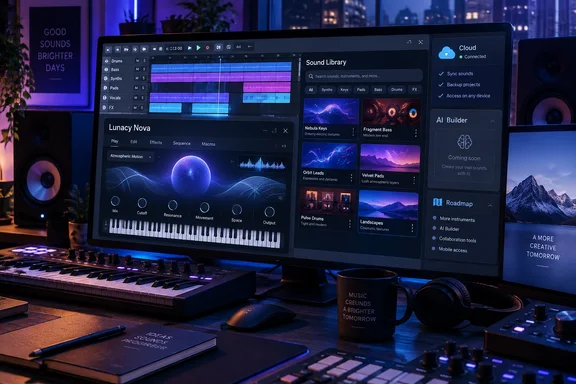
For Windows music producers, Nova’s immediate proposition is simpler than the larger pitch. The service offers browser-playable instruments and effects that can be loaded into a DAW through Lunacy’s host plug-in. Lunacy lists Windows 10 or later, VST3 and AAX compatibility, 8GB of recommended RAM, and a stable internet connection among the requirements. It says the platform works with “all major DAWs,” but does not publish a detailed DAW-version compatibility list or a browser support matrix.
The initial release matters less as a breakthrough in synthesizer design than as an experiment in how plugin distribution could work on a Windows production PC: browse an instrument in a web interface, try it without the conventional installer-and-license-key workflow, then call it up inside a DAW. The more ambitious part — user-built, remixable, commercial instruments — remains a roadmap item whose licensing terms deserve close reading before creators assume it resembles a conventional plugin storefront.
Nova launches as a hosted instrument library
According to The Verge, Nova begins with 10 instruments spanning chiptune, lo-fi, vintage-synth, ambient and more experimental sounds. The outlet singled out Lunacy’s Drift Cassette and Silhouettes instruments for their ’80s-oriented and science-fiction textures, respectively. Lunacy’s own launch page separates the catalog into free tools and premium partner collaborations, naming Rainbow Circuit and producer Virtual Riot among the collaborators.
Lunacy is selling a five-instrument Launch Bundle for $99, marked down from $149, with more than 200 presets and 50 multisampled instruments. The company says free instruments and effects will receive frequent additions, although it has not committed to a release schedule beyond that general promise.
The core workflow is deliberately cloud-centric. Nova instruments run in a browser, then synchronize with a DAW through the Nova host plug-in. This is a meaningful departure from the conventional Windows audio workflow, where each virtual instrument is installed as an individual VST3, sample library and preset collection, often with separate license-manager software.
It also shifts part of the working environment outside the DAW. A producer who primarily uses Ableton Live, FL Studio, Cubase, REAPER, Pro Tools or Studio One may appreciate quickly auditioning a sound before loading it, but the platform’s practical value depends on the stability of the host plug-in and the persistence of Lunacy’s online service. The published requirements explicitly call for an internet connection for downloading and activation. Lunacy has not said whether previously accessed instruments remain usable during a service outage or if its browser connection is unavailable.
That is a major operational difference from a conventional perpetual VST purchase. The company’s “no license keys, no messy installs” message describes a lower-friction setup, but it also means the catalog, authentication and browser service become part of the instrument’s dependency chain.
The Builder is a promise, not the shipping product
The phrase “build and sell your own AI-powered music plugins” describes Nova’s destination, not its launch-day capability. Lunacy’s current product page places the Builder beneath a “Coming soon” label and says the company is still building it in public. Its broader roadmap similarly identifies no-code creation and creator sales as a later chapter after the initial library and marketplace.
The Verge made the same sequencing clear: the early catalog comes from Lunacy and a small group of partner developers, with Nova Builder planned for a later release. The outlet describes the proposed creation system as assembling ready-made effects blocks and using AI prompts rather than writing code in a text editor.
That could be useful for musicians who can define a sound or signal flow but do not know C++, JUCE, DSP programming, VST3 SDK conventions or the packaging work required to ship a commercial plug-in. But Lunacy has not publicly described the limits of its prompt system, the kinds of DSP modules it will expose, the performance cost of generated instruments, or how it will vet user-made tools before they reach the marketplace.
Those unanswered technical details will determine whether Nova Builder becomes a credible low-code audio-development environment or a preset-construction layer with a marketplace attached. The first has implications for plugin developers and sound designers; the second mainly competes with existing instrument editors, modular effects systems and preset-sharing communities.
For now, Windows users should treat Nova as a hosted catalog and DAW integration product, not as a new way to publish a VST3 binary. Nothing Lunacy has published suggests that a creator will export a self-contained Windows installer or independently distributable VST3 plug-in. The stated model is that instruments live within Nova’s browser-and-host runtime.
The creator terms give Lunacy broad control
Lunacy’s terms of service reveal more about the eventual creator economy than the product launch page does. The terms say users can make virtual instruments using audio files they upload, share them in a Nova Community, and allow others to browse, preview, fork and import them. They also describe a Nova Marketplace in which approved third-party sellers can sell premium virtual instruments.
The company says creators retain rights to audio files they provide and, where copyright applies, to user-generated instruments they create from those files. However, users who make an instrument available in the community grant Lunacy a worldwide, perpetual, royalty-free, transferable and sublicensable license to use, reproduce, modify, perform, display and distribute it in connection with Lunacy’s business.
Community sharing goes further. Other registered Nova users receive a perpetual, royalty-free license to reproduce, modify, distribute and perform a user-made instrument that has been made available through the community. In plain terms, the remixable model described by Lunacy CEO Casey Kolb is not merely a creative feature. It is backed by terms that permit derivative versions once a creator publishes into the community.
That arrangement will suit creators who want open-ended collaboration and iterative sound-design experiments. It is far less suited to someone who wants to release a proprietary commercial instrument while retaining tight control over its derivative works. Lunacy does not explain on its product page whether creators will be able to choose between public, forkable community releases and private or commercially restricted projects.
The seller terms impose another important condition: Lunacy may approve or revoke Verified Seller status and marketplace listings at its discretion. Verified Sellers also grant Lunacy an exclusive, worldwide, perpetual, transferable and sublicensable license to use, reproduce, modify, perform, display and distribute their instruments in the Nova Marketplace.
“Exclusive” is the word prospective sellers should pause over. The terms do not spell out whether that exclusivity prevents a creator from selling the same sound design, instrument concept or content package through another store, nor do they set out a public revenue share on the material reviewed. Lunacy also reserves the ability to impose payment limits and requires seller onboarding through its payment provider, including identity, tax and compliance information before sales proceeds can be paid.
AI is the interface, not an answer to rights problems
Lunacy calls Nova AI-powered, and its terms refer to proprietary AI models. Yet the company has not publicly detailed the model’s training data, whether prompts generate DSP structures or merely configure approved blocks, how uploaded audio is processed, or whether source-audio rights are checked beyond a user’s contractual promise that they own the material.
The terms put responsibility for uploaded material squarely on the user. Creators represent that they own or control the rights needed to submit their audio and grant the licenses required by Nova. Lunacy also says it can remove or refuse user contributions and act on alleged intellectual-property violations.
This is a familiar allocation of risk in user-generated-content platforms, but it is especially significant for sampled instruments. A creator who uploads recordings of a favorite commercial synth, a chopped vocal, a recognizable film sound, or samples acquired under a restrictive license may be able to make a tool technically, but may not have the rights to distribute it or permit others to fork it.
Nova’s terms say user contributions other than the user-provided audio files may be used to improve or modify Lunacy’s AI and machine-learning models. The company says it needs rights to host, cache, store, reproduce, transmit, display, publish, distribute and technically modify submissions to operate the service. Musicians and small developers who care about where their work travels should separate the appeal of browser-based experimentation from the contractual permissions that come with publishing it.
Windows producers should test the host, not buy the vision
Nova is a legitimate new Windows-compatible music-software platform, and Lunacy’s existing work on products such as Cube and BEAM gives it more audio-plugin credibility than a generic AI startup entering the category. Its immediate release also has a straightforward appeal: low-friction auditioning, a centralized library and instruments that can move from browser to DAW without the familiar clutter of installers and activation utilities.
But the product available on September 17, 2026 is a curated, cloud-linked instrument platform, not yet an open marketplace where anyone can prompt a plugin into existence and sell it. The headline vision depends on Builder tooling, moderation, portability, commercialization rules and a clear answer to how much control creators retain over their work.
Until those pieces ship, the sensible approach is to try the free instruments on a real Windows production setup, verify that the Nova host behaves properly in the DAW and project format you use, and avoid treating the planned creator marketplace as a replacement for conventional VST3 development or distribution.
References
- Lunacy Audio Nova is a place to build and sell your own AI-powered music plugins The Verge · 2026-09-17T14:00:00+00:00