

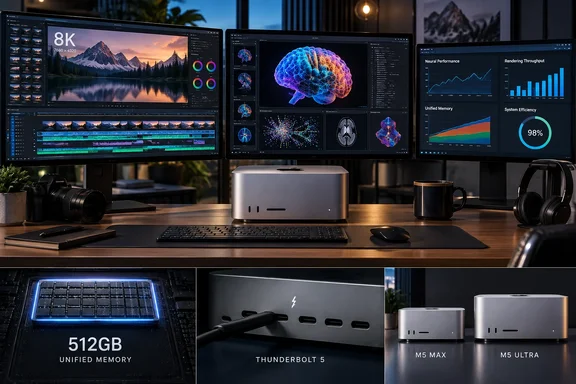
Apple announced the new Mac Studio on August 25, with availability beginning September 22. The M5 Ultra model starts at $5,499 in the US, versus $2,499 for M5 Max; importantly, 512GB configurations are scheduled for late October, rather than the initial release. Apple’s advertised maximum AI and graphics improvements are workload-specific claims, separate from the results measured by Engadget reviewer Steve Dent.
What the premium actually buys
Apple’s specifications distinguish three configurations that are easy to blur together when discussing this machine:
| Configuration | CPU and GPU | Unified memory | Storage |
|---|---|---|---|
| Base M5 Ultra | 30-core CPU, 64-core GPU | 96GB | 1TB |
| Engadget’s reviewed M5 Ultra | 36-core CPU; the corresponding top chip has an 80-core GPU | 256GB | 2TB |
| Maximum M5 Ultra options | 36-core CPU, 80-core GPU | 512GB | Up to 16TB |
The maximum specifications do not describe the $5,499 entry model. Apple restricts the 512GB option to the 36-core CPU and 80-core GPU configuration, while its technical specifications list 1.2TB/s of memory bandwidth for both M5 Ultra chip variants.
According to Engadget, the reviewed 256GB system costs $11,299, compared with $7,499 for the previous M3 Ultra configuration with its top 32-core CPU, 256GB of memory and 2TB SSD. That is a $3,800 increase, or approximately 51 percent. Engadget attributes much of the increase to memory prices and Apple’s pricing, but the review does not establish how much each contributes.
The less expensive comparison is also consequential. Engadget quotes $5,899 for an M5 Max configuration with its top chip, 128GB of memory and 2TB SSD. Its reviewed Ultra therefore costs about 92 percent more, while also providing twice the memory capacity. This is not an equal-memory comparison, and buyers should separate the value of additional capacity from the value of faster execution.
Benchmarks show gains, with limits on the comparisons
Dent reports broadly 20–30 percent better CPU, GPU and Neural Engine results than M3 Ultra. In his comparisons with M5 Max, single-core CPU performance was effectively the same, while multicore CPU and GPU results were around 20–30 percent faster. Geekbench AI results across the CPU, GPU and Neural Engine were only about 10 percent ahead of M5 Max, according to Engadget.
Those findings explain the review’s cautious value assessment. A workload that fits within an M5 Max configuration may gain speed from Ultra without gaining anything close to a doubling of throughput.
The CPU benchmark details deserve care. Engadget reports a Geekbench 7 multicore score of 52,185 for M5 Ultra against 39,145 for M3 Ultra—approximately a 33 percent improvement. Dent says he switched from Geekbench 6 because it appeared unable to handle the new system’s additional cores. That is the reviewer’s account of a testing problem, not a verified general limitation of Geekbench 6.
Engadget also compares the result with a recent 64-core AMD Ryzen Threadripper Pro processor, but does not identify the exact processor or provide enough matching test detail to support a workstation-wide equivalence claim. Buyers should not interpret one CPU score as proof of equal performance in rendering, compilation or local AI.
Apple, meanwhile, advertises up to 1.3 times the CPU performance, 1.8 times the graphics performance and 4.3 times the peak AI compute performance of M3 Ultra. Those are different measurements from Engadget’s benchmark averages, so they should not be combined into a single expected improvement.
The review’s measurements remain single-outlet findings; the additional reporting available here does not independently reproduce them.
Video results are strong, but timeline resolution matters
Engadget’s practical editing tests provide a more useful picture of the machine than the headline CPU ranking.
Dent reports exporting a nine-minute 4K timeline containing mostly 8K footage in one minute and 13 seconds, compared with more than eight minutes on his M3 Pro MacBook. That is a substantial improvement for that particular project, although it compares a high-end desktop with a different class of portable computer rather than isolating the generational benefit of M5 Ultra.
The playback results establish an important boundary. According to Engadget, the machine played eight 8K, 30fps ProRes tracks in real time on a 4K timeline with 4K monitoring, but could not reproduce that result on an 8K timeline. Dent also reports successful simultaneous playback of four 7K RAW tracks with extensive color correction.
For an editor, source resolution and timeline resolution describe different demands. These results support using high-resolution material within a 4K production workflow; they do not establish that the same number of streams remains smooth when the complete timeline is processed at 8K.
There is also a discrepancy in the advertised comparison. Engadget describes testing an Apple claim of eight simultaneous 8K ProRes tracks. Apple’s August 25 announcement instead specifies up to 33 streams of 8K ProRes 422 at 30fps. The available test descriptions do not establish equivalent conditions, so Dent’s eight-track result neither verifies nor disproves Apple’s 33-stream figure.
Apple’s specifications give the Ultra two video decode engines, four video encode engines, and four ProRes encode/decode engines—twice the corresponding engine counts listed for M5 Max. That helps explain why media-specific work deserves its own evaluation: CPU benchmark gains alone do not describe the resources available for supported video processing.
For a studio considering the premium, the useful comparison is a representative project with the actual footage, effects, timeline resolution and output settings it uses.
Local AI: capacity is the clearest differentiator
Apple positions M5 Ultra around local AI, pairing up to 512GB of unified memory with 1.2TB/s of bandwidth. Its announcement also identifies Neural Accelerators inside the GPU cores, designed to accelerate matrix multiplication used in AI computation. These GPU accelerators are distinct from the chip’s separately listed 32-core Neural Engine.
Unified memory gives the CPU and GPU access to a shared memory pool. The practical attraction is the ability to accommodate large workloads without treating dedicated graphics memory as an entirely separate capacity limit. MacRumors’ buying guide likewise identifies local inference and model residency in memory as a principal reason to consider Ultra over Max.
Capacity and speed still answer different questions. A larger memory pool can make a model feasible to load; it does not, by itself, establish satisfactory response latency or generation speed. Apple’s references to “frontier-class” local models do not provide a universal performance guarantee for every model or application.
Engadget supplies one concrete application result: Dent reports transcribing a 70-minute podcast in Mac Whisper in 18 seconds, less than a quarter of the time required on the M4 Max Mac Studio he compared it with. That is compelling evidence for the tested transcription workflow, but it is not a measurement of large-language-model generation speed. Nor does the result establish which hardware engine accounts for the improvement.
The reviewed machine had 256GB of memory. Readers should therefore keep its observed performance separate from the capabilities advertised for the later 512GB option.
Four-machine clustering remains a vendor claim
Apple says multiple Mac Studio systems can be connected using Thunderbolt 5 and remote direct memory access, or RDMA, for distributed AI inference. It advertises up to three times the inference performance from four systems compared with one.
Engadget did not test that arrangement. Dent describes the proposed equipment as roughly $45,000 worth of computers and says Apple did not provide the cluster.
The distinction is important for procurement: physical connectivity alone does not establish that a particular application will distribute its work successfully. Apple’s claim concerns distributed inference, not automatic acceleration of every AI tool attached to the machines. Even at the advertised maximum, four computers deliver up to three times the performance, rather than four times.
Storage, displays and gaming
Engadget reports sustained storage results of approximately 14GB/s writing and 11GB/s reading on its 2TB review system. Those numbers should stay attached to that tested configuration; they do not establish identical performance across every SSD capacity. Apple advertises up to twice the storage performance of the preceding generation.
For desktop integration, Apple’s specifications give M5 Ultra six Thunderbolt 5 ports—four rear and two front—alongside 10Gb Ethernet, HDMI 2.1, two USB-A ports and an SDXC card slot. The M5 Max has slower front USB-C connections instead of the Ultra’s additional Thunderbolt ports.
Display capability may be more useful than a small benchmark advantage for some buyers. Apple lists support for up to eight displays, or up to four at 5K and 120Hz, subject to the specified display combinations. CNET also highlights four-display 5K/120Hz support as a change relevant to professional graphics users. The eight-display maximum should not be read as eight displays at that highest refresh-rate configuration.
Gaming is a secondary benefit. According to Engadget, Baldur’s Gate III averaged more than 80fps at 4K with Ultra settings and did not fall below 60fps during Dent’s testing. He also reports hearing the fan only during gaming, although this was a subjective observation rather than an acoustic measurement.
Engadget expects a Windows gaming machine with an Nvidia GeForce RTX 5090 to outperform it, but does not supply a matched comparison. One game’s results provide no basis for choosing an $11,299 workstation primarily for gaming.
When the Ultra makes sense
The purchase case is strongest when a workload needs more than M5 Max’s 128GB memory ceiling, benefits materially from the Ultra’s additional media resources, or saves enough paid production time to justify the premium. The reported editing and transcription results make those possibilities credible, without establishing them for every application.
For Windows teams, the decision also includes whether the required applications and acceleration paths work on macOS. Nothing in these results measures the cost of changing platforms, and the incomplete Threadripper comparison does not establish better value than a similarly priced Windows workstation.
An M3 Ultra owner should weigh Engadget’s roughly 20–30 percent general performance improvement against the much larger price increase for the reviewed configuration. A buyer whose workload fits comfortably within M5 Max has an even clearer reason to compare the two using actual project completion times.
For buyers who specifically need 512GB, the immediate decision is simpler: Apple schedules that configuration for late October, and Engadget’s 256GB review is not a test of it.
Update: The Verge independently benchmarks the M5 Ultra (September 21, 2026)
The Verge has now published independent testing of a 36-core CPU, 80-core GPU M5 Ultra Mac Studio with 256GB of memory and a 4TB SSD, priced at $12,299. Its results broadly corroborate Engadget’s reported generational gains: compared with a similarly configured M3 Ultra, The Verge measured roughly 30 percent higher single- and multicore CPU scores, while Cinebench GPU performance was 63 percent higher.
Its practical media results were also strong. The Verge completed its Premiere Pro 4K export in 40 seconds, versus 50 seconds on its M3 Ultra system, and finished Blender’s Classroom render in 11 seconds versus 15 seconds. These are separate test workloads and configurations, so they should not be treated as direct replacements for Engadget’s timeline results.
The Verge additionally measured sustained SSD reads of 14,867.60MB/s and writes of 18,782.91MB/s on its 4TB review unit—materially higher write performance than Engadget reported from its 2TB system. That difference reinforces that storage figures should remain tied to the tested capacity rather than assumed across all Mac Studio configurations.
References
- Apple Mac Studio (M5 Ultra) review: Huge AI and graphics power at a huge premium Engadget · 2026-09-21T13:00:00+00:00
- The M5 Ultra Mac Studio tears through our benchmark tests The Verge · 2026-09-21T13:00:00+00:00
- Mac Studio - Technical Specifications - Apple apple.com