

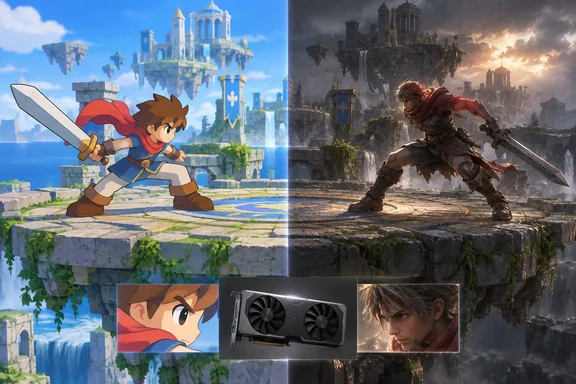
Melee Unlocked's DLSS 5 Experimental Build Puts NVIDIA's Realism Model on a 2001 Cartoon Fighter
Melee Unlocked comes from developer Hero88go. The repository describes it as a beta, translated ahead of time into C++ (static recompilation of the retail executable plus Slippi's Gecko codes), and running on a native Direct3D renderer. The DLSS 5 work lives in its own package. The GitHub release notes for version 0.6.0 introduced a new DLSS 5 Experimental build. Pick it in the launcher under Game Build. Version 0.6.1, released September 19, is headlined "DLSS 5 Lighting and tone goes up to 200% again." It comes with a warning that above 150% the panel warns that the lighting can flicker on stage backgrounds (Yoshi's Story, Dream Land).
One version number doesn't match the record. Wccftech says DLSS 5 support was recently added to the 0.6.61 version of Melee Unlocked. The project's GitHub releases show a 0.6.0 tag that introduced the DLSS 5 build and a 0.6.1 tag that adjusted it. TweakTown, reporting separately, also listed it as Version 0.6.1. We found no 0.6.61 release, so "0.6.61" looks like a typo for 0.6.1.
Wccftech describes the build as coming with in-game controls for intensity, surface detail, lighting and tone. The repository's README says the neural pass is turned on by choosing "Insane" in the Quality presets, or through the DLSS 5 controls in the PC settings overlay (F1, or Z + Start). The 0.6.0 notes add a scope limit: DLSS 5 runs during matches. Menus are shown without it.
How NVIDIA's DLSS 5 Differs From the Upscaling Melee Already Had
Earlier DLSS versions and DLSS 5 do different jobs. NVIDIA's research group says previous DLSS technologies used learned reconstruction to approximate output that would otherwise need a bigger rendering budget. DLSS 5 is described as "the first DLSS technology to generate the final displayed appearance" instead of reconstructing a higher-cost reference image. Put simply, older DLSS predicts what the game's own renderer would have drawn at higher quality. DLSS 5 adds appearance detail the renderer never computed.
NVIDIA's technical paper, published September 1, 2026, calls the system a real-time generative rendering stage that draws on appearance knowledge learned from real-world visual data. It uses a one-step pixel-space diffusion model. At run time the model is conditioned on the current rendered frame, engine motion vectors, carried temporal state and artistic-direction values. NVIDIA says the model runs locally on GeForce RTX 50 Series GPUs at up to 4K output.
NVIDIA's September 22 developer blog describes the design goal as using the engine's rendered frame, including its artist-authored geometry, textures and lighting buffers, as the foundation. The model is meant to add lifelike lighting and material detail while keeping scene structure and character identity intact. The blog's flagship example is NBA 2K27. There, DLSS 5 keeps scanned facial geometry while enhancing skin subsurface scattering, light passing through hair and ears, and contact shadows.
That design explains the Melee result. A model trained to push images toward real-world lighting and materials will pull a bright, flat-shaded 2001 cartoon toward something moodier and more photographic. The darker, less saturated look in the showcase video fits that aim. This is our reading of NVIDIA's stated goals, not a documented diagnosis of this particular integration.
What Official DLSS 5 Controls Offer Developers, and What a Community Port Can Reach
NVIDIA's developer-facing toolkit is broad. Studios can choose among several models and mix them across scenes, gameplay or cutscenes. They can adjust "Structure Intensity" and "Tone Intensity" to tune high-frequency detail and the wider lighting and color response. They can also use semantic AI masking and engine-level masks to keep the effect off specific props or asset groups such as glassware, water droplets and foliage. NVIDIA adds that richer input, such as ray-traced or path-traced lighting, gives "dramatically more-accurate results" than rasterized frames.
Melee Unlocked's sliders sound like a partial match. "Lighting and tone" and "surface detail" resemble NVIDIA's Tone and Structure controls. Neither the project nor NVIDIA says they map one-to-one, and nothing suggests the port uses per-asset masking. Melee is also a rasterized GameCube game with no ray-traced lighting to feed the model. By NVIDIA's own account, that puts it at the thin end of the input-quality range.
Masking is the tool a stylized game would need most, because it lets artists protect things that should stay flat or saturated. A hobbyist integration without it is closer to a worst case than a best case for cartoon art. That makes the "surprisingly decent" verdict more interesting, and it also argues against treating one Melee video as a verdict on what a studio could do with its own art direction.
Wccftech's "Usually Disappoints" Claim Rests on Impressions From Community Mods
The headline claim that DLSS 5 usually disappoints in stylized games is an impression from Wccftech's coverage, not a measured result. Its author wrote that he wasn't expecting much, as the tech at its current stage doesn't seem to work well with games with stylized visuals, but the video proved it can work quite well with them as well. The same report says users have been adding DLSS 5 to many games since launch, with widely varying results. It singles out Dark Souls III as an older, realistically styled game where the author says the output reaches "remake-level" quality.
The Melee judgment comes from a YouTube video Hero88go published after the release, not from hands-on testing by the outlet. The author concluded that no one would realistically play the game this way, but called it an interesting experiment. No frame-time cost, latency figure or side-by-side image-quality measurement has been published for the Melee integration.
The developer's own release notes are the most concrete observation available. The flicker warning above 150% lighting and tone on Yoshi's Story and Dream Land is a specific, reproducible-sounding artifact that the developer acknowledges. Wccftech's remark about noise points the same way: at aggressive settings, the generative pass is visibly unstable on some of Melee's backgrounds.
Melee Unlocked Setup: Legacy Build vs. DLSS 5 Experimental Requirements
For anyone who wants to try it, the most important fact is that DLSS 5 is fully separate from the normal game. The README says the Legacy package is the regular game and already includes ordinary NVIDIA DLSS/DLAA upscaling, Frame Generation and Reflex, none of which need DLSS 5. The Experimental package includes everything in Legacy plus the optional neural pass. The Legacy executables are compiled without the DLSS 5 code, so it can't be reached from them.
The prerequisites and moving parts are:
- You need your own Super Smash Bros. Melee NTSC 1.02 disc image. The project states that nothing from the game is included.
- The Experimental build is intended for GeForce RTX 50-series GPUs or newer.
- DLSS 5 needs NVIDIA's
nvngx_dlssnr.dll. The 0.6.0 notes say plainly that it is not included, and we will not provide it. - The game looks for it in the NVIDIA driver first, then next to melee_port_dlss5.exe (or the _compat executable).
- The default Direct3D 12 renderer is required. The Direct3D 11 fallback needs a restart and has no DLSS support at all.
Switching to the Experimental build
- Download the Legacy zip (
MeleeUnlocked-<version>-win64.zip) from the project's GitHub releases, extract it, and run the optionalMeleeUnlockedLauncher.exe. - On the launcher's Play page, choose DLSS 5 Experimental from the GAME BUILD dropdown. From a Legacy-only install, this downloads and installs the full experimental zip once and then launches it.
- Start a match, press F1, and either pick the "Insane" quality preset or adjust the DLSS 5 controls directly.
The manual .bat launch files always run Legacy, so the launcher is the supported route to the Experimental build. If the DLL can't be found, the failure is harmless: without it the game runs normally, and the PC settings panel says DLSS 5 could not start and why. Going back is simple too, since switching to Legacy needs nothing extra. When updating, the project says settings, saves and replays carry over.
The Rest of Melee Unlocked Is Why Most Players Would Install It
The DLSS 5 option gets the headlines, but the Legacy build is what most Windows players would actually use. The port keeps game logic at the GameCube's original 60 Hz while the display runs at any rate. Wccftech summarizes it this way: in-between frames are built from the game's own animation and physics data, not image interpolation, so there is no added latency. That is a different approach from GPU frame generation, which synthesizes frames from rendered images.
The feature list also includes online play with rollback against regular Slippi Dolphin users (this requires a Slippi account logged in through Slippi Launcher), official GameCube adapter support through the WinUSB driver, DualSense and Switch Pro controllers, HD texture packs, and a "Low spec" switch for integrated graphics. The project says it isn't affiliated with Nintendo, HAL Laboratory or the Slippi team, and it asks users to report bugs to its own repository, not to Slippi.
Two background points help explain the project. It follows the completion of a six-year decompilation of Melee that TweakTown reported a few weeks earlier. Hero88go's FAQ also says the port was built with heavy help from AI coding models. Separately, a community Linux fork shows that DLSS stays a Windows-only feature here: it replaces the D3D12 renderer with OpenGL and lists no DLSS/DLAA (NVIDIA Streamline is D3D12/Windows only).
What this means for you
If you play Melee competitively or online, stay on the Legacy build: it has the unlocked frame rate, DLSS/DLAA and Reflex without an experimental generative pass that changes how the game looks. If you own an RTX 50-series card and are curious about DLSS 5, the Experimental build is a low-risk way to see how the model treats non-photorealistic art. The switch can be undone, and a missing DLL leaves the game running normally. Anyone on older NVIDIA hardware, AMD or Intel graphics, the D3D11 fallback or Linux can skip the DLSS 5 build entirely.
- The DLSS 5 option is only in the separate Melee Unlocked "DLSS 5 Experimental" package. The regular Legacy build doesn't contain the code.
- The Experimental build targets GeForce RTX 50-series GPUs and needs NVIDIA's
nvngx_dlssnr.dll, which the project doesn't ship. The game checks the NVIDIA driver first, then the executable's folder. - DLSS 5 in Melee Unlocked works only during matches and is enabled through the "Insane" preset or the DLSS 5 controls in the F1 panel.
- Keeping lighting and tone at or below 150% avoids the flicker the developer warns about on Yoshi's Story and Dream Land in version 0.6.1.
- "0.6.61" appears to be a typo: the project's releases are 0.6.0 (which introduced the build) and 0.6.1.
- Published judgments of the effect come from a developer showcase video, with no performance or image-quality measurements yet.
The Melee experiment shows that a model built to make a basketball player's skin scatter light like real skin will, when pointed at a cel-shaded cartoon, drag it toward the same moody realism: sometimes attractive, often muted, and unstable at the extremes. For now, a small beta project with a flicker warning is where that behavior is easiest to see. How DLSS 5 treats stylized art will be decided by studios with access to NVIDIA's model selection and masking tools, not by community injections, and NBA 2K27 is the only official integration NVIDIA has named so far.
References
- NVIDIA DLSS 5 Neural Rendering Usually Disappoints In Stylized Games, Yet Delivers Solid Results in Super Smash Bros. Melee Wccftech · 2026-09-25T10:53:47+00:00
- GitHub - Hero88go/melee-unlocked: Super Smash Bros. Melee with unlocked FPS as a native Windows build with Slippi online play. Current release is in BETA. Bring your own NTSC 1.02 ISO. · GitHub github.com
- GitHub - ikz87/melee-unlocked: Super Smash Bros. Melee with unlocked FPS as a native Windows build with Slippi online play. Current release is in ALPHA. Bring your own NTSC 1.02 ISO. · GitHub github.com