

Meta VR Glasses Split a Quest Into a 100-Gram Visor and a Snapdragon Puck
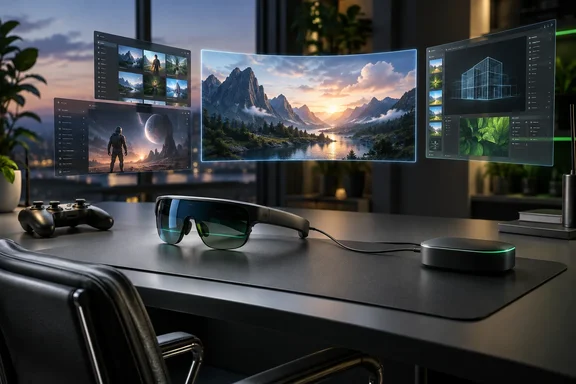
Shacknews first reported the reveal. Its figures match Meta's own newsroom post and coverage from several other outlets. Priced at $1300, they have 2.4K micro-OLED displays, weigh 100 grams, and are powered by a tethered puck with Qualcomm's Snapdragon Reality Elite chipset, according to UploadVR. Yahoo Finance adds that the glass's computing components, battery, and storage are housed in a separate dedicated puck that tethers to the spectacles, helping to ensure they're light enough to wear for long periods.
The 100-gram figure covers only the part on your face. Meta compares it to a deck of cards and says the glasses are five times lighter than a Meta Quest 3. The whole system you carry weighs more, and Meta's announcement doesn't give a weight for the puck. UploadVR says the visor has no computing hardware at all: Meta VR Glasses have no onboard computing, not even a tracking coprocessor, and thus entirely rely on the puck, which provides both power and data over a thin and flexible fiber optic cable. The same report says the frame uses a magnesium alloy that minimizes weight while also enabling a fanless, passively cooled design.
According to Meta, the puck has up to three hours of continuous high-resolution media playback and supports 45W fast charging. Meta didn't say how that holds up under gaming or mixed use, so treat three hours as a best case for watching video. UploadVR reports the puck features 12GB of RAM and 128GB of storage, and there's a microSD slot in the puck to expand it.
Software matters more than the chassis for anyone already using Quest. UploadVR reports that the puck runs the same operating system as Quest 3, and supports all the same content, rendered at notably higher resolution thanks to a combination of the more powerful chipset (essentially an XR2 Gen 3 by a different name) and eye-tracked foveated rendering. In other words, the device is a Quest-class platform in a new body, not a new ecosystem starting from scratch. Road to VR also confirms, via VR.org, that this is the device previously known as Project Phoenix.
Xbox Cloud Gaming Is the Microsoft Hook and the Least-Defined Feature
The Xbox link comes straight from Meta's announcement. Meta lists two separate gaming libraries. One is more than 75 games at launch that you play with hand gestures alone. The other is "hundreds more" that you can stream through Xbox Cloud Gaming. Yahoo Finance independently reports that Microsoft is bringing its Xbox Cloud Gaming service to the glasses, so users can play on the go.
Keep the two libraries apart. The gesture-only claim applies to Meta's 75-plus launch titles. It doesn't mean the streamed Xbox catalog works without a controller, and Meta hasn't said which input devices work with streamed games. Xbox's own cloud library is built around gamepad play. Whether you can pair an Xbox Wireless Controller to the glasses is an open question for anyone planning to use them mainly for Xbox Cloud Gaming.
Meta's announcement also leaves out the details that decide whether the feature is useful. It lists no required Game Pass tier, no countries, no bandwidth or latency requirements, and no promise that Xbox Cloud Gaming will be ready on day one. An earlier Meta–Xbox offer involving Game Pass for Meta Horizon+ subscribers was a separate deal and doesn't tell you the terms here. The Quest line has had Xbox branding before: in June 2025 Meta announced a limited edition model known as the Quest 3S Xbox Edition; this variant features black-colored hardware with green accents, and is bundled with a matching Xbox Wireless Controller. Nothing like that has been announced for the glasses.
My reading, which is inference rather than anything Meta has said: the glasses run the Quest operating system, and Xbox Cloud Gaming already runs there, so the integration is likely to be a carry-over rather than something new. That would make it a low-risk promise. The subscription terms and controller support will still have to be confirmed nearer to spring 2027.
A 5K Micro-OLED Display Pitched at Windows Desktops as Much as Games
Meta calls the screen a "5K Infinite Display" built on micro-OLED panels. It quotes 37 pixels per degree, uses compact pancake lenses, supports Dolby Vision and builds Dolby Atmos spatial audio into the frames. Benzinga reports the display runs with up to a 120Hz refresh rate. The "5K" and UploadVR's "2.4K" don't contradict each other. Meta's figure appears to describe the combined output and UploadVR's the per-eye panels. Meta hasn't published a per-eye resolution table.
Gizmodo, after seeing the device, called the panel premium—like, Vision Pro premium. That is one outlet's impression from a demo, not a measurement. It does line up with Meta's pixel-density claim.
The workspace pitch is the most relevant part for PC users. According to Meta, the glasses can show one or more virtual screens, turn a flat surface into a keyboard and touchpad, and use full-color passthrough so you can still see your desk and phone. Gizmodo describes using the glasses as a virtual multi-monitor setup for productivity. Benzinga goes further, reporting that users can also connect the glasses to Mac and Windows computers and use them as virtual external displays.
No other outlet reviewed here has reported the Windows virtual-display detail. Meta hasn't published requirements for it either: no supported Windows versions, connection method, companion app, or resolution per virtual screen. Until those exist, a laptop user can't tell whether this would replace physical monitors while travelling or is closer to a mirrored desktop.
Controllers, Quest Compatibility and the Real $1,299.99 Price
The $1,299.99 box contains less than the Quest comparison suggests. VR.org, citing Road to VR, says the $1,299.99 covers 128GB of storage, a microSD slot that takes cards up to 1TB, and a 45W power supply, and adds bluntly that it does not cover controllers.
That matters because the glasses are marketed as running the full Quest library, and much of that library needs Touch controllers. UploadVR explains the options: you can buy Touch Plus controllers separately (available in a new all-black color), or pair the controllers from your existing Quest 3 or Quest 3S, and there'll be a bundle with controllers "in some retail channels". Quest 3 and 3S owners can reuse what they already have. Anyone new to Quest should budget for controllers on top of the headline price.
Timing is fixed only to the season. VR.org notes there are no preorders and no date beyond the season. The price is higher than earlier targets suggested: in June 2025, the Wall Street Journal reported an internal hope of landing under $1,000.
The Quest 3 comparison also fails on price. For reference, the Quest 3S launched in 128 GB and 256 GB models priced at US$299.99 and US$399.99 respectively. The glasses sell comfort and display quality at roughly four times entry-level Quest money, and they don't replace Quest as the cheap way into VR.
Where Meta VR Glasses Sit Against Valve's Steam Frame for PC Gamers
PC gamers already have another option at the same price. Valve's Steam Frame released September 18, 2026 at an introductory price of $1,059 for 256GB and $1,299 for 1TB. VR.org notes Valve includes controllers, a wireless adapter and Half-Life: Alyx in the box.
The two devices come at PC gaming from opposite directions. Steam Frame runs SteamOS and ships with a wireless adapter (Wi-Fi 6E, 6 GHz, low-latency PC link), so it's built around your Steam library and your gaming PC. In the material Meta has published, its glasses reach PC and Xbox gaming mainly through the cloud, via Xbox Cloud Gaming. Meta hasn't said how PC VR streaming, such as Quest-style PC links, will work on the glasses. That gap matters if you own a capable Windows gaming rig.
What Meta offers in return is comfort and a display built for films and sports. Meta calls it the first VR device certified as IMAX Enhanced. It says Disney+ subscribers in select countries can start streaming some films in 3D in November. It also promises more than 100 immersive live sports events a year once the glasses launch, with partners including MLB, NBC Sports, TNT Sports and UFC. Those are Meta services, not Xbox features, but they explain how Meta can justify $1,299.99 for a device that isn't mainly a PC VR headset.
Meta also demonstrated hologram calling, which uses a photorealistic avatar that follows your expressions in real time. Meta says it works with WhatsApp and Zoom, and people joining from phones or computers can see your hologram. According to Yahoo Finance, users take a picture of themselves in the Meta AI app, which then creates a full-body digital version of them that they can use to make video calls with friends and family while wearing the glasses. Meta hasn't given rollout details, or said whether Microsoft Teams is supported, so treat it as a consumer feature for now.
What this means for you
If you're thinking about buying: nothing can be bought until spring 2027, and the details that matter for Xbox and Windows users will only arrive closer to launch, so decide then. Quest owners with a controller pair are in the best position, because their Quest content and controllers are reported to carry over. Anyone buying mainly for Xbox Cloud Gaming or as a Windows virtual monitor should wait for Meta and Microsoft to publish subscription terms, controller support and PC connection requirements.
- Meta VR Glasses go on sale in spring 2027 for $1,299.99 in the US. There are no preorders, no exact date and no published pricing outside the US.
- The roughly 100-gram weight covers only the glasses. The Snapdragon Reality Elite puck carries the compute, battery and storage, and Meta rates it at up to three hours of media playback.
- Xbox Cloud Gaming is confirmed as a streaming option. Game Pass tier, regions, network requirements and controller support haven't been announced.
- Controllers aren't in the box. Existing Quest 3 and Quest 3S controllers are reported to pair, and Touch Plus controllers are sold separately.
- Benzinga reports Windows and Mac virtual-display support, but Meta hasn't published supported Windows versions or setup requirements, so don't plan a monitor-free laptop setup around it yet.
- PC VR players comparing it with Valve's Steam Frame should note that Steam Frame includes controllers and a low-latency PC wireless adapter at a similar price.
Meta has shown that Quest-class VR can fit into something people might actually wear for a film or a flight. Xbox Cloud Gaming is part of the launch pitch, which gives Microsoft's streaming service a place on a premium, lightweight headset. Whether that becomes real value for Game Pass subscribers and Windows users depends on terms Meta and Microsoft haven't published yet. Those should arrive before the spring 2027 launch.
Update: Meta VR Glasses reportedly support Bluetooth gamepads for Xbox Cloud Gaming (September 24, 2026)
BestMediaInfo reports that Xbox Cloud Gaming on Meta VR Glasses will use a Bluetooth gamepad. If accurate, that resolves the central input question left open by Meta’s initial launch material: streamed Xbox titles are not being positioned as hand-tracked, controller-free games.
The report does not identify supported controller models or confirm Xbox Wireless Controller pairing specifically. It also does not add Game Pass tier, regional availability, bandwidth, or launch-day availability details, so Windows and Xbox users should still wait for Meta or Microsoft to publish those terms.
BestMediaInfo also says Meta is expanding the media pitch with services including Prime Video, YouTube, DIRECTV, AMC+, Crunchyroll, Plex and Tubi, while Peacock, HBO Max and Paramount+ are planned to offer 3D catalogs. It further reports an ESPN partnership for immersive broadcasts with 8K streaming and 180-degree views.
Update: Meta VR Glasses’ puck reportedly weighs 300 grams, narrowing the portability claim (September 24, 2026)
PC Gamer reports that the tethered compute-and-battery puck weighs 300 grams. That is the first reported weight for the component Meta left unquantified at launch, and it puts the carried system at roughly 400 grams before accessories—not 100 grams.
The same report says the micro-OLED panels run at 2,412 by 2,288 pixels per eye at up to 120Hz, while the field of view is reportedly 70 degrees, citing Road to VR’s Scott Hayden. Meta’s earlier “5K” specification therefore appears to describe the combined display resolution.
For Windows users considering the glasses as portable virtual monitors, the puck’s weight and cable are important practical constraints. The face-worn unit may be unusually light, but users still need somewhere to carry or secure the separate 300-gram module.
PC Gamer also reports that Meta’s built-in AI can respond to voice commands for tasks such as opening apps and playing media. It does not add new confirmation on Windows connection requirements, Xbox Cloud Gaming subscription terms, or supported Bluetooth controller models.