

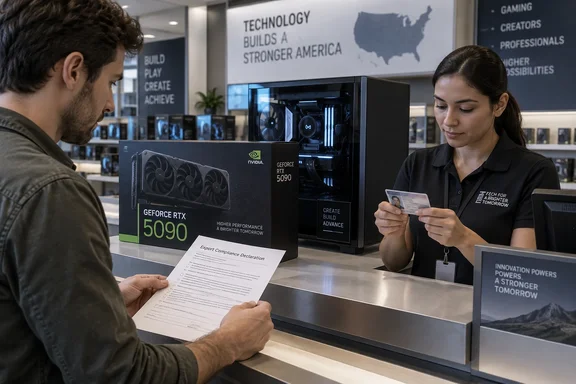
For PC buyers, the immediate consequence is straightforward: purchasing the hardware may now involve explaining who will use it and where. But the evidence warrants a narrower conclusion than a confirmed nationwide crackdown. The reporting does not establish a chain-wide rollout, and Micro Center had not provided an explanation in Tom’s Hardware’s coverage.
What buyers are reportedly asked to provide
According to Tom’s Hardware’s account of the customer-posted Advanced Computing Product Purchaser Declaration, the form requests:
- Full legal name and residential or business address.
- Government-issued photo identification.
- Phone number and email address.
- The actual end user, if different from the purchaser.
- The product’s installation location and intended use.
Its headline instruction is emphatic: “NO EXPORT - NO EXCEPTIONS.” The reported wording says Micro Center will not sell the product to someone intending to export, reexport, resell or transfer it in a way that causes it to leave the United States, regardless of destination. That is broader than a restriction aimed only at China.
TechRadar also reports a commenter’s claim that the declaration appeared at the Columbus, Ohio, store. That is anecdotal corroboration, not confirmation that every location follows the same procedure. Its mention of similar paperwork at Central Computers likewise rests on a commenter’s account—not evidence of a universal U.S. retail requirement.
The practical distinction: this is a reported purchasing condition, not merely a limit on how many cards fit in your shopping cart.
Export-control context explains the questions—not a mandate
There is a concrete regulatory backdrop. In its May 13, 2025 Industry Guidance to Prevent Diversion of Advanced Computing Integrated Circuits, the U.S. Commerce Department’s Bureau of Industry and Security recommends customer due diligence and end-user certifications for relevant advanced-computing transactions. Its suggested information includes customer identity, contact details, intended activity, the end user and delivery or installation addresses. Those fields overlap with the reported Micro Center declaration.
However, that guidance does not establish a requirement for this particular retail form or for scanning every RTX 5090 buyer’s driver’s license. It describes export-control obligations and recommended checks; it should not be treated as proof that a new law dictated Micro Center’s checkout procedure.
One especially useful detail: BIS says a residential address without an alternative use location is a warning sign only when the quantity of chips is inconsistent with personal use. A home address alone is not the red flag described in that provision.
Deterrence is plausible; effectiveness remains unproven
Recording an identified purchaser’s stated intentions could discourage some casual export resellers. That is a plausible interpretation—not a measured result. Tom’s Hardware questions how the declaration would prevent subsequent diversion and notes that the document does not list the GPU’s serial number. Neither point proves the declaration is legally unenforceable.
Customer reactions are mixed, according to TechRadar: some accept additional checks as an anti-scalping measure, while others object to the inconvenience or disclosure of personal information. Those comments illustrate the trade-off, but they are not representative consumer research.
What to ask before visiting a store
For prospective buyers, a short conversation before checkout is more useful than discovering the paperwork with a workstation already on the counter:
- Ask about the exact product. Does the declaration apply to the standalone card, the prebuilt PC, or both?
- Clarify identification requirements. Which documents are accepted, and is the ID copied or scanned?
- Ask about data handling. What is retained, for how long, and who can access it?
- Explain the real end user. If buying for an employer or another person, ask how to record that accurately.
- Confirm purchase limits separately. Do not assume a reported quantity restriction establishes a permanent lifetime ban.
The bottom line is not that a signature has solved GPU scalping. It is that some RTX 5090 purchases reportedly now involve identity and end-use checks—and buyers deserve clarity about both the purchasing conditions and the personal information collected.
References
- Micro Center cracks down on scalpers looking to export the RTX 5090 GPU TechRadar · 2026-10-03T03:00:00+00:00
- Micro Center requires photo ID and signed no-export pledge to buy Nvidia RTX 5090 gaming GPU — buyer forced to sign declaration disclosing install location and promise GPU will remain in the US | Tom's Hardware tomshardware.com
- RTX 5090 No-Export Declaration: Micro Center Rule (2026) - shattered.io shattered.io · 2026-10-04T16:27:44+00:00