

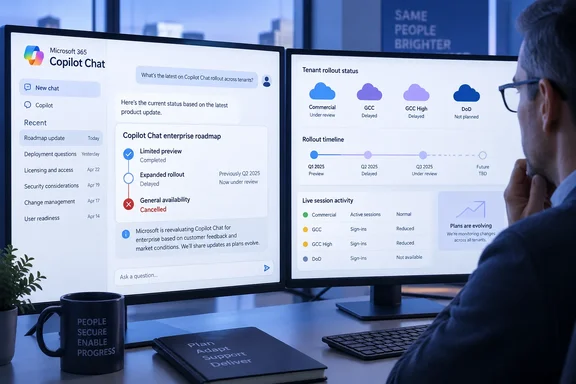
That distinction is important because this was not a feature that existed only on a future-looking roadmap. Microsoft’s October 2025 What’s new in Microsoft 365 Copilot post described session persistence as a new Copilot Chat enhancement, while Message Center post MC1174856 repeatedly set rollout dates for the same Roadmap ID 500638 through June 2026. The public record now shows a feature that Microsoft announced, delayed several times, and has subsequently marked Cancelled without explaining whether the cancellation concerns unfinished deployment, a withdrawal, or a replacement implementation.
For administrators and users, the immediate takeaway is simple: do not treat the cancelled roadmap card as confirmation that Copilot Chat history has been removed from your tenant. Test the behavior that exists today, document what users can rely on, and avoid promising universal session persistence—especially in regulated Microsoft 365 environments that may have received changes on a different schedule.
What Roadmap ID 500638 was supposed to change
The proposed behavior was narrowly focused but meaningful in day-to-day Copilot use. When a user submitted a prompt in Copilot Chat, Microsoft planned for the service to create a conversation entry immediately in the navigation pane. The user could then leave the page or open another area of the Microsoft 365 Copilot experience and return to the same exchange with its prior context intact.
Before that behavior, a chat that had not yet been established as a history item could feel temporary. A user could begin drafting a prompt, receive an answer, navigate away, and then find that the interaction was no longer conveniently available as a resumable conversation. Session persistence was meant to eliminate that gap by committing the conversation to history at the first submitted prompt rather than later in the interaction.
Microsoft attached the item to the web platform, marked it for general availability, and listed all four major Microsoft 365 cloud environments: Worldwide multi-tenant, GCC, GCC High, and DoD. Its stated audience covered both Microsoft 365 Copilot and Copilot Chat users, rather than only organizations paying for the full Microsoft 365 Copilot add-on.
The original roadmap schedule was already a moving target. Third-party archives of the Microsoft 365 Message Center record show that the rollout was initially expected in late 2025, shifted into 2026, and eventually carried an end-of-June 2026 completion date for commercial and government environments. Microsoft’s September 18 update cancels the item roughly three months after that final stated rollout window.
Microsoft’s cancellation leaves the key operational question unanswered
The roadmap entry now says, “We are cancelling this Roadmap item at this time,” followed only by an apology for inconvenience. It does not identify a technical defect, policy concern, tenant configuration, licensing change, or successor feature. It also does not say whether the capability was fully deployed, partially deployed, renamed, or rolled back.
Microsoft’s earlier Message Center communication is more specific about expected behavior than the cancellation notice. MC1174856 said the feature would create a session entry after the prompt was submitted, required no administrator policy changes, and had no stated compliance considerations. The notice expired at the end of July 2026, so it did not receive a matching public Message Center update explaining the September cancellation.
That creates a documentation mismatch for IT teams. An administrator reviewing the roadmap today sees a cancelled item; a user who has already received the behavior may still see Copilot conversations saved after navigating away. Both can be true. Roadmap status describes Microsoft’s product-delivery intent, while the live service behavior is determined by what Microsoft has already enabled in each tenant and whether it has subsequently changed it.
Microsoft’s October 2025 Copilot update complicates the usual interpretation of a cancelled roadmap entry further. In that post, Microsoft described session persistence in the present tense and said a navigation-pane history entry would be created after prompt submission. That language indicates Microsoft had at least publicly positioned the capability as part of Copilot Chat’s delivered experience well before today’s cancellation.
What the company has not established is the scope of actual deployment. There is no public statement confirming that every Worldwide, GCC, GCC High, and DoD tenant received the change by June, and there is no statement confirming that every tenant which received it will retain it. A cancellation notice is therefore insufficient evidence for either conclusion.
Why this matters more than a cosmetic navigation change
Copilot Chat history affects more than convenience. Session continuity determines whether users can safely leave an AI-assisted task—such as revising a document, working through a troubleshooting sequence, or refining a summary—and resume without reconstructing the question and prior answers. When that continuity is inconsistent, users tend to copy material elsewhere, restart the prompt, or make local notes to preserve context.
For support teams, the behavior also shapes expectations. If an employee says a Copilot chat “disappeared,” the relevant troubleshooting question is no longer simply whether Copilot was available. It is whether the first prompt created a persistent navigation item in that user’s current Copilot web experience, whether the user returned to the same account and tenant, and whether the organization’s experience has changed since Microsoft’s cancellation notice.
The feature was also designed to reduce ambiguity about what counts as a conversation. Creating a history entry at the first prompt makes the interaction visibly durable from the user’s perspective. That does not by itself change Microsoft Purview retention, eDiscovery, auditing, or data residency behavior; Microsoft’s earlier notice expressly said no compliance change was identified. But it can affect user assumptions about whether a conversation is saved, discoverable in the interface, or safe to leave and revisit.
Organizations should be careful not to fill the gaps in Microsoft’s notice with policy claims of their own. A visible session entry is not proof of a particular retention period, and an absent entry is not proof that no service-side records exist. Those matters remain governed by the tenant’s Copilot, Microsoft 365, and Purview configuration—not by a cancelled feature card.
Administrators should verify the live behavior, not the roadmap label
There is no announced remediation or replacement timeline. Microsoft has not instructed customers to make a configuration change, and the earlier rollout notice said there was no admin control associated with the feature. That leaves tenant-level validation as the practical response.
A short functional test is enough to establish the experience users can expect today:
- Use a standard end-user account in the Microsoft 365 Copilot web experience and submit a non-sensitive test prompt.
- Confirm whether a new chat entry appears in the Copilot navigation pane immediately after sending the prompt.
- Navigate to another area of Microsoft 365 Copilot, then return to that entry and verify whether the exchange and context remain available.
- Repeat the check with representative accounts in separate cloud environments or release populations if the organization operates across commercial and government tenants.
- Update help-desk guidance to describe the behavior observed in the tenant, rather than stating that all Copilot chats will always persist.
Testing should be performed with an account that reflects ordinary user licensing and policy assignment. The point is not to prove what Microsoft intended in 2025; it is to establish whether session persistence is dependable in the tenant after the September 18, 2026 cancellation.
For organizations that built onboarding material around “pick up where you left off” Copilot workflows, the cancellation is a reason to soften that wording. State that users should verify that a chat is visible in their Copilot history before relying on it as a resumable workspace. That is less elegant than the feature Microsoft originally described, but it accurately reflects the unresolved rollout status.
A cancelled roadmap item is not a rollback notice
Microsoft’s update closes Roadmap ID 500638, but it does not close the larger question of what happens to Copilot Chat sessions already created under the feature. The company has provided no retirement date, no removal notice, no replacement Roadmap ID, and no explanation for the decision.
The evidence supports a limited conclusion: Microsoft cancelled the formal roadmap commitment on September 18 after publicly promoting and repeatedly scheduling the session-persistence behavior. It does not support saying that Copilot Chat history has been universally withdrawn.
Until Microsoft publishes a clarifying Message Center notice or product documentation, enterprises should treat session persistence as a tenant-observable behavior rather than a guaranteed Copilot Chat contract.
References
- Microsoft Copilot (Microsoft 365): Copilot Chat - Session Persistence Enhancement Microsoft 365 Roadmap · 2026-09-18T22:00:04.2303666Z