

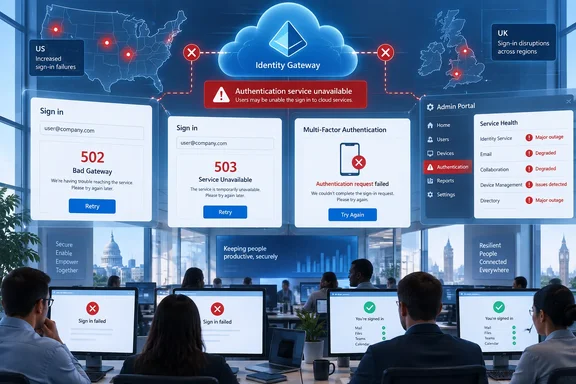
Neowin first reported the incident after Microsoft posted a public status notice, while administrators on the r/sysadmin subreddit independently reported 502 and 503 responses during Microsoft 365 and Azure portal authentication attempts. Microsoft has said that some affected customers are seeing service return, but it has not declared the incident resolved or named a root cause.
The practical problem is straightforward: users with a working session may be able to keep using some services, while anyone forced through a fresh sign-in, token refresh, MFA prompt, portal session renewal, or new-device enrollment can fail. That makes this more disruptive for IT teams than a simple application outage: the people needed to investigate access problems may be unable to reach the Microsoft 365 admin center or Azure portal in the first place.
Microsoft has confirmed the Microsoft 365 impact, not a full Azure outage
Microsoft’s service-health notice says the company is examining SSO failures, 5xx errors, and possible upstream dependencies. Earlier status updates described the scope as U.S.-only before the title was expanded to include the United Kingdom. That change is important: it shows that the initial geographic scope was incomplete, not that every tenant or user in either country is necessarily affected.
Reports from administrators are broader than the formal service label. Some say they could not sign in to Azure or Microsoft 365 portals; others reported that existing access continued to work, or that service recovered quickly. Those reports are useful confirmation that the fault is visible outside Microsoft’s own telemetry, but they do not establish that Azure itself has a declared platform-wide incident.
Microsoft’s public Azure status page currently shows no active broad Azure event. That is not necessarily a contradiction. Azure’s public status page is intended for incidents with wide-ranging platform impact, while Microsoft 365 Service Health and Azure Service Health can deliver tenant-specific notices that are not visible as a global status-page event. In other words, a portal login problem can be real and severe for affected organizations without appearing as a red regional outage across every Azure service.
For administrators, the distinction means that a failed Azure portal login should be treated as potentially connected to MO1472904, but workloads already running in Azure should not be assumed down simply because portal authentication is failing.
The errors point to a control-plane access problem
A 502 or 503 response during authentication normally indicates that a service in the request path is unavailable or unable to complete the request. It is different from a bad password, a Conditional Access denial, an expired certificate, or a misconfigured SAML application. Microsoft’s wording places the current investigation at the shared sign-in layer and says it is reviewing upstream dependencies, so this is not presently evidence of a customer-side identity configuration failure.
That matters for Windows and enterprise IT teams because Microsoft Entra-backed authentication sits in front of far more than a single web application. A disruption can affect Microsoft 365 web access, admin portals, new Outlook or Teams sign-ins, device and user provisioning actions, and line-of-business applications that rely on Microsoft identity for federated sign-in.
The blast radius will vary by session state. Users who already have valid tokens, open desktop apps, or established browser sessions may see little or no interruption. Users whose tokens expire during the incident, who sign out, who clear browser data, who switch devices, or who are prompted for MFA can be exposed to the failure immediately. This is why an IT desk can receive a mix of “everything works” and “nobody can sign in” reports from the same organization.
The incident is also a reminder not to confuse a shared-cloud authentication fault with an on-premises Active Directory or Windows device issue. Repeated password resets, Entra Connect changes, federation-rule edits, tenant-wide Conditional Access exclusions, or mass device re-registration are high-risk responses when Microsoft has already acknowledged an active SSO incident.
Do not turn an outage into a tenant configuration incident
The safest response during an acknowledged identity outage is to preserve evidence, reduce unnecessary authentication churn, and avoid irreversible troubleshooting. Administrators should first capture the exact failure: the UTC time, affected user location, portal or service, HTTP status code, correlation ID if present, and whether the user had an existing session before the failure.
A short triage sequence is appropriate:
- Check Microsoft 365 Service Health using a still-authenticated administrator account if one is available, and record the MO1472904 updates in the organization’s incident channel.
- Test a small number of representative paths, such as a normal Microsoft 365 web session, a new private-browser session, the Microsoft 365 admin center, and the Azure portal, rather than repeatedly forcing every user to reauthenticate.
- Compare a user with a valid cached session against one requiring fresh authentication, because that separates service continuity from new-token acquisition failures.
- Pause nonessential changes that require Entra authentication, including broad device enrollment work, identity-policy deployments, planned access-package changes, and nonurgent account migrations.
- Keep break-glass procedures available, but do not use or alter emergency accounts merely to work around ordinary portal access unless the organization’s incident process requires it.
For software teams, retry behavior deserves attention as well. A 5xx response is a transient service failure, not a signal to continuously hammer an identity endpoint. Applications should use bounded retries with exponential backoff and should surface a meaningful service-unavailable state rather than hiding the failure behind endless login loops. This will not restore Microsoft’s authentication service, but it can prevent an outage from becoming a support flood or a self-inflicted traffic spike.
The Salesforce reference does not establish a common cause
The submitted reporting places the Microsoft incident after a Salesforce outage, but no evidence currently ties the two events together. Microsoft’s own status language says it is examining upstream dependencies; it does not name Salesforce, a third-party identity provider, a network provider, or any internal Microsoft component.
That absence is material. Large enterprise outages often create an understandable temptation to connect events occurring on the same day, especially when both involve SaaS access and identity. But timing alone is not causation, and publishing or acting on an assumed connection would be premature. At this stage, the supported conclusion is that Microsoft is investigating an SSO-related disruption affecting some users in the United States and United Kingdom.
Microsoft has also not published the affected Microsoft 365 workloads, the number of tenants involved, a confirmed start time, or an estimated resolution time. Neowin placed the onset at roughly 1:22 PM UTC, while the service-health details copied by affected administrators list a 1:47 PM UTC incident start. Until Microsoft issues a final incident report, the difference should be treated as an ambiguity in public reporting rather than a precise measure of when every customer first encountered impact.
Recovery reports are encouraging, but are not an all-clear
Administrators on r/sysadmin have reported that some Microsoft 365 and Azure portal sign-ins began working again, including from U.S. East locations and the UK. Microsoft similarly says that some customers have reported improved availability. Those are signs of partial recovery, but neither replaces a formal resolution notice or verifies that all authentication paths have stabilized.
Teams should watch for more than a successful portal page load. Confirm that users can complete a new interactive sign-in, satisfy MFA, open the services required for their role, and obtain fresh tokens from affected Windows devices and managed mobile endpoints. Monitor help-desk volume for delayed waves of failures as cached sessions and application tokens expire.
Until Microsoft closes MO1472904, the sensible operational posture is to treat sign-in instability as an active external service incident, communicate that users should avoid signing out or resetting credentials unnecessarily, and defer configuration changes that could obscure the eventual root cause.