

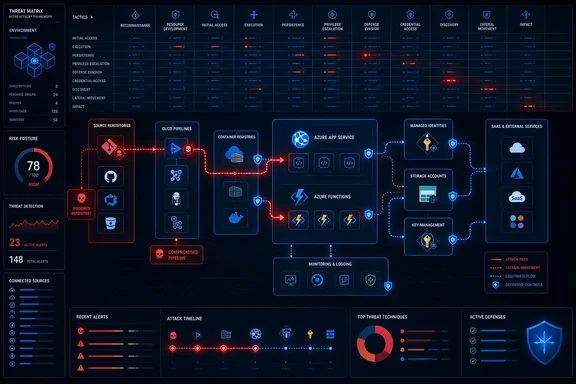
The framework, introduced by the Microsoft Security Research team on September 9, is organized around 11 attack tactics and covers cloud-specific paths including compromised container registries, poisoned repositories, serverless-trigger abuse, cloud-native terminals, staging-slot manipulation, workload identity token access, connector reuse, and denial-of-wallet attacks. Microsoft describes the work as aligned with the MITRE ATT&CK format, while MITRE’s own Cloud Matrix provides the wider catalog of cloud techniques that the new framework selectively maps into an application-hosting context.
This is not a new Defender feature, security advisory, or evidence of a newly disclosed campaign. It is a planning model. But it fills a real operational gap: the teams that own a public application, the subscription, the repository, and the identity tenant often use different dashboards and investigate different fragments of the same intrusion.
The matrix treats deployment as part of the attack surface
The strongest part of Microsoft’s model is its insistence that production application code is not the only thing defenders must protect. A compromised GitHub repository, container registry, publishing profile, deployment slot, or automation account can alter a cloud workload through an approved path, leaving conventional web-application controls looking at the wrong place.
That distinction matters for organizations using continuous deployment. A malicious commit placed in a connected repository can be built and pushed by the same pipeline that normally deploys legitimate releases. Rebuilding an affected app instance does not solve that problem if the pipeline keeps drawing from the altered repository, image tag, artifact store, or deployment package. The attacker’s persistence is in the trusted delivery source rather than in a process running on one compromised host.
Microsoft includes source-code modification under persistence for precisely this reason. A review of the published matrix also shows that it pairs this risk with concrete controls—signed commits, protected repository write access, enforced code review, image-assurance policies, and restrictions on deployment permissions. Those are familiar DevSecOps practices, but the matrix frames them as incident-response controls as well as preventive ones.
For Windows and Azure administrators, the operational consequence is straightforward: an investigation into an altered App Service or Function App must preserve and review deployment history, repository audit trails, image provenance, publishing-profile access, Azure Activity Log events, and role assignments. Restoring a clean ZIP package or rolling back a slot is only a partial response until the team establishes how the untrusted code reached the deployment path.
Azure App Service publishing credentials deserve renewed scrutiny
Microsoft’s examples repeatedly point to Azure App Service’s Kudu deployment and SCM endpoints, and the company’s documentation confirms why. App Service supports user-scoped deployment credentials that can work across applications in subscriptions where the account has access, as well as application-scoped credentials tied to a single app. Those credentials can be used with local Git or FTP/S publishing where basic authentication has been enabled.
Microsoft Learn says basic authentication is disabled by default for newly created App Service applications. That is a useful safeguard, but it is not a guarantee for established estates, migrated apps, or automation that retained legacy publishing methods. User-scoped credentials are especially worth identifying because they are associated with the user rather than a single application; resetting them can affect every app in that user’s accessible subscriptions that still permits SCM or FTP basic authentication.
The matrix classifies exposed administrative interfaces, deployment credentials, cloud-native terminals, and brute-force activity as related risks. Its mitigation guidance explicitly recommends removing username-and-password authentication from deployment endpoints and administrative interfaces where possible. Microsoft’s App Service deployment documentation separately recommends token authentication for the Kudu publishing API, while still allowing basic authentication with deployment credentials.
Administrators should therefore inventory App Service applications with SCM Basic Auth Publishing Credentials or FTP Basic Auth Publishing Credentials enabled. Where a legacy workflow genuinely requires them, access should be constrained through private networking or narrowly scoped network rules, credentials should be rotated, and telemetry for publishing-profile retrieval and unusual SCM activity should be retained outside the workload being protected.
Managed identity removes one secret—and raises the value of code execution
The matrix correctly highlights an uncomfortable cloud security reality: replacing connection strings with managed identities is usually the right design, but it does not make a compromised application harmless. It changes the attacker’s target.
Azure App Service and Azure Functions can use managed identities to authenticate to services such as Azure Key Vault, Azure Storage, and Azure SQL without embedding long-lived secrets in source code or app settings. Microsoft’s App Service security guidance recommends that approach and advises using Key Vault references for sensitive values rather than leaving them in application configuration.
Once an attacker obtains code execution inside the workload, however, the relevant question becomes what that workload identity can do. Microsoft’s matrix calls out access to workload identity credentials and access to connected cloud resources as privilege-escalation paths. In App Service, a process can request a managed identity token through the local identity endpoint exposed to the app environment; the token carries whatever Azure RBAC and data-plane permissions the identity has been granted.
This means least privilege has to be tested from the application’s perspective, not merely documented in an architecture review. A Function App that needs to read one blob container should not also be able to manage a resource group, retrieve every Key Vault secret, modify production slots, or invoke unrelated APIs. The matrix turns a broad identity-security principle into an incident question: after a web-shell, RCE, or malicious deployment, which resources can this app reach without asking for another credential?
Security teams should also avoid treating environment-variable exposure as a minor configuration issue. App settings, connection strings, diagnostic endpoints, and process-access permissions can expose credentials or resource names that help an intruder move beyond the original application. Microsoft’s guidance to use managed identities should be paired with strict RBAC, Key Vault access controls, and an explicit review of what remains injected into the runtime environment.
The published matrix is broader than the announcement’s technique catalog
There is one material discrepancy between Microsoft’s September 9 blog post and the associated web-hosted matrix. The announcement describes techniques across 11 tactics, but it does not discuss server-side request forgery, or SSRF, in its technique catalog. The published matrix does include SSRF under lateral movement and assigns it Microsoft’s internal technique identifier MS-TA7024, mapped to MITRE ATT&CK technique T1210.
That omission should not be dismissed as editorial tidying. SSRF is one of the clearest examples of why cloud web applications require a combined application-and-platform investigation. An input-validation flaw that persuades a server to make an outbound request can reach internal services that an external attacker cannot access directly. In cloud deployments, that may include private APIs, storage endpoints, management services, or metadata-related endpoints, depending on the platform configuration.
Microsoft’s matrix prescribes two controls for the SSRF case: validate and normalize outbound request targets, and restrict outbound traffic to approved domains or address ranges. In practice, a WAF can help block known malicious request patterns, but it cannot safely substitute for application-level URL validation and outbound egress restrictions. A workload with unrestricted outbound access remains capable of reaching far more than its public interface reveals.
The omission also reinforces a larger point about how to use the release. The blog is an introduction; the matrix is the working artifact. Teams should consult the matrix itself during threat modeling and detection engineering rather than converting only the examples in the announcement into a checklist.
MITRE alignment is useful, but this is Microsoft’s own overlay
Microsoft calls the framework MITRE ATT&CK-aligned, and that is fair as a description of its structure and its individual technique references. It should not be mistaken for a replacement for MITRE’s Cloud Matrix or a verbatim copy of it.
MITRE’s current Cloud Matrix divides activity across 12 tactics, including Stealth, Defense Impairment, and Exfiltration. Microsoft’s cloud web application model instead uses 11 columns, including Resource Development and Defense Evasion, and does not create a dedicated Exfiltration tactic. Its accompanying “About” page describes the framework more precisely as inspired from MITRE ATT&CK and intended to provide quick insight into cloud-web-application tactics, techniques, and procedures.
That design choice is defensible. A cloud web app threat model needs to emphasize application-specific surfaces such as Kudu, site extensions, deployment slots, event triggers, image registries, and reusable API connectors—concepts that would be diluted in a general cloud matrix. Still, defenders should preserve the MITRE technique IDs in their internal detections and case-management tooling where Microsoft supplies them. Doing so keeps local application-focused investigations connected to broader threat intelligence and cross-cloud reporting.
Start with the joins attackers exploit
The most productive use of the matrix is not to make a 35-item audit spreadsheet. It is to identify the joins between administrative domains: repository to pipeline, pipeline to production slot, app process to managed identity, app identity to data store, connector to third-party SaaS, and workload logs to the account where they are retained.
A focused first pass should establish a few facts:
- Production deployments should require protected branches, code review, approval gates, and traceable artifact provenance.
- App Service and function management endpoints should not retain unnecessary basic authentication or unrestricted public administrative access.
- Managed identities should have narrowly defined permissions, while secrets that remain necessary should move into a dedicated secrets-management service.
- Diagnostic logs should be centralized in a protected destination where the same compromised workload identity cannot silently reduce retention, redirect collection, or delete evidence.
- Serverless functions and web apps should have rate limits, concurrency limits, budgets, and spending alerts that turn denial-of-wallet from an open-ended billing event into a contained incident.
Microsoft’s matrix is most valuable when it changes ownership conversations. The application team cannot secure this class of workload by fixing code alone, and the cloud platform team cannot secure it by reviewing RBAC alone. A production web application is now a chain of code, deployment authority, runtime access, identity permissions, and cloud services. The first compromise often occurs in one link; the damaging consequence appears in another.
References
- Threat matrix: Mapping threats across cloud web applications Microsoft Security Blog · 2026-09-09T21:30:00+00:00