

SoCura Replaced Qlik Sense With Microsoft Fabric by Rebuilding Its Reports
In Microsoft's account, SoCura runs BI and reporting for several organizations, including Malteser Hilfsdienst. Its Qlik Sense environment had grown over years to several hundred reports used by different organizational units. Microsoft lists SoCura as a healthcare-sector organization in Germany with 50–999 employees.
Microsoft's story gives three reasons for leaving Qlik Sense: rising regulatory requirements, increasingly complex role and permission models, and growing maintenance work. Compliance reporting and data management were spread across different systems and data sources. Manual processes increased the risk of errors and slowed reporting cycles. KPIs, data lineage and transformation logic were barely documented, and knowledge sat with a small number of experts.
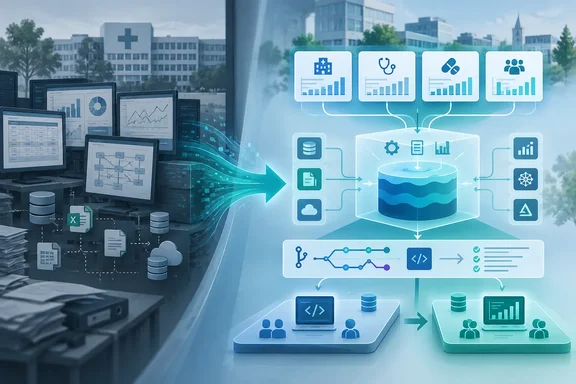
That last problem explains the approach SoCura took. According to Microsoft, SoCura did not technically migrate the existing reports. It redesigned and reimplemented all of the content, and gave KPI definitions, data models and transformation logic a common structure, end-to-end documentation and a single standard. Dataciders' method covered six phases: analysis of the old environment, architecture design, migration planning, data integration, governance implementation, and a phased rollout of new analytics capabilities.
Technology Record's shorter report says the same central things: Dataciders as partner, Qlik Sense replaced, hundreds of reports consolidated "under a single governance model." One point on independence: Technology Record describes itself as published with Microsoft's support and guidance. Its report and Microsoft's customer story are therefore close to a single source, not independent confirmation of each other. Nobody outside the project has published measurements of it.
The 70% and 80% Figures in the SoCura Fabric Case Measure Different Things
The two headline numbers are easy to mix up, and even Microsoft's own page labels them inconsistently.
| Figure | What Microsoft's story body says it measures | What it's attributed to |
|---|---|---|
| Up to 70% | How quickly data becomes available for reporting (Technology Record calls this "data wait times" and "data retrieval") | Data pipelines |
| Up to 80% | Performance of transporting data from source to report | "Well-designed notebooks and smart centralization" |
Microsoft's page title says SoCura "boosts data performance by up to 80%." Its summary tiles say "data retrieval accelerated by up to 70%" and "data pipeline performance accelerated by up to 80%." The body text, however, credits the 70% gain to data pipelines and the 80% gain to notebooks. Readers repeating these numbers should stick to the body's wording: faster data availability (70%) and faster source-to-report transport (80%).
Neither source gives a baseline, absolute times, a measurement period, a workload breakdown or a calculation method. "Up to" also means the figures are best cases, not averages. They do not show that every SoCura report is 80% faster, and they don't support predictions for other organizations moving from Qlik Sense.
The performance gains also can't be credited to Fabric alone. SoCura changed its platform, rebuilt its data models, standardized its transformation logic and reworked its pipeline design all in one project. Any of those could explain part of the improvement. The record doesn't allow a split between what the platform delivered and what the redesign delivered.
OneLake, Data Factory and Power BI Do the Work; Purview Handles Governance
Both accounts list the same core Fabric workloads: OneLake, Data Factory, Data Engineering, Data Warehousing and Power BI. They say SoCura uses them to store data centrally, simplify integration, optimize transformations and deliver reporting and analytics. Microsoft's product list for the project also includes Azure Data Factory and Microsoft Purview.
Microsoft says a deciding factor was being able to run different workloads on one platform. SoCura also valued the integrated architecture, the fit with its existing Microsoft environment, unified governance, scalability, and support for future AI work. That reasoning matches the problem it had: an environment where logic and documentation were scattered across tools and people.
Governance is where the two accounts differ most in detail. Technology Record calls the platform "compliance-ready." Microsoft adds that Fabric is paired with Microsoft Purview for data governance and with role-based security concepts in Microsoft 365. Microsoft also says business teams, BI teams and management now share a single source of truth, and that self-service reporting is possible without putting governance at risk.
Neither source names a regulation, certification, audit result or compliance test. "Compliance-ready" describes how the platform was designed and what the customer says it gained. It is not a regulatory finding. Thomas Wilhelm Krueger, senior project manager at SoCura, said the governance and compliance structures provide "the framework for secure, compliant handling of our enterprise data." That is the customer's own assessment.
Git Integration and Separate Dev and Prod Workspaces Are the Practical Story in SoCura's Fabric Build
The most transferable detail is in a short paragraph of Microsoft's story about development operations. SoCura uses Fabric Git integration for version-controlled development of all Fabric artifacts. It uses Custom Environments to centralize dependencies, libraries and notebook configurations, and it keeps development and production separate for a structured deployment process. Given that SoCura's old problem was undocumented logic held by a few experts, this is the part that most directly addresses it.
Microsoft's Fabric documentation explains how these features fit together. Fabric provides two tools for different jobs. Git integration syncs a workspace to a Git repo and manages incremental changes, team collaboration, and commit history, and deployment pipelines deploy a workspace across development, test, and production environments. For notebooks, Microsoft advises teams to use deployment pipelines to promote notebook changes across stages such as Development, Test, and Production, and validate updates in earlier stages before promoting them to production.
Custom Environments can also be version-controlled. According to Microsoft Learn, when a workspace is connected to a Git repo, Fabric serializes the environment's libraries and Spark compute settings (including the Spark runtime) into files, and the automatic pipeline can include the environment items to streamline the recreation process. Git-connected notebooks that are committed together with their attached environment stay bound to it when synced to another workspace. Microsoft recommends managing notebooks and their dependent environment in the same workspace, and using Git to version control both notebook and environment items.
Teams copying this pattern should know one limit. Git tracks definitions, not data. In lakehouses, tables (Delta and non-Delta) and folders in the Files section aren't tracked or versioned in git; data in these items is always preserved during git operations. Promoting a lakehouse to a new stage without a dependency mapping has a specific consequence: a new empty lakehouse with the same name is created in the target workspace, and notebooks and Spark Job Definitions are remapped to reference the new lakehouse. The notebook documentation also notes that the Environment Resources folder and integration with deployment pipelines and public APIs are not currently supported.
Microsoft's story does not say whether SoCura connected Fabric to GitHub or Azure DevOps, whether it has a test stage between development and production, or how it handles environment-specific connection settings. Microsoft also reports no measured effect of these practices on delivery speed or reliability. They are best read as the engineering setup that made the rebuild manageable, not as a cause of the percentage gains.
SoCura's Agentic AI and Self-Service Plans Are Still a Roadmap
Both accounts end with SoCura's plans. The company intends to add advanced analytics, AI-powered insights, agentic AI, broader self-service reporting and more data domains on Fabric. Microsoft adds that governance and automation processes will keep developing.
None of these has been delivered or measured. The AI plans are credible mainly because of the groundwork already done: standardized KPIs, documented lineage and transformation logic, and a governed single source of truth are the preconditions for AI tools that answer business questions. Tools that query inconsistent KPI definitions give inconsistent answers. That reasoning is this article's inference; neither source says how SoCura will build or govern agentic features.
Self-service reporting is further along. Microsoft says it is already possible on the platform within governance limits, and that expanding it is the next step.
What This Means for Teams Weighing a Qlik-to-Fabric Migration
For organizations comparing Qlik Sense with Microsoft Fabric, the SoCura case supports one decision more strongly than the others: plan a rebuild, not a like-for-like report conversion, if your KPI definitions and transformation logic are poorly documented. The speed figures can show that improvement is possible. They cannot serve as a benchmark in a business case, because nobody has published how they were measured.
Organizations already in the Microsoft 365 stack, with Purview in place or planned, have the closest match to SoCura's setup. Teams whose Qlik environment is small, well documented and stable have less reason to act on this case, since it describes an environment whose problem was growth and scattered knowledge.
- SoCura reports up to 70% faster data availability for reporting (attributed to data pipelines) and up to 80% faster source-to-report data transport (attributed to notebooks and centralization), without a published baseline or method.
- SoCura redesigned and reimplemented all of its several hundred Qlik Sense reports, with standardized KPIs, data models and transformation logic, instead of converting them directly.
- The core stack is OneLake, Data Factory, Data Engineering, Data Warehousing and Power BI, with Microsoft Purview and Microsoft 365 role-based security for governance.
- Fabric Git integration, Custom Environments and separate development and production workspaces handle version control and deployment. Git tracks item definitions only, so data and lakehouse contents must be handled separately in each stage.
- "Compliance-ready" is SoCura's description of its design, and neither account names a certification or audit outcome.
- The agentic AI, AI-powered insights and expanded self-service features are future plans, not delivered results.
The SoCura project shows what a Fabric migration looks like when the main problem is undocumented reporting logic spread across hundreds of reports: rebuild the models, define every KPI once, and put every artifact under version control before promising AI features. The performance numbers make a good headline, but they are best cases without supporting data. What SoCura can actually demonstrate at this point is the governed, Git-backed platform, which is also what its agentic AI and self-service plans will depend on.
References
- SoCura boosts data performance by up to 80% with Microsoft Fabric | Microsoft Customer Stories microsoft.com
- Notebook source control and deployment - Microsoft Fabric | Microsoft Learn learn.microsoft.com
- Git integration and deployment pipelines - Microsoft Fabric | Microsoft Learn learn.microsoft.com