

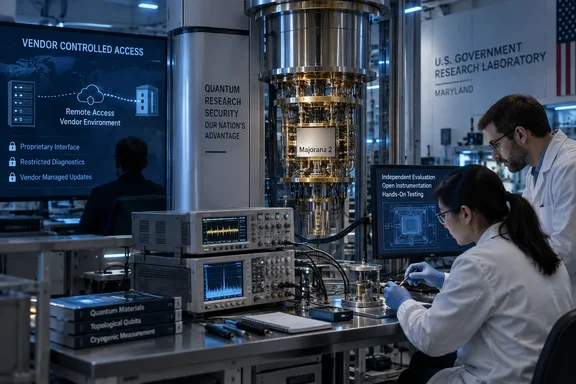
Microsoft's Maryland Quantum Center Moves DARPA From Remote Login to the Lab Floor
According to The Quantum Insider, which drew on a Microsoft blog post by Charles Tahan, a partner at Microsoft Quantum, the 15,000-square-foot center combines Microsoft's proprietary research space with laboratories for partner companies, a DARPA testing area and a hands-on training lab. Microsoft says it built the project with the university, Maryland's state-backed Capital of Quantum Initiative and industry partners. The state bought and renovated the Discovery Center building. Microsoft, UMD and the initiative designed the quantum facility inside it.
Reuters, reporting separately, explains why the site matters more than its floor plan suggests. Until now, DARPA has evaluated Microsoft's technology remotely, accessing machines in Redmond, Washington, and Europe. Reuters says the Maryland delivery marks a shift to physical access in a dedicated DARPA space where its experts can load hardware and run it through their own boot sequences. There is a real difference between logging into a vendor's machine and running your own startup and test routines on hardware sitting in your own space. The second lets evaluators control more of the conditions themselves.
The system is also meant to be upgraded in place. Zulfi Alam, corporate vice president of Microsoft Quantum, told Reuters that DARPA will start with the Majorana 2 chip, but that the system in Maryland will be built to swap in future chips Microsoft is developing. The Maryland installation is therefore designed to host each new generation of Microsoft's hardware as it arrives.
The center had been announced a year earlier. When Gov. Wes Moore revealed the project in September 2025, the governor's office said the state's DARPA agreement would unlock up to $100 million in federal funds to match the state's quantum computing investments—some of which will be used to invest in Microsoft's new quantum center. That agreement, signed in April 2025, set up the "Capital Quantum Benchmarking Hub" at UMD. The opening fits a plan laid out in advance, with the state, the university and a federal testing agency all involved.
Majorana 2 Goes Under Outside Scrutiny for the First Time
Majorana 2 is Microsoft's second-generation topological quantum chip. The company's hardware blog, written by Technical Fellow Chetan Nayak, says the chip swaps the aluminum superconductor used in Majorana 1 for lead. It also changes the semiconductor active region to indium arsenide and indium arsenide antimonide. Microsoft says the new materials more than double the topological gap, the energy barrier that protects the qubits from environmental noise.
Microsoft's performance claims are specific. It reports mean qubit lifetimes of more than 20 seconds, sometimes over a minute, compared with 1 to 12 milliseconds on the aluminum-based Majorana 1. It calls this a 1,000-fold reliability improvement. These figures come from Microsoft's own blog and technical paper. The DARPA arrangement exists so that someone other than Microsoft can check numbers like these.
The design itself explains why outside checking is harder than usual. Microsoft describes its qubits as tetrons: pairs of superconducting nanowires with Majorana zero modes at their ends. The qubit stores information in parity, meaning whether a wire holds an even or odd number of electrons. That is a very different approach from the superconducting-circuit and trapped-ion qubits used by most of the industry. Microsoft argues that topological qubits naturally have low error rates, are small and can be controlled digitally. Those properties, if confirmed, would reduce the heavy error-correction overhead that other designs face.
The Quantum Insider says the chip has drawn skepticism from parts of the scientific community, and independent DARPA testing is framed as a step toward validating the approach. That skepticism is the most important background here. Microsoft's topological program has faced doubts before, and handing hardware to a government test team with its own procedures is a strong answer to them. But the answer only counts once results come back. So far nobody, including DARPA, has published findings from the Maryland system.
Alam described the arrangement to Reuters in terms of discipline more than validation: "It enforces a certain amount of engineering rigor that scientific teams normally do not have," he said. That is a company executive's view. It is still useful because it shows how Microsoft wants the arrangement read: as a check on its engineering as the program moves toward a product, not as an endorsement it has already won.
DARPA's US2QC Asks Whether Machines Are Worth Their Cost by 2033, Not Whether They Work
The testing takes place under DARPA's Underexplored Systems for Utility-Scale Quantum Computing program, known as US2QC. US2QC is part of the agency's larger Quantum Benchmarking Initiative (QBI). DARPA's February 2025 announcement defines the bar clearly. QBI aims to verify whether any quantum approach can reach "utility-scale operation", meaning its computational value exceeds its cost, by 2033.
That definition is an economic one. Alam told Reuters that DARPA's key evaluation metric is whether the value of the computation performed by a quantum system outweighs the system's cost. A chip with long-lived qubits could pass a physics test and still fail this one. The question is whether the full system, with its cryogenics, control electronics and error correction, produces results worth what it costs to build and run.
In February 2025, DARPA said it had chosen Microsoft and PsiQuantum for the Validation and Co-Design stage of US2QC after analysis by an independent verification and validation team. It described Microsoft's approach as a compact superconducting topological-qubit architecture and PsiQuantum's as silicon photonics. DARPA's QBI program manager, Joe Altepeter, said at the time that the next step was to "conduct government testing of components and hardware" and assess prototype performance. On-site hardware in Maryland puts that stated plan into practice.
Microsoft says the US2QC evaluation team includes people from the Air Force Research Laboratory, the Johns Hopkins University Applied Physics Laboratory, and the Los Alamos, Oak Ridge, Lawrence Berkeley and Lawrence Livermore national laboratories. Their work covers hardware, control systems, software and applications.
There are two dates in this story, and they are easy to confuse. Microsoft's own roadmap aims for a scalable, practical quantum computer by 2029. The company says Majorana 2's progress cut that timeline in half, and Reuters notes Microsoft has said it plans to have commercial quantum systems ready by 2029. DARPA's 2033 date is separate: it is the deadline by which the agency wants to know whether any approach can reach utility scale. The first is a vendor target. The second is an independent benchmark. Neither has been met.
The AMD, Intel and Fermilab Makerspace Targets Quantum's Hardware Skills Gap
The part of the center likely to reach the most people is its training lab. Microsoft describes a quantum hardware makerspace for students, researchers, educators and people moving into quantum from other technical fields. The center also includes a quantum hardware makerspace with partners AMD, Intel, IQM, Fermilab, Riverlane and Quantum Motion. Microsoft's own list also names Bluefors, a supplier of cryogenic equipment. Microsoft says the partners will contribute hardware access and technical expertise.
Microsoft sets the makerspace apart from quantum courses that focus mainly on theory or software. Participants are expected to work through practical problems across the hardware stack: choosing designs, deciding what to measure, and diagnosing unexpected experimental results. That matches how quantum systems are actually built. They depend on cryogenic hardware, lasers, control electronics and complicated calibration routines, and these skills are hard to learn from a cloud interface.
A separate strand involves Fermilab's Quantum Instrumentation Control Kit (QICK), a control-electronics platform. Microsoft says it is working with Fermilab to expand the use of quantum-control technologies across hardware platforms. With UMD, the partners are exploring how QICK could be used in teaching. This is described as exploratory work, with no implementation date.
Microsoft has not said how many people the makerspace will take, how courses will be scheduled, how anyone applies, or what each partner is contributing. It says it hopes the Maryland makerspace becomes a model that can expand elsewhere as course material develops. For now it is a stated program at one site.
Measurement-Based Computing, Magne and the QDK Complete Microsoft's Multi-Vendor Pitch
Microsoft also plans an annual workshop series on measurement-based quantum computing. In this approach, the results of measurements help determine the next operations in a calculation. It is closely tied to Microsoft's hardware. Microsoft's Majorana 2 blog explains that in its topological design, basic operations are carried out through parity measurements, each giving a 0 or a 1. Computations are broken into sequences of those measurements plus an extra step called "magic state" preparation. The workshops will focus on faster and more accurate measurements, error-correcting codes, and verification and validation methods.
Speed matters here. In an error-corrected machine, the system has to detect an error and decide how to respond before the error spreads through the calculation. Microsoft is also funding its first quantum postdoctoral positions at UMD, in research areas of mutual interest to the company and faculty. It has not said how many positions there are or how much the funding is worth.
The center also supports a strategy that does not depend on Majorana alone. Microsoft says the facility has room for future prototypes and for companies that want to connect quantum hardware or components to its software platform. Hardware builders could integrate machines there, while developers and end users could explore applications. Microsoft describes its Azure-based quantum platform as including developer tools, a real-time operating system for quantum computers and support for multiple qubit technologies.
Two items from the announcement come with timing caveats. Microsoft says it is working with Atom Computing on Magne, a neutral-atom machine that uses Microsoft's error-correction technology. Magne is a 50-logical-qubit machine planned with Atom Computing for operation in Denmark by early 2027, at the QuNorth site. A logical qubit is a group of physical qubits combined through error correction into a more stable unit of computation. Microsoft also says its Quantum Development Kit (QDK) now has a private-preview analytics library with algorithms and data-science tools for large-scale data analysis. "Planned" and "private preview" are the actual status of these items. Neither is a shipped product.
What this means for you
Most WindowsForum readers do not need to do anything. The announcement affects research infrastructure and government evaluation, not Windows, Microsoft 365 or any product that is generally available on Azure. The people with a real decision to make are those tracking Microsoft's quantum roadmap for strategy or procurement, and those who might use the Maryland center directly.
- IT leaders weighing Microsoft's quantum claims should wait for DARPA or its partner labs to publish findings from the Maryland system. Right now, all performance figures for Majorana 2 come from Microsoft.
- Microsoft's 2029 target and DARPA's 2033 benchmark are different things. Neither shows that a commercially useful, fault-tolerant quantum computer exists today.
- Developers already using the Quantum Development Kit should treat the new analytics library as a private preview, with the access limits and possible changes that implies.
- Hardware startups and component makers wanting to integrate with Microsoft's quantum software stack now have a physical site for it in College Park, Maryland. Microsoft has not published an application process.
- Students, educators and engineers changing careers near the Washington, D.C. area should watch for makerspace enrollment details. Microsoft has not yet announced capacity, schedules or eligibility.
- Anyone modeling the Magne neutral-atom machine into their plans should treat early 2027 in Denmark as a planned date, not a confirmed delivery.
Microsoft has spent years asking people to trust a qubit design that few outside the company have examined closely. The Maryland center changes that: DARPA's evaluators now have Majorana 2 hardware in their own space, running their own boot sequences, and the system is built to take Microsoft's future chips as well. Whatever DARPA's teams find will carry more weight than any figure in a Microsoft blog post, because they will be judging it against a cost-versus-value test with a 2033 deadline.