

Where the announcement came from
The primary source is a guest post on the Rust Foundation site, dated September 10, 2026. It was written by Victor Ciura, a principal engineer on the Rust tooling team in Microsoft DevDiv/CoreAI. Linuxiac covered it on October 3, so this isn't breaking news. Other outlets ran it in mid-September. That makes it a good moment to separate what Microsoft actually said from what commentators have added since.
One point is easy to miss. "Tier-1" is Microsoft's internal engineering label. It is not a Rust Project platform-support tier, so nothing changes in the official Rust target tiers.
What Tier-1 means in practice
Microsoft describes a "paved path" for internal teams, from local development through to production. The post lists these parts:
- Secure supply-chain builds of
rustc, the standard library and associated tools. - Productive developer tooling and integration with local development and production pipelines.
- Shared quality and compliance workflows.
- Compliance with the Security Development Lifecycle (SDL) requirements all Microsoft software must meet.
- Lifecycle coverage that includes acquisition, deployment and long-term support.
A Medium write-up of the announcement puts the practical effect this way: teams no longer have to fight the organization to use Rust. That is commentary, not Microsoft's wording. It does fit the picture of infrastructure that used to be assembled team by team now being provided centrally.
Microsoft says Rust is already used across firmware, drivers, kernels, hypervisors, microservices and applications. The post gives no usage totals for those categories.
The technical centerpiece: rustc_codegen_utc
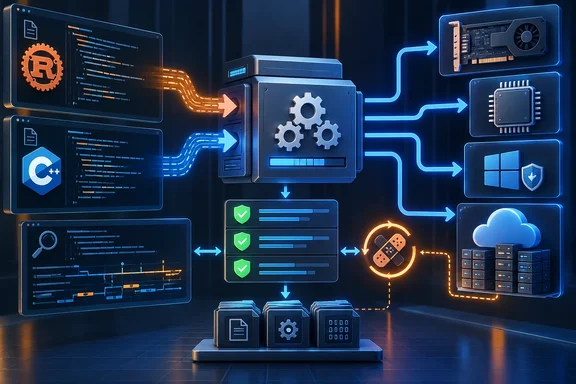
rustc_codegen_utc is an alternative code-generation backend for rustc. Microsoft puts it in the same architectural family as rustc_codegen_llvm, rustc_codegen_gcc and rustc_codegen_cranelift. It connects the compiler's shared machinery to the backend used by MSVC, which Microsoft calls "UTC".
Microsoft lists the capabilities this is meant to deliver:
- Compatibility with Windows tooling and the platform ABI.
- Binary hardening and code-security features.
- Post-link compliance, analysis and servicing, including Hotpatch.
- Rust/C++ interop in hybrid projects.
- Cross-language inlining, optimization and sample profile-guided optimization (SPGO).
- Debugging and crash-dump analysis.
- Profiling, diagnostics and coverage.
The argument is economic as much as technical. MSVC and Windows keep adding code-generation, security, diagnostic and servicing features. Without a shared backend, each one would need a parallel Rust implementation. With it, those investments land on a common foundation for both languages.
The post also says that on other platforms, a hybrid project that builds its C++ with Clang can already share LLVM with Rust. rustc_codegen_utc creates the same shared-backend opportunity for Windows-native C++ projects built with MSVC.
Maturity and adoption claims
Microsoft says the backend has been production-ready since early 2026 and self-hosted since Rust 1.90. Linuxiac reads this as the backend having been able to compile itself since Rust 1.90. That does not mean every Microsoft Rust project uses it.
The post says more than 100 Microsoft project repositories build with it today, and that the rollout continues weekly. It gives no denominator, no breakdown by team or product, and no benchmarks. These figures come from Microsoft itself in a guest post, not from an independent audit.
What this is not
- Not a replacement mandate. The post says C++ still dominates after decades of development. It expects many systems to combine both languages for years.
- Not a finished interop story. Microsoft says codegen, ABI, exception handling and post-link tooling are only half the problem. Language-level interop, FFI contracts, bindings, semantic differences and build systems are still being worked on internally and across the industry.
- Not a public release. Nothing in the post announces a public release, a timetable, or outside availability of the backend or the internal pipeline. One secondary report, from vpodk, says Rust compiler forum discussions suggest Microsoft intends to upstream test and backend infrastructure first. It concludes that a public release may be some way off. I could not confirm that from the primary source, so treat it as unverified.
Some secondary coverage goes further than the primary source. Web And IT News cites Microsoft's stated ambition to remove C and C++ from its codebases by 2030. Other pieces quote a "70 percent of CVEs" memory-safety figure. Neither appears in the Rust Foundation post. They are background from Microsoft's earlier public statements and industry reporting, not part of this announcement. Also note the dates: one secondary article says September 11, while the Foundation post is dated September 10.
Why Windows developers should care
Microsoft is putting its weight behind one proposition. Rust code can go through the same compiler backend, hardening and servicing pipeline as C++ on Windows. For driver, firmware and kernel work, that is the real obstacle to adoption. A language can be memory-safe, but if it can't be debugged with the usual tools, hotpatched, or profiled alongside C++, large teams won't ship it.
For outside developers the effect is indirect for now. Microsoft's Rust investment is likely to show up first in Windows and Azure components. Third-party developers may eventually benefit if the backend or its test infrastructure reaches the wider Rust ecosystem. That is inference, not an announced plan.
The takeaway
Microsoft is formalizing Rust as an internally supported production language and building shared Windows-native infrastructure so Rust and C++ can evolve together. The 100-plus repositories and the early-2026 readiness date are Microsoft's own claims. The caveats in the post itself matter most: C++ remains entrenched, hybrid systems will persist, and the hard interop work continues.
References
- Rust Is Now a Tier-1 Programming Language at Microsoft - Linuxiac Linuxiac · 2026-10-03T15:10:56+00:00
- Microsoft Tier-1 Rust Language Integration vpodk.com
- Guest Post: Rust Is Tier-1 Language at Microsoft rustfoundation.org