

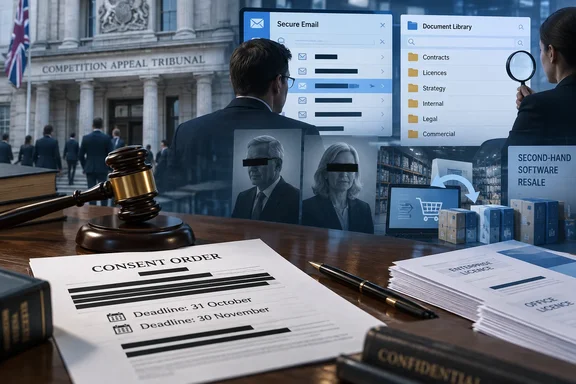
The Register first reported the new disclosure directions. The underlying order, now published by the Competition Appeal Tribunal, confirms the core facts and sets deadlines of October 31 and November 30, 2026. It also shows why this procedural development matters: Microsoft’s broader liability trial remains stayed while it seeks permission to appeal to the UK Supreme Court, but the Tribunal has allowed the disclosure and confidentiality fights to proceed anyway.
For enterprise customers with old Windows and Office estates, this is a case about more than a reseller’s ability to trade surplus licences. ValueLicensing alleges Microsoft used discounts attached to its “From SA” programme—an offer for customers moving from Software Assurance-backed perpetual licensing to subscription services—to prevent those customers from reselling unused perpetual licences. Microsoft denies the competition-law allegations.
The presentation is important, but its contents remain unknown
The newly central document is titled “Second-Hand Software Presentation,” dated June 2013 and disclosed by Microsoft on December 22, 2025. Neither the Tribunal’s September order nor the public court judgments reveal its contents. Readers should therefore be cautious with the suggestion that the document itself is a smoking gun.
What the order does establish is narrower and still serious: Microsoft must provide a verified witness statement explaining when, where, and by whom the presentation was first located for this litigation; who within Microsoft knew about it and when; when the company’s in-house legal team became aware of it; and why it was not identified and disclosed earlier as a Known Adverse Document.
That language does not amount to a judicial finding that the presentation is adverse to Microsoft on the merits. It means the disclosure process must now address whether it should have been identified as a document materially damaging to Microsoft’s own case or supportive of ValueLicensing’s. The distinction matters in litigation. A document may be highly relevant without resolving liability, and the Tribunal has not publicly assessed the presentation’s substance.
Microsoft must also make reasonable efforts to contact former executives Jean-Philippe Courtois, Kevin Turner, and Joe Matz, using their last known contact details. It must make enquiries of five more people ValueLicensing will select from a previously identified list, and of the person or people from whom the presentation was obtained. “Reasonable endeavours” is not a guarantee that every former executive will produce records, but it expands the inquiry beyond systems Microsoft still directly controls.
The search order reaches Microsoft’s licensing decision-makers
By November 30, Microsoft is required to provide electronic inspection of responsive material from the mailboxes and SharePoint—or equivalent repositories—of Randy Levitt, Carlos Cruz, Richard Chin, Ryan Baker, Courtois, Turner, Matz, and Jane Gilson. The period runs from July 3, 2012 through June 1, 2020, encompassing the year before the presentation and much of the period in which enterprise subscription migration accelerated.
The specified searches are broad without being a free-for-all. They combine phrases such as “second hand,” “used software,” “used license,” “antitrust,” “competition,” “subscription,” “risk,” “incentive,” “exhaustion,” “resellers,” and “trade-in,” including proximity searches designed to find discussions that connect used licences with commercial strategy. They separately target names and terms including UsedSoft, ValueLicensing, Discount Licensing, Peter Schneider, Preo, Relicensing, and “value license.”
The search design is meaningful because it is aimed at the alleged mechanism, not merely the word “ValueLicensing.” ValueLicensing’s claim concerns whether discounts and contractual terms made a customer’s choice economically conditional on retaining or surrendering perpetual licences rather than selling them. Internal discussions of resale-market “risk,” subscription incentives, inventory, enforcement, or “go dark” arrangements could help establish how Microsoft understood the commercial consequences of those terms. Equally, documents could support Microsoft’s stated position that restrictions were justified by intellectual-property protection, compliance concerns, ongoing service costs, or the economics of discounted upgrades.
Microsoft must disclose further documents concerning the same or similar issues addressed in the 2013 presentation, including material on its creation and use. Each tranche comes with a disclosure statement verified by a statement of truth, and Microsoft must update ValueLicensing on the investigation’s progress at least every 21 days.
Confidentiality will no longer be a blanket shield
The Tribunal also removed confidentiality designations from 11 documents identified in an appendix to the order. That does not make the entire case file public, nor does it prevent Microsoft from seeking confidentiality for genuinely sensitive material found in the new search.
It does impose a more exacting process. Any confidentiality claim for the new disclosure must be made document by document, limited to the precise words, figures, or passages said to be sensitive, and supported by specific reasons. The order expressly bars blanket or default “Restricted” or “Confidential” labels.
For IT buyers, this is the part that could eventually produce useful visibility into practices that are typically hidden behind negotiated enterprise agreements and non-public pricing. Large organizations evaluating whether to retain, retire, reassign, or resell perpetual Windows and Office licences often confront terms that are bespoke, commercially sensitive, and difficult to compare. Publicly available material from this case may clarify historical policy and decision-making, but it will not automatically disclose a universal Microsoft price list or create a one-size-fits-all right to transfer licences.
The same order preserves ValueLicensing’s ability to challenge the adequacy of Microsoft’s explanation for earlier privilege redactions. It also postpones, rather than decides, an application for a statement from Microsoft Deputy General Counsel for Litigation Cynthia Randall or another suitable officer.
Microsoft already lost the preliminary copyright fight
This disclosure dispute is proceeding after Microsoft’s more fundamental copyright argument failed at two stages. In November 2025, the Competition Appeal Tribunal decided preliminary issues in ValueLicensing’s favor. The Tribunal held, on the facts before it, that the online first sale of perpetual Windows and Office licences could exhaust Microsoft’s relevant distribution and reproduction rights. It also rejected Microsoft’s argument that embedded non-program content such as graphics, templates, or fonts prevented that result in these products.
The Court of Appeal dismissed Microsoft’s appeals on July 7, 2026. Its ruling confirmed that copyright issues could be handled within the Competition Appeal Tribunal case and upheld the preliminary findings that Microsoft could not use the structure of the enterprise agreements or included non-program works to defeat resale in the circumstances examined.
That ruling did not decide the central competition claim. ValueLicensing still must prove that Microsoft’s contractual and commercial conduct unlawfully stifled the supply of pre-owned licences and caused recoverable loss. Microsoft can still contest market definition, competitive effects, causation, damages, and its asserted justifications. The Court of Appeal’s decision also rests on the law applicable to the UK and European Economic Area during the claimed period, which runs from January 1, 2014 through December 31, 2022.
The result should not be read as a green light for cheap consumer product keys sold online. This case concerns perpetual Windows and Office licences acquired under enterprise arrangements, and it turns on facts including the original sale, the licence type, and whether the original user continues using its own copy after resale. Microsoft 365 subscriptions, retail consumer licences, OEM licences tied to hardware, counterfeit keys, and account sales are different propositions.
The liability trial is still paused
Microsoft told The Register it had no comment on the consent order. ValueLicensing chief executive Jonathan Horley said the directions were the result of years of work to obtain appropriate disclosure and would move the liability trial closer.
The immediate calendar is more concrete than the trial date. By October 31, Microsoft must file the verified statement explaining the discovery history of the 2013 presentation and the expanded search effort. By November 30, it must complete the designated repository searches, disclose responsive materials and related documents, and report the outcomes of its former-executive inquiries.
The liability proceedings remain stayed pending the outcome of Microsoft’s Supreme Court permission effort, except for these disclosure and confidentiality steps. The next consequential development will therefore be the material Microsoft produces—or says it cannot produce—by the November deadline, rather than a final ruling on whether its enterprise licensing practices unlawfully constrained the secondhand market.
References
- Judge orders Microsoft to spill internal docs and scour execs' comms in secondhand licensing case The Register · 2026-09-17T08:30:00+00:00