

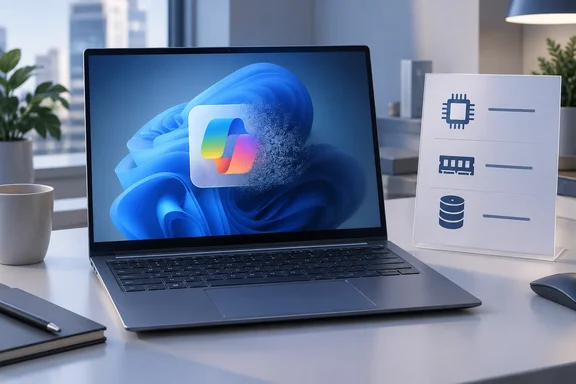
The shift was reported by Windows Central's Zac Bowden on September 24, 2026. His evidence is on-the-record comments from a senior Microsoft Surface executive and a Qualcomm executive, plus the fact that the name is missing from 2026 Surface product names. Microsoft has not formally announced that it's retiring the name. Its own Windows 11 specification pages still define Copilot+ PCs and list their requirements. In practice, though, the company's product marketing has already moved on.
Surface Chief Brett Ostrum Confirms 2026 Surface PCs Aren't "Copilot+ PCs"
The clearest evidence comes from Microsoft itself. Asked about the missing branding on recent Surface hardware, Surface corporate vice president Brett Ostrum told Windows Central that "these are not called Copilot+ PCs." He added that they meet all the requirements of Microsoft's earlier Copilot+ bar, and that the company still leans on a story about AI running on the device itself ("AI on the edge") alongside the cloud.
Bowden also noted that none of the Surface PCs launched in 2026 include the Copilot+ PC moniker in their product names, unlike the Surface PCs that launched in 2025 and before. Now, you have to go digging to find any mention of Copilot+ compatibility in specification sheets.
Others spotted this months earlier. In June, Windows Latest reported that Microsoft announced the new Surface Laptop Ultra powered by NVIDIA's RTX Spark platform, yet during the reveal, the company never mentioned Copilot+ PC branding at all. The same outlet said the Surface RTX Spark Dev Box also lacks any Copilot+ PC badge. A later Windows Central piece added that the webpage for the Surface Laptop Ultra fails to mention "Copilot+ PC" at all. The new Surface Pro 12 and Surface Laptop 8 that were announced earlier this month are Copilot+ PCs, but the branding is not featured heavily by Microsoft.
The timeline is consistent. Through the first half of 2026 the label moved off Surface product names and launch stages and into the fine print. Ostrum's comment now confirms that was a deliberate choice.
Qualcomm Says Copilot+ Experiences Will Carry On Without the Name
Qualcomm helped launch the category in 2024 with its Snapdragon X chips, and it describes the change the same way. Kedar Kondap, Qualcomm's senior vice president of compute, told Windows Central that the Copilot+ name existed to define a class of devices that meet a set performance bar so they could run features on the NPU. An NPU (neural processing unit) is a chip dedicated to AI work. In Kondap's words, the industry is now "offering the same experiences, probably without just using [Copilot+ PC] terminology now."
Kondap used a 45 TOPS NPU as his example. TOPS means trillions of operations per second, a rough measure of how much AI work a chip can do. Don't read 45 TOPS as the cutoff, though. Microsoft's official requirement is an NPU capable of at least 40 TOPS. The first Snapdragon X chips were rated at 45 TOPS, which is likely where his number comes from, but the published minimum is 40.
Bowden also pointed out that NVIDIA has stayed away from the Copilot+ name for its RTX Spark platform, even though, in his words, all RTX Spark PCs meet the Copilot+ specification bar. He suspects that's deliberate. Windows Latest saw it the same way, arguing that RTX Spark, on the other hand, immediately communicates something more tangible: local GPU-powered AI acceleration.
One detail readers can check against Microsoft's own documentation: the current Windows 11 specifications page lists the processors that qualify for Copilot+ as AMD Ryzen AI 300 and 400 series, Intel Core Ultra 200V and 300V series, and Snapdragon X series. NVIDIA's RTX Spark isn't on that list. So the claim that RTX Spark machines meet the bar comes from Windows Central, not from Microsoft's published list. If Copilot+ eligibility matters for a purchase, that gap is worth knowing about.
The Copilot+ Hardware Floor Still Exists in Microsoft's Windows 11 Specs
The label may be disappearing from marketing, but the definition hasn't gone anywhere. Microsoft's Windows 11 specifications page still describes Copilot+ PCs as a class of Windows 11 AI PCs with more memory, more storage, and an NPU capable of more than 40 TOPS. On top of the normal Windows 11 requirements, a Copilot+ PC needs:
- A compatible processor or system-on-a-chip with an NPU rated at 40 TOPS or more (currently AMD Ryzen AI 300/400, Intel Core Ultra 200V/300V, or Snapdragon X series).
- At least 16 GB of DDR5 or LPDDR5 memory.
- At least 256 GB of SSD or UFS storage.
Microsoft also notes that individual features, apps and add-on hardware can have their own requirements, and that these can change.
The most useful line on that page for buyers is the one about machines that almost qualify. Microsoft says some Windows 11 PCs have a 40+ TOPS NPU but miss the other requirements; for example, a machine with less than 16 GB of RAM or less storage is not a Copilot+ PC. Those machines can still run local AI work in compatible apps. But to get the Copilot+-only features, such as improved Windows search and Click to Do, you need a PC that meets every requirement.
This is why losing the label is a real inconvenience. A laptop can have an NPU fast enough for Copilot+ and still miss out on the exclusive features because of how it's configured. A clear "Copilot+ PC" badge used to flag that difference. Without it, you have to check the memory and storage yourself.
Microsoft's Build 2026 Pivot Toward GPUs and Lower-Memory PCs
The branding retreat fits a broader shift in how Microsoft talks about AI on Windows PCs. A report on Build 2026 carried on MSN said Microsoft still heavily promoted AI at this year's Build conference, but it neglected to mention its AI-first PC hardware brand. According to that report, Microsoft CEO Satya Nadella quickly dismissed Copilot+ PCs at the start of his keynote, telling developers that "you now have the full scope of GPUs that you can get to" when writing AI software targeting Windows ML. Windows ML is Microsoft's framework for running AI models locally on Windows.
The same report tied part of the change to memory costs and competition. It said the high price of RAM and external industry pressure are forcing Microsoft to adapt and noted that Microsoft itself announced a version of the Intel Panther Lake-powered Surface Laptop for Business with the same amount of memory, meaning 8 GB.
That affects how far Ostrum's statement stretches. Microsoft's published Copilot+ floor is 16 GB of RAM, so by Microsoft's own rules an 8 GB configuration can't be a Copilot+ PC, whatever NPU it has. Ostrum's comment about "these" devices meeting the bar is best read as covering configurations that actually meet the published floor, not every model and memory option Surface sells in 2026. That reading is our inference from the published requirements; Ostrum didn't break it down by configuration.
Recall's Troubled 2024 Launch and the Case Against the Name
Windows Central argues that the brand was damaged from the start. When the category launched in 2024, this pretty much tarnished the Copilot+ PC brand, and over the last two years more and more OEMs have dropped the moniker from marketing materials and product names. The headline feature was Recall, which takes snapshots of your screen so you can search your history later. Security researchers criticized it heavily, and Microsoft shipped the first Copilot+ PCs without it.
Microsoft's own record confirms the delay. In June 2024 it replaced the planned broad preview of Recall with testing through the Windows Insider program, then pushed Insider availability to October and later to December. When Recall did return, it had a redesigned security model. Microsoft's business documentation now says Recall is off by default even when IT admins enable it. It requires Windows Hello Enhanced Sign-in Security, stores snapshots encrypted with keys protected by the TPM, and keeps those keys accessible only inside a Virtualization-based Security enclave. It's still labeled a preview.
Bowden's second point is simpler: the name was confusing. He writes that Copilot's own shaky reputation probably didn't help, and that the machines "have nothing to do with Copilot," the chatbot. His colleagues have made similar arguments. One April Windows Central column said it's the Copilot+ PC brand that I think is meaningless to most people in 2026. It feels like Microsoft tried to force a branded term, "Copilot+ PC," instead of leaning into a more logical title like "AI PC."
These explanations come from the journalists, not the companies. Neither Microsoft nor Qualcomm has said Recall or Copilot's reputation drove the decision. The claim that PC makers have broadly dropped the label also has exceptions. The same April column noted that the New Dell XPS (2026) shows the Copilot+ PC logo on its thumbnail and specifically mentions that it's a Copilot+ PC in its tech specs. The clearest documented case is Microsoft's own Surface line. Across the rest of the industry the picture is mixed, and nobody has counted.
What this means for you
If you're buying a Windows 11 PC for AI features, check the parts list, not the badge. Copilot+ features haven't gone away. Click to Do, improved Windows search, Recall (preview), Live Captions translation and the extended Windows Studio Effects are still tied to the published hardware floor. What's changed is that product names and launch materials may no longer tell you whether a machine meets it.
For enterprise IT, Microsoft's business documentation adds a few details that still apply. Recall doesn't run on Arm64EC models, requires Windows Hello Enhanced Sign-in Security, and needs the April 2025 Windows non-security preview update or later. Admins on Windows 11 Pro can use a management tool such as Microsoft Intune to allow or block Recall snapshots. Customers with E3/E5 licenses get extra policy controls, such as storage limits, retention and app or website filtering. Some Copilot+ features also depend on the chip: Photos Relight, Paint Generative fill and automatic super resolution are listed for Snapdragon X Series Copilot+ PCs only.
Developers targeting on-device AI should also take note of the Build 2026 messaging. Microsoft is now pointing Windows ML work at GPUs as well as NPUs, so the Copilot+ class is no longer the only target Microsoft promotes for local AI.
- Confirm the NPU is rated at 40 TOPS or more and on Microsoft's qualifying processor list (AMD Ryzen AI 300/400, Intel Core Ultra 200V/300V, or Snapdragon X series).
- Make sure the exact configuration has at least 16 GB of DDR5/LPDDR5 RAM and 256 GB of SSD/UFS storage. A 40+ TOPS NPU with less memory doesn't count as a Copilot+ PC.
- Don't assume an unbadged 2026 Surface or RTX Spark machine gets every Copilot+ feature. Check the specific configuration, and note that RTX Spark isn't on Microsoft's current qualifying processor list.
- Before relying on a feature, check its own requirements. Some are Snapdragon-only, some need a Microsoft account or Entra ID plus an internet connection, and some vary by language or region.
- For Recall rollouts, plan around Windows Hello Enhanced Sign-in Security, the April 2025 update baseline, and whether your licensing includes the E3/E5 policy controls.
- Test the actual workload on the actual model before a fleet purchase. With the badge gone, testing is the only reliable check.
The Copilot+ PC name is being retired quietly, without an announcement. Surface has dropped it from 2026 product names, Qualcomm is framing the experiences without it, and NVIDIA never adopted it. Microsoft's Windows 11 specification pages still define the 40-TOPS, 16 GB, 256 GB floor, so for now the most reliable place to confirm Copilot+ eligibility is those spec pages, not the box. The next thing to watch is whether Microsoft updates those pages as more lower-memory and GPU-centric Windows AI hardware ships.