

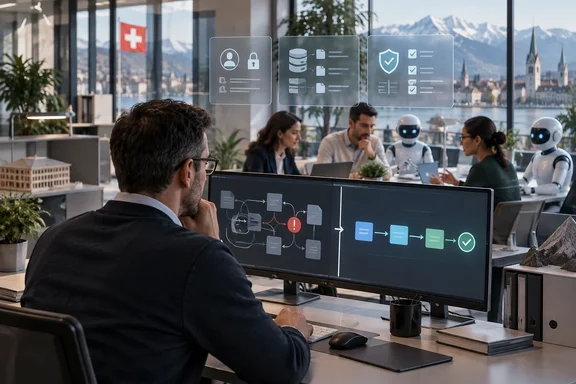
The summary covers the broad themes: people and agents sharing a workspace, critical thinking, process redesign, governance and digital sovereignty. The full German interview has more detail. It includes survey figures, a national skills target, local datacenter and investment claims, and a short list of what Jameson thinks a modern AI workplace needs beyond hardware and a Teams licence.
This is a vendor executive talking about her employer's products, so read it that way. It still contains a useful checklist for anyone who manages identity, data and policy in a Microsoft 365 shop.
The core argument: pick valuable work, not maximum AI
Jameson told IT-Markt that the IT workplace is turning into a shared space for people and AI agents. In her view, the question is not how much AI a company uses but where it adds the most value. She points specifically to places where processes stall or valuable time is lost.
She also draws a clear line on delegation:
- Agents can take on preparatory and repetitive tasks.
- People keep judgment, responsibility and the job of putting results in context.
She doesn't name specific agents, products, customer deployments or measured productivity gains. This is a set of principles, not a case study. It is still a sensible way to decide what to automate. "We deployed 40 agents" is a vanity metric. "We removed a three-day wait from the procurement approval chain" is an outcome.
Section summary: Judge AI by the bottlenecks it removes, not by how much of it you deploy. Accountability stays with people.
What Microsoft's Swiss survey data says
Asked what skills employees need, Jameson highlighted the ability to check AI output critically, put it in context and use it responsibly. She cited Microsoft's Swiss Work Trend Index figures: 84% of Swiss AI users treat AI output as a starting point rather than a finished answer, and 46% name quality control as a key skill.
Microsoft's July 2026 Swiss release gives more context. 65% of Swiss AI users say they can now perform higher-value analytical and creative work that would not have been possible for them a year ago, vs. 58% globally. The same release is less flattering on leadership: only 24% of Swiss AI users say leadership is clearly and consistently aligned on AI.
The release also defines a smaller group of advanced users. In Switzerland, 18% of AI users qualify as Frontier Professionals today. Microsoft says Frontier Professionals are nearly 20 percentage points more likely to produce work they could not have achieved a year ago. It adds that their leaders actively use AI themselves, set clear quality standards, and create space for experimentation.
Two notes on the numbers:
- Don't mix up the skills figures. The July release puts quality control at 46% and critical thinking at 42%. Those are separate measures.
- Remember who ran the survey. The global 2026 report is based on anonymized Microsoft 365 signals and a survey of 20,000 AI users across 10 countries. That is a big sample, but the respondents already use AI, and the publisher sells AI products.
Wider adoption is still rising. Microsoft's AI Economy Institute reports that Switzerland was ranking 15th worldwide with an adoption rate of 39.1%, up from 37.8% in the previous quarter.
Jameson treats skill-building as a job for leadership. Companies need to set up the right conditions, and managers need to show responsible AI use themselves. That matches the survey's finding that the leadership gap, more than tool access, is the main thing holding organisations back.
Section summary: Swiss users say they check AI output, but only about a quarter see their leaders aligned on AI. That gap is where rollouts tend to stall.
Jobs, automation and a big training target
On fears about job losses, Jameson turns the question around to "How is work changing?" She points to studies by the International Labour Organization in Geneva. By her account, they show that individual tasks are changing more often than whole occupations are disappearing. The interview doesn't name a specific ILO report or give its methodology, so this is her summary rather than a figure you can check from the interview itself.
Her conclusion is that continuing education becomes the deciding factor. She says Microsoft is supporting a goal of helping one million people in Switzerland build AI skills by 2027, and that more than 630,000 have already been reached. The interview doesn't say what "reached" means. It could mean trained, enrolled or just engaged, so treat the number as a milestone Microsoft reports about itself.
Digital sovereignty: control, resilience, connectivity
IT-Markt asked a pointed question: could pressure to become more efficient with AI push Swiss companies further into dependence on foreign providers? That is effectively the vendor lock-in question.
Jameson defines digital sovereignty as keeping control over data, access and technology while still benefiting from global innovation. She says organisations need different mixes of control, resilience and connectivity depending on their legal and operational requirements.
She also made several Microsoft-specific claims:
- Microsoft runs four datacenters in Zurich and Geneva.
- It is investing US$400 million in local infrastructure and skills.
- Microsoft Sovereign Cloud extends the options up to fully isolated cloud and AI environments.
The interview gives no timeline for the investment, no breakdown by facility and no technical specification of which sovereignty controls are included. Her answer also doesn't really address lock-in. Putting data in a Swiss region answers "where is my data?" It doesn't answer "how hard would it be to leave?" Those are separate risks. Regulated organisations should assess both against their own legal needs rather than treating a local datacenter as a complete answer.
Section summary: Jameson frames sovereignty as a set of requirements, not just a question of where data sits. Microsoft's local infrastructure claims are the company's own, and the lock-in question is still open.
The part admins should care about: three extra layers
The most practical part of the interview comes when IT-Markt asks whether a monitor, laptop, collaboration tool and good network are enough. Jameson says they are the foundation but no longer sufficient. Anyone who wants to work productively with AI needs three more layers:
| Layer | What it means for IT |
|---|---|
| Identity and access protection | Agents act with permissions. Weak access controls combined with an agent become a problem that grows much faster. |
| Reliable access to organised, well-structured data | An agent is only as good as the data it can find. Overshared, messy file stores give it more to get wrong. |
| Governance that also applies to agents, not just people | Policies, oversight and accountability need to cover non-human actors too. |
She adds that employees also need the skills to use these tools safely and responsibly. She doesn't prescribe specific products, settings or configurations. Microsoft admins will still recognise the areas: identity, data classification and permissions, and policy enforcement. Those are the systems that decide whether an agent rollout goes quietly or ends up as an incident report.
Here is how you could turn her principles into a first pass. This is our own synthesis from general industry practice, not steps from the interview:
- List the bottlenecks first. Find the workflows where work stalls or time is lost, which is Jameson's own test.
- Check permissions before agents inherit them. Clean up overshared sites and stale access groups.
- Put a named person in charge of each agent-assisted process so it's clear who owns the result.
- Set quality checks. Decide where people review AI output, in line with the "starting point, not final answer" habit the survey describes.
- Measure the process, not the tool. Track cycle time or error rates, not how many licences are in use.
Pilots aren't the goal
Jameson's view of the biggest barrier is blunt. Plugging AI into isolated steps of existing workflows doesn't unlock its potential. Companies need to redesign whole processes and define clearly how people and AI work together. What counts, she says, is not the pilot project but embedding AI in daily operations for the long term.
Her best line comes at the end: if you automate the detours you already have, you just make them faster. Anyone who has seen a broken approval process "digitised" into a broken approval process with notifications knows what she means.
Microsoft's global 2026 report makes a similar point, arguing that the best AI users will be the ones who redefine their value around what only humans can do: setting clear intent—defining the desired outcome and quality bar—and designing how the work gets done across humans and AI.
The rest of the panel
Jameson was one of several speakers in an IT-Markt panel on how AI is changing office work. The other answers show the wider Swiss industry view. Oliver Bachmann of TD Synnex argued that training alone won't embed AI in daily work. Karin Bühler of Adnovum stressed transparency, continuing education and involving employees. Tobias Quelle of Brack Alltron said making employees active shapers of the change reduces their fears. Patrice Steiner of Procloud recommended starting with one clearly defined use case. Peter Zanoni of HP said AI literacy includes critical thinking as well as knowing the tools.
The panel broadly agrees: the technology is the easy part, and organisation, skills and trust are harder.
Bottom line
This isn't a product launch and it isn't evidence that any particular deployment worked. It's a Microsoft executive setting out principles, backed by Microsoft's own survey data, and it should be read with that in mind. The principles still hold up:
- Aim AI at real workflow friction.
- Keep human judgment and accountability in place.
- Build critical-evaluation skills, with leaders setting the example.
- Redesign processes before automating them.
- Get identity, data and agent governance in order before scaling.
- Judge sovereignty, and lock-in separately, against your own requirements.
For IT teams under pressure to "do something with agents", that list is useful whichever vendor you use.
References
- Interview with Ann Jameson: AI Unfolds Its Value When People and Agents Work Together news.microsoft.com · 2026-09-30T08:50:24+00:00
- 2026 Work Trend Index report: Agents, human agency, and opportunity microsoft.com
- Swiss AI users outperform global peers on productivity - Source EMEA news.microsoft.com