

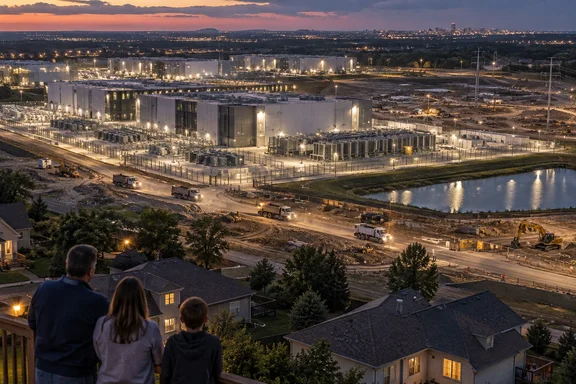
The key correction to the familiar “a data center comes to town” framing is that Microsoft has been in West Des Moines since 2008. This is not a community confronting a single proposed building or reacting to a short-lived construction cycle. It is a city that has spent nearly two decades becoming one of Microsoft’s established U.S. infrastructure hubs, with some completed campuses and others still expanding. Microsoft itself says it operates datacenters and is building new facilities in West Des Moines.
That longer record is precisely what makes the residents’ accounts more useful than a generic fight over an announced AI campus. Construction disruption ends. Site lighting, road patterns, utility demands and the physical conversion of land do not necessarily end when a facility goes live.
Microsoft’s Iowa campuses are a long-running buildout
West Des Moines approved Microsoft’s first Iowa campus, Project Mountain, in 2008. Project Alluvion followed in 2014, and city officials announced Project Osmium in 2016 as a project expected to add between $1.5 billion and $2 billion in investment. The city said at the time that Osmium would be built in phases across 200 acres in Warren and Madison counties.
The scale is important. A construction project of that size cannot be evaluated solely as a building permit or an economic-development announcement. It requires roads, water mains, fiber routes, substations or other electrical upgrades, construction staging areas, heavy-equipment access and ongoing security and lighting. West Des Moines records have previously documented road and water infrastructure work connected to Microsoft’s Project Ginger developments.
STLtoday reports that residents near several of these facilities described increased truck traffic and dust during construction, as well as continuing light pollution. Neither Microsoft’s public community page nor the city’s older project announcements provides a facility-by-facility public accounting that would let a resident compare the promised mitigations with the lighting, traffic and other effects experienced at a specific property line.
That omission is not trivial. “Datacenter” is often used as if it describes a self-contained industrial building. Hyperscale sites are instead long-lived infrastructure complexes, and the impact that a nearby household notices may come from roads, utility construction and site operations as much as from the server halls themselves.
The golf-course loss was not an incidental complaint
The change in land use described by residents has a documented history. Reporting from Data Center Dynamics in 2014 said Microsoft acquired roughly 160 acres for Project Alluvion, including nine holes from a local golf course. That conversion was part of the project’s physical footprint, not a temporary effect of earthmoving.
The distinction matters for cities considering similar deals. Dust, truck volume and construction noise can be managed, though not eliminated, with enforcement and scheduling. A golf course, farm field or open tract that becomes a fenced industrial campus is a permanent change unless the site is later redeveloped. The economic case for a data center may still be compelling, but it should not be presented as a cost-free addition to the tax base.
West Des Moines promoted Alluvion and Project Mountain as a net positive for taxpayers, and public documents show major public commitments around the development. Iowa’s urban-renewal records list an agreement tied to Microsoft Alluvion with an estimated $1 billion in private capital investment and $62 million in public infrastructure costs. Good Jobs First’s subsidy database separately identified state sales-tax refunds and city-financed infrastructure connected to the expansion.
Those figures do not establish that the projects were a bad deal. They establish something more basic: the public contribution was substantial enough that residents are entitled to measurable answers on the service and infrastructure consequences, not only broad claims about investment totals.
Water improvements do not answer every neighborhood question
Microsoft’s Iowa footprint has received national scrutiny over water use. The Associated Press reported in 2023 that Microsoft used West Des Moines facilities for AI-related computing and that local officials had said future Microsoft data-center projects would need technology that significantly reduced peak water demand.
Microsoft has since described newer West Des Moines buildings as using zero-water cooling technology, Axios Des Moines reported in January. That is a meaningful operational change if it performs as described, particularly during peak summer demand. It also suggests that the water question was serious enough for city policy and technical design to change.
But water use and light pollution are separate operational issues. A facility can reduce or eliminate process-water demand while still create nighttime visual effects through perimeter lighting, loading areas, roads, construction work or neighboring utility infrastructure. Likewise, a new cooling design says little about truck routing, dust controls, work hours or how complaints are handled once a project is in service.
For communities negotiating future data-center projects, the West Des Moines record argues for treating these as individual, enforceable subjects. A sustainability pledge is not a substitute for a site-specific lighting plan. A large capital-investment figure is not a substitute for designated truck routes, street-cleaning requirements, construction-hour limits, a documented complaints process and post-construction compliance checks.
What enterprise IT buyers should take from the local record
For Azure customers, Microsoft’s continuing investment in Iowa confirms that the company is maintaining and expanding physical capacity behind its cloud operations. But enterprise buyers should resist the temptation to treat capacity growth as an abstract proof that every underlying dependency has been solved.
Cloud contracts properly focus on regions, availability zones, uptime commitments, data residency and security controls. Those remain the operational criteria for customers. Yet the West Des Moines experience is a reminder that capacity ultimately depends on local approvals, land availability, power and water arrangements, construction logistics and a social license to keep expanding.
The practical procurement consequence is modest but real. Organizations with long-term Azure growth plans should keep multi-region resilience, portability and exit planning on the agenda rather than reading every new hyperscale construction announcement as guaranteed frictionless capacity. A new campus can strengthen a provider’s fleet without making any individual workload immune to regional constraints, permitting disputes or infrastructure bottlenecks.
There is also a lesson for IT leaders participating in their own companies’ data-center or edge-computing projects. The objections reported in West Des Moines are not objections to a rack layout or a cloud architecture. They are reactions to externalities that the technology organization may never see on a capacity-planning dashboard.
The missing metric is whether mitigation works after opening
Microsoft’s public material emphasizes local jobs, workforce development and investment. West Des Moines has also partnered with Microsoft and Des Moines Area Community College on data-center training, including a city-supported program reported by Axios Des Moines this year. Those benefits belong in any honest account of the company’s local role.
The STLtoday report does not erase them. It supplies the part of the ledger that press events, investment announcements and ribbon cuttings tend to leave out: what residents say remains after construction teams depart.
West Des Moines is therefore less a warning that data centers cannot coexist with communities than a warning against treating the announcement as the finish line. Microsoft’s Iowa facilities have already shown the long arc of a hyperscale buildout. The next credible measure of success is whether the company and the city publish enough site-level information to demonstrate that traffic, lighting, water and construction commitments are being met where residents actually live.