

What happened
Mozilla originally commissioned researchers Harry Brignull and Cennydd Bowles to study how Microsoft treats people who try to use another browser on Windows. Their first report documented design choices in Windows, Edge and Bing that nudged, pressured and at times tricked people into using Edge. The second report retested the same questions across Windows 10 and Windows 11.
The new test covered four regions: the United States, the United Kingdom, India and Germany. Germany stood in for the EEA. The researchers did not test every European country.
The report says Mozilla commissioned it, but that its findings are entirely those of the authors. Mozilla says it shared the findings with Microsoft and discussed them. Its October 7 post reports no resulting change in the practices it cites. The post doesn't quote any Microsoft response.
What Mozilla says still happens outside the EEA
Mozilla lists three examples for users in the US, India, the UK and most other regions:
- Windows 10 setup message. The "You're almost done setting up your PC" message uses wording that pulls people away from the default browser they chose.
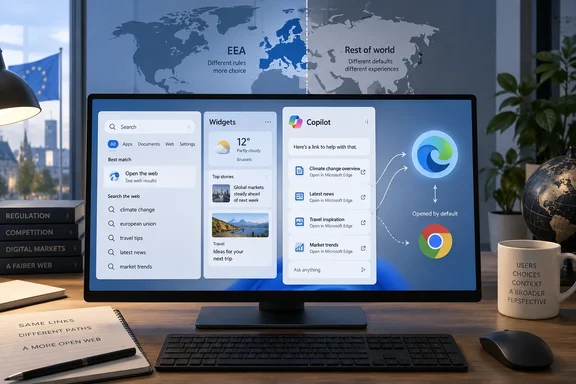
- Search and Widgets. Links opened from Windows Search and Widgets go to Edge, not the user's default browser.
- File types. Edge stays the default for common browser file types such as PDF and SVG, even after another browser becomes the default.
The post gives no build numbers or reproduction steps for these three claims. Treat them as findings from specific test setups, not as behavior on every PC. The report's authors also caution that software and web services change through updates, A/B tests and feature flags. They say they can't guarantee that every user sees every pattern.
What Mozilla says persists even in Europe
The post's sharper claim is that some behavior survives even where the Digital Markets Act (DMA) applies:
- Taskbar pinning. Mozilla says Edge remains pre-pinned to the taskbar. It argues this conflicts with Microsoft's 2023 pinning principles.
- Copilot links. Mozilla says Copilot opens web links in a side panel instead of the user's chosen browser, in every region tested, Europe included.
- Windows Backup. Mozilla says the tool silently tries to set Edge as the default when it restores a PC. It also says the tool fails to properly bring the user's own browser along.
Press coverage of the July report describes the backup test. Researchers set up a Windows 10 computer, installed another browser and made it the default. They then restored the backup on a Windows 11 computer. The alternative browser was not transferred, and Edge became the default again. That is one tested migration path. It doesn't show that every backup or upgrade behaves this way.
The regional gap
The July summary said some patterns were absent in the EEA. The EEA no longer showed the Bing "All you need is right here" panel. It also no longer showed the nagging Windows 10 setup journey. Mozilla also reported that Copilot data toggles default to "On" in the US and India. They default to "Off" in the EEA and the UK. Mozilla's own words were that the EEA product still has obvious harmful design patterns.
Mozilla draws the inference that the regional difference is a choice Microsoft made. It argues the DMA is the only thing that has moved the company. That is Mozilla's position. The comparison supports the claim that Windows behaves differently by region. It doesn't prove why.
Microsoft's own 2023 pledge
The taskbar complaint rests on a Microsoft document. In March 2023, Microsoft said it wanted people to control what gets pinned to the Desktop, Start menu and Taskbar. It also said people should control default apps, such as their default browser. Microsoft committed to three things:
- Provide a common supported way for developers to request default status or a taskbar pin.
- Have Microsoft's own apps use the same methods.
- Release an Edge update that adopts the new Settings deep link and public pinning APIs as they became available.
That pledge is the yardstick Mozilla uses. The post doesn't establish whether Edge's current pre-pinning breaks the commitment. Microsoft could argue that the pledge covers how apps request pins, not how the OS image ships. I haven't seen a Microsoft statement on that point.
The market-share caveat
Skeptics will point to the numbers. The Register's coverage of the July report noted that, judging by market share statistics, any such efforts are not going too well for Microsoft. The report's own table shows Edge gaining share between Q1 2024 and Q1 2026. It rose about 3.9 points globally. Chrome and Firefox fell.
The authors say they cannot determine how much of Edge's growth came from the design patterns, because marketing and other strategies may also contribute. They only hypothesize that the patterns played a role. Those figures are context, not proof of cause.
Why this matters beyond browsers
Mozilla's pitch for why this matters now is AI. It says browsers are a key distribution layer for AI tools and services. They also decide many of the privacy and security features people rely on. If Copilot, Search or Widgets route links into Edge, that decides which browser's protections apply. Mozilla offers this as a rationale for treating those surfaces as choice issues. It doesn't claim any particular user was harmed.
The report also notes that Windows 10 support ended in October 2025. It cites StatCounter estimates that about 32% of Windows users globally were still on Windows 10 in Q1 2026. In India the figure was nearly 43%. Those users are the ones still facing the Windows 10 setup journey and any migration to Windows 11.
What Mozilla wants
- Ship the EEA's fairer designs to all Windows users worldwide.
- Stop the remaining harmful patterns in the EEA.
- Honor the default browser in Windows Search, Widgets, Copilot and Windows Backup restoration.
- Apply Microsoft's 2023 pinning principles to Edge itself.
Mozilla says it is taking the findings to regulators and policymakers. It names the US, UK, India and Brazil. The Browser Choice Alliance, a separate coalition of browser makers, has echoed the criticism. It cited the Mozilla study and an open letter it sent Microsoft on June 3, 2026.
What Windows users and admins can do
The behaviors Mozilla describes are choices made inside Windows, and the post offers no workaround for them. These checks fit the specific complaints:
- After setting a default browser, test it. Open a link from Windows Search, from Widgets and from Copilot. Note where each one lands.
- Check file associations for PDF and SVG in Settings under default apps. Don't assume they followed your browser choice.
- After a restore from Windows Backup, confirm which browser is default. Reinstall your preferred browser if it didn't come across.
- Managed fleets should treat default-browser behavior as something to verify after feature updates, not assume. I haven't verified a policy-based fix for each behavior here, so check Microsoft's documentation before relying on one.
Bottom line
Mozilla's follow-up has no new test data and no new Microsoft statement. Its main contribution is a framing: the same Windows ships with different browser-choice behavior depending on where you live. It also claims a few behaviors, Copilot links, Backup restoration and taskbar pinning, that persist everywhere tested.
The evidence is public, with a screenshot-based journey database that others can inspect. It still comes from a sponsor with a competing browser, and it measures interface patterns, not user harm. Microsoft's reply, whenever it comes, will matter. So will whether regulators outside Europe pick up the case.
References
- 100 Days Later: Microsoft still undermines browser choice - The Mozilla Blog The Mozilla Blog · Wed, 07 Oct 2026 10:03:04 GMT
- Over The Edge 2.0: what independent researchers found about browser choice on Windows blog.mozilla.org
- 1 Over The Edge 2.0 Do Microsoft’s Design Tactics Still Compromise research.mozilla.org