

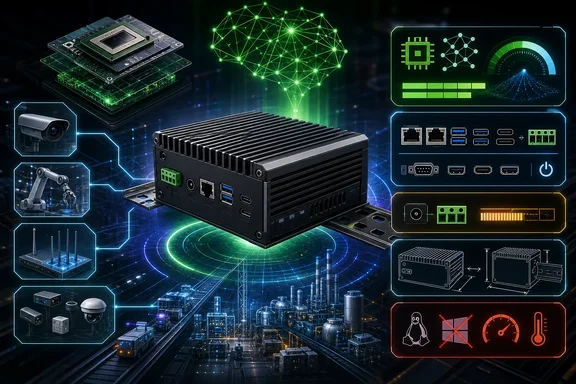
There are important limits to the headline, however. The MS-C9ZA is listed with Jetson Linux 35.5 support, not Windows, and the widely repeated 67 TOPS performance number is a conditional NVIDIA “Super” configuration figure rather than a verified result from this particular MSI box. Likewise, fanless operation should not be confused with unrestricted installation in a sealed or stagnant-air cabinet: MSI qualifies its advertised operating-temperature range with a 0.7 m/s airflow requirement.
What MSI is actually offering
The MS-C9ZA is built around the NVIDIA Jetson Orin Nano 8GB module. MSI lists a six-core Arm Cortex-A78AE processor running at up to 1.5 GHz, 8 GB of LPDDR5-3200 memory, and an NVIDIA Ampere GPU. NVIDIA’s current module specifications describe that GPU as having 1,024 CUDA cores and 32 Tensor Cores. In practical terms, this is an Arm-based embedded AI platform, designed to run accelerated inference workloads close to data sources rather than sending every video stream or sensor reading to a distant server.
MSI supplies a 256 GB OS-bundled SSD in the published configuration. Storage expansion is provided through an M.2 M-key 2280 PCIe Gen4 x4 NVMe slot, while an M.2 E-key 2230 PCIe/UART interface provides a route for suitable expansion hardware. That combination matters for edge deployments where an integrator may need local recording capacity alongside wireless or specialized connectivity.
The enclosure measures 126 × 96 × 74 mm and weighs 1 kg. It supports DIN-rail mounting, a common requirement for industrial cabinets, and takes 12–24 V DC power. These are more meaningful deployment details than the term “mini PC” suggests. A system intended for a machine enclosure, utility room, retail installation, or vehicle-adjacent environment must fit existing mounting and power arrangements, not merely occupy little desk space.
MSI’s published operating range is -25°C to 60°C, but the condition attached to that specification is crucial: thermal performance at that range assumes 0.7 m/s airflow. The chassis may be fanless, yet the stated rating is not evidence that it can sustain the same workload and temperature range in a completely still, tightly enclosed cabinet. Buyers need to account for ventilation, internal enclosure temperature, cable routing, and any nearby heat-generating equipment.
Connectivity is the product’s industrial differentiator
The MS-C9ZA’s port list is tailored much more toward equipment integration than consumer peripherals. MSI lists:
- Two Gigabit Ethernet ports
- HDMI output at up to 3,840 × 2,160 at 30 Hz
- Two USB 3.2 Gen 2 Type-A ports
- One USB 2.0 Type-C port used for recovery
- CAN connectivity
- Two I2C interfaces
- Two UART interfaces
- Isolated digital I/O
Dual Gigabit Ethernet is particularly relevant for segregating a machine or camera network from an upstream corporate network, although a specific network topology, throughput result, or security architecture has not been established for the device. CAN, I2C, UART, and isolated digital I/O are the clearer signs that MSI is targeting industrial controls and edge gateways rather than general office computing.
For a machine-vision installation, the available interfaces could connect cameras and local storage while exposing serial, sensor, or controller links. For industrial automation, isolated I/O and CAN can reduce the need for separate interface adapters. But system builders should not assume every use case is plug-and-play. The dossier provides no independent validation of particular cameras, field devices, protocols, drivers, or workload stacks on the MS-C9ZA.
The HDMI specification also deserves a realistic reading. A maximum of 4K at 30 Hz is sufficient for setup screens, dashboards, and many fixed monitoring roles. It is less attractive for a workstation-like experience where 60 Hz desktop output is expected. This is another indication that display output is a supporting feature, not the central purpose of the machine.
The 67 TOPS figure needs careful qualification
NVIDIA identifies the Jetson Orin Nano 8GB’s original configuration at up to 40 sparse INT8 TOPS, 68 GB/s memory bandwidth, and a 1.5 GHz CPU frequency. NVIDIA also describes a later “Super” configuration that can reach up to 67 sparse INT8 TOPS, 102 GB/s memory bandwidth, and a 1.7 GHz CPU frequency. The higher figure is tied to a new power mode, newer JetPack software, and a 25 W module mode.
That distinction makes it inaccurate to present the MSI system as simply delivering 67 TOPS. The hardware foundation is compatible with NVIDIA’s Jetson Orin Nano family specifications, but MSI’s listing identifies Jetson Linux 35.5 support. NVIDIA identifies Jetson Linux 35.5 as part of JetPack 5.1.3, while the Super performance configuration is associated with later software and configuration changes.
The available documentation does not establish whether the MS-C9ZA ships with, is qualified for, or is supported after an upgrade to the relevant later JetPack releases and Super Mode configuration. It also does not establish whether MSI’s thermal design can sustain the associated operating mode in a real enclosure. Therefore, prospective purchasers should treat “up to 67 sparse INT8 TOPS” as a Jetson-module potential subject to software, power, and thermal conditions—not as a confirmed, sustained MS-C9ZA benchmark.
This is more than a wording dispute. Edge-AI deployments are frequently sized around expected frame rates, model latency, stream counts, and thermal headroom. A difference between a standard module mode and a boosted configuration can affect whether one box handles a workload or whether an integrator needs a more capable model, a lower-resolution pipeline, fewer simultaneous streams, or additional systems.
No independent benchmark, sustained-clock test, power measurement, or high-ambient thermal result for the MS-C9ZA was identified in the reviewed material. Until such testing appears, exact performance expectations should remain provisional.
A specification inconsistency to keep in mind
There is also a cache-specification discrepancy between MSI’s product listing and NVIDIA’s current module information. MSI lists 1 MB of L2 cache for the MS-C9ZA. NVIDIA lists 1.5 MB of L2 cache plus 4 MB of L3 cache for the Jetson Orin Nano 8GB.
The material reviewed does not explain the difference. NVIDIA’s listing supports the presence of 4 MB L3 cache at the module level, but MSI does not state that L3 figure on its own page and differs on L2 capacity. This does not by itself show a functional hardware difference, but it is a worthwhile point for organizations producing formal bills of materials, benchmarking documentation, or compliance records. They should seek clarification rather than silently selecting one number.
Optional features are not universal features
MSI lists several capabilities that may matter for remote installations: IEEE 802.3af PSE, out-of-band management, and 5G daughter boards. It also lists hardware TPM 2.0, an RTC battery, and MCU-based battery-life monitoring.
The distinction between listed hardware and delivered configuration is important. PSE, out-of-band management, and 5G are identified as optional or daughter-board-based features. A buyer should not assume a quoted system includes cellular connectivity, power-sourcing Ethernet, or remote management without confirming the precise SKU and bill of materials.
A hardware TPM 2.0 can be valuable in an edge deployment for device identity and key-protection designs, but it does not alone define the security posture of the installation. Secure provisioning, operating-system maintenance, physical access controls, network segmentation, and recovery procedures remain deployment responsibilities.
What this means for Windows-oriented buyers
For readers accustomed to selecting compact x86 Windows PCs, the MS-C9ZA needs to be evaluated differently. MSI lists Jetson Linux 35.5 support, reflecting the Jetson software ecosystem and the Arm processor architecture. The supplied information does not list Windows support, Windows drivers, or a Windows image for this model.
That does not make the system less useful; it makes it specialized. Organizations already using NVIDIA’s embedded Linux stack for CUDA-accelerated AI inference, robotics, video analytics, or industrial control may find the integrated I/O and fanless form factor compelling. Conversely, teams whose application, management tooling, peripheral drivers, or endpoint policy depends on a conventional Windows environment should not treat this as a drop-in mini-PC substitute.
The practical question is not whether the chassis is compact, but where the application stack lives. A Windows workstation or server can remain the development, administration, and visualization endpoint while the MS-C9ZA performs local Linux-based inference and device interfacing. That split can make sense where bandwidth, latency, privacy, or resilience argues for processing data near the source.
Availability and the real buying decision
MSI’s product page directs customers to request a quotation. No MSRP, public distributor price, regional availability date, or retail sales channel was identified. This is consistent with the product’s industrial orientation, where configurations, support arrangements, lifecycle expectations, and volume requirements are often handled through direct sales or integrators.
The unit had been publicly seen at MSI’s Computex booth by July 23, 2026. Later September coverage should not be treated as proof of a first introduction date, because no formal launch date was established in the reviewed material.
For now, the strongest case for the MS-C9ZA is specific: a compact Jetson Orin Nano-based edge box with industrial interfaces, DIN-rail mounting, DC power, local NVMe expansion, and fanless construction. The weaker case is a broad performance promise based on 67 TOPS, or an assumption that fanless hardware automatically thrives in any restricted space.
Before committing, buyers should confirm the exact included options, JetPack and Jetson Linux support policy, power mode, thermal installation requirements, peripheral compatibility, and delivered price. Those answers will determine whether the MS-C9ZA is a well-matched edge appliance or simply a promising specification sheet with too many operational unknowns.
References
- MS-C9ZA compact fanless Edge AI Box PC powered by the NVIDIA Jetson Orin Nano 8GB MSI IPC
- Jetson Linux 35.5.0 NVIDIA Developer