

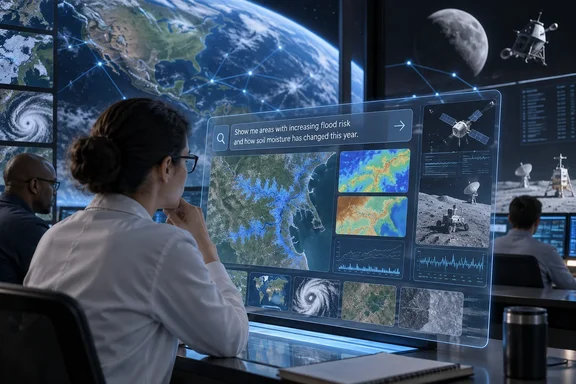
The feature describes several NASA efforts that run on AI, many of them on Microsoft technology. Hydrology Copilot and Earth Copilot let people query Earth-science data in plain English. AI tools helped with planning for Artemis II. A prototype AI agent is being built for Mission Control. NASA researchers are also looking at processing data on or near satellites for faster disaster response. And an internal hackathon drew far more employees than anyone planned for.
One caveat applies to everything below. This is a Microsoft customer story, and Microsoft is the vendor. The interviews are real and the people are named, but they are describing their own programs. This piece attributes the claims to the people who made them and adds outside context where it exists.
The problem: open data that's hard to use
Anna Steers-Smith, NASA's senior adviser on AI, says a lot of the agency's data is already public under its open data initiative. Pulling insights out of many separate sources and connecting them has still been slow and complicated. Her complaint is that NASA has plenty of open data, but it "can sometimes be hard to find" and hard to connect.
The article gives Artemis II as an example. Safety analyses, engineering reviews and mission data were spread across at least 10 separate sources. NASA's mission page lists the crewed lunar flyby as launching April 1, 2026 and splashing down April 10, 2026, a total of 9 days, 1 hour and 32 minutes. That confirms the timeline. It says nothing either way about the AI claims.
Steers-Smith also points out that AI is not new at NASA. The agency has used machine learning for decades, from autonomous navigation on Mars rovers to spotting anomalies in spacecraft systems. What has changed, in her view, is that large language models let people outside a small group of specialists use AI. "AI is not our mission," she says, describing NASA as an exploration and discovery agency that treats AI as one tool among many.
Section summary: NASA's main obstacle is disconnected data, not a shortage of it. LLM-based tools are being used to make that data reachable for non-specialists.
Hydrology Copilot: asking water data questions in plain English
Hydrology Copilot is the most concrete system in the story. Sujay Kumar, assistant lab chief at NASA's Hydrological Sciences Laboratory, says his team built it with Microsoft engineers. It lets users ask questions about water data. It can analyze variables like precipitation and soil moisture to help with drought preparation and flood-risk assessment, and it runs calculations that would otherwise take manual effort.
Kumar's pitch is broad access. His example is a farmer asking what environmental conditions were like in a given year and place, or a local agency looking at water conditions without needing technical skills. He says it will "democratize" data.
The feature doesn't explain how the system works. Other sources do:
- The data: A NASA Goddard page for research scientist Mahya Hashemi says she works with Microsoft on the Hydrology Copilot for hydrological and drought-monitoring analysis. The work uses NASA's high-resolution (1 km) NLDAS-3 dataset and relies on multi-agent systems and retrieval-augmented generation (RAG) built with Azure AI Foundry. NLDAS is a North American land data assimilation product, so readers should assume the coverage is North American and not global.
- The Azure stack: A December 2025 post on Microsoft's Tech Community public-sector blog describes the architecture. Azure Synapse Analytics curates and indexes hydrology datasets, including NLDAS-3, so they can be queried quickly and efficiently. Azure AI Search provides the semantic understanding needed for the system to interpret hydrology concepts and map them to the correct variables and workflows. The same post says NASA's scientific documentation and metadata are indexed so that answers are grounded in authoritative sources.
- Public demos: Hashemi's NASA page says she demonstrated the NASA–Microsoft Hydrology Copilot at a NASA Goddard AI Center of Excellence seminar on April 8, 2026. She showed it again two days later during a keynote at a regional water resources symposium in Washington, D.C.
This setup will look familiar to Windows admins and developers who have built internal copilots. Structured data sits in an analytics layer, a search index handles grounding, and agents manage the workflow. The difference is that the data here is gridded hydrology, not SharePoint libraries.
The sources leave some gaps. None of them give accuracy figures, independent evaluation results, a clear statement of public availability, or guidance on using the output for high-stakes decisions such as emergency response. A plain-English interface makes a question easy to ask. It doesn't make the answer correct. A farmer asking about last season's soil moisture is one thing. A county emergency manager deciding whether to evacuate needs the numbers checked by someone who knows the model.
Section summary: Hydrology Copilot is a multi-agent RAG system built on Azure, using NASA's 1 km NLDAS-3 data. It has been demonstrated publicly, but no published validation metrics or general availability details were found.
Earth Copilot: where it started
Earth Copilot came first. Microsoft announced it in November 2024. At the time, Microsoft said NASA had worked with it to explore the use of a custom copilot using Azure OpenAI Service to develop NASA's Earth Copilot, with the aim of making it easier to navigate more than 100 petabytes of collected data. GeekWire reported the example questions users could ask, such as "What was the impact of Hurricane Ian in Sanibel Island?", and said the AI would then retrieve the relevant datasets.
It was presented as a prototype. NASA IMPACT and Microsoft jointly developed a prototype of NASA Earth Copilot. Developers will be interested in a note on NASA's Earthdata site: it points to material on how to use Azure and Azure OpenAI Service to recreate the NASA Earth Copilot in your own cloud environment. It also notes that NASA and NASA-funded science teams can request an Azure subscription through NASA's SMCE.
The progression is simple. Earth Copilot mainly helps people find the right datasets. Hydrology Copilot goes further and runs the analysis on those datasets.
Section summary: Earth Copilot (2024) was about discovering data. Hydrology Copilot adds agent-based analysis on top. Both run on Azure, and NASA has pointed developers to guidance for rebuilding Earth Copilot in their own environments.
Artemis II and a possible AI agent in Mission Control
The biggest claims in the feature come from Troy LeBlanc, CIO of NASA's Johnson Space Center. He says NASA used AI tools during Artemis II planning to generate safety recommendations and risk-mitigation scenarios for leaders. Experts would normally need weeks to gather information from multiple sources and assess risk and spacecraft readiness. "The AI tools did that work in seconds," he says.
That is a large claim, and no benchmark, task definition or evaluation method was published with it. The wording is also worth reading closely. The tools produced recommendations to help leaders decide. They did not make the safety calls. The time saved is presumably in assembling and synthesizing information, while experts still did the judging.
At Johnson, the center has built a prototype AI agent for SPARTAN flight controllers, who handle the International Space Station's power and thermal-control systems. The idea is for it to act as a virtual member of the back-room support team. LeBlanc describes a flight controller at the front console calling the back room and hearing an answer on the headset "from his AI agent in this case."
This is a vision for a prototype, not something in operation. Enterprise readers will know the pattern from early Copilot rollouts: the agent helps a human, and the human stays accountable. In Mission Control, that difference matters more than in almost any other workplace.
LeBlanc also says a 10-day mission produced far more data than he expected, and future lunar missions, including a planned Moon Base, will produce as much or more.
Section summary: NASA leaders say AI sped up Artemis II risk analysis, but that is an unverified claim. The Mission Control agent is a prototype meant to advise flight controllers, not replace them.
Edge processing and forecasting
Kumar also expects AI to change weather forecasting. He says NASA foundation models trained on decades of Earth-science data and physical models can detect and simulate weather patterns faster.
His disaster-response example is simple. If satellite data about a flood has to be sent down to Earth and processed first, the result may come too late. If the flood map is produced on the edge, near where the data is collected, he says it's "a matter of minutes."
The claim needs the same framing as the others. The feature names no specific satellite, edge hardware, deployment or latency figures. It is a stated aim, not a program anyone has measured. The reasoning is familiar to anyone who has argued for edge computing in a factory or on a retail network: move processing closer to the data, cut transfer time, and act sooner.
Section summary: On-orbit or edge flood mapping is a direction Kumar describes, not a deployed system with published results.
The hackathon
NASA's first agencywide data and AI hackathon was held in 2025. Steers-Smith was told to expect about 30 participants, and more than 500 employees signed up. Winning projects included:
- A chat interface built from AI agents for searching NASA's public "lessons learned" database, which holds decades of knowledge from missions and programs
- A machine-learning approach to judging forest-fire severity, intended to better protect firefighters and equipment
Steers-Smith says working on other people's problems helps staff think more critically about how AI could fit their own work. That is her observation, not a measured result, and the sources don't say whether either project went beyond the hackathon.
Section summary: Employee interest far exceeded expectations, but the winning projects have no confirmed deployment.
Why it matters to WindowsForum readers
Remove the Moon photos and this is a large-scale version of a problem most IT departments already have: data in silos, weak cataloging, and a small group of experts who know where everything is. NASA is using a common Microsoft stack to tackle it, pairing Azure OpenAI and Foundry agents with Synapse for structured data and AI Search for grounding. That makes its choices a useful reference for anyone planning something similar.
There are three points to take from it.
- Grounding is the core of the design. A hydrology copilot is only as trustworthy as the NLDAS-3 data behind it and the metadata index that keeps its answers tied to real variables.
- Human review stays in place. Even NASA's most ambitious example keeps the flight controller in charge of the decision.
- Treat vendor stories as starting points. "Seconds instead of weeks" may well be true for some tasks, but without published metrics it is a claim, not a benchmark.
Steers-Smith ends the feature with the Moon Base: seismic activity, solar conditions, ice deposits, images, audio and video, all of which have to be connected. "The possibilities are just endless," she says. Right now NASA's copilots are prototypes and demos, so they have yet to show how well they hold up in actual operations.
References
- At NASA, AI is helping scientists unlock discoveries hidden in decades of data - news.microsoft.com news.microsoft.com · 2026-09-28T07:59:56+00:00
- Mahya Hashemi - NASA Sciences and Exploration Directorate science.gsfc.nasa.gov
- Artemis II: NASA’s First Crewed Lunar Flyby in 50 Years - NASA nasa.gov