

Noctua's JouleForce partnership is a long-term research project
The announcement, carried by TechPowerUp, describes a joint research partnership to explore how Forced Physics' patented JouleForce micro-channel array technology can be brought to desktop PCs and workstations. The two companies go out of their way to set expectations low. The collaboration is a long-term research and development effort that is not tied to a specific product or release date. They say they will report again when they reach significant milestones, and they give no dates for those milestones.
Greek hardware site TheLab.gr covered the news with the same date and framing. It reports that the technology has been developed mainly for data centres and needs more static pressure than conventional PC fans can supply. That coverage is based on the same press release, so it confirms the announcement exists but adds no independent detail.
The partners have very different backgrounds. Noctua is the Austrian maker of quiet air coolers and fans. Forced Physics DCT has spent years selling into server rooms and remote computing sites. As far back as 2021, DatacenterDynamics covered the company's Edgeility micro data centre, where CEO Scott Davis said "Our Edgeility System allows customers to compute anywhere - even the harshest environments,". The same report described Davis as the inventor of the JouleForce heatsink. In January 2025 the company announced an exclusive partnership with A.R.T Digital to cool Bitcoin mining hardware. In the announcement, Davis acknowledges that desktops are different territory: desktop and workstation systems, he said, "pose airflow challenges that differ fundamentally from our data centre deployments."
How JouleForce micro-channel arrays differ from a tower cooler's fins
A conventional air cooler, whether a tower heatsink or a GPU shroud, works by blowing air across a large area of metal fins. Forced Physics says this approach runs into a limit called the boundary layer: a film of slow-moving air right against the fin surface that holds back how much heat can move from the metal into the air. On its technology page, the company says a conventional cooler only has three ways to handle rising chip power: more fin area, more air, or more noise.
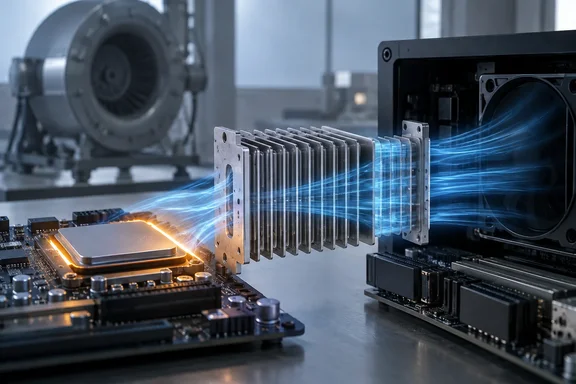
JouleForce instead forces air through very small channels, and heat is removed at the channel walls. The announcement says JouleForce arrays leverage geometry-driven molecular collisions at the channel walls: the boundary layer that limits conventional air cooling never fully forms, so heat is extracted along the entire length of each micro-channel. On its corporate site, Forced Physics DCT says the design forms controlled molecular beams that remove heat efficiently and cost effectively with very low energy overhead. This is the company's own explanation of the physics. It has not been independently established across all operating conditions, and it should be read that way.
The overall layout is familiar. According to Forced Physics' description, the array is mounted on a thermal interface such as a vapor chamber, which carries heat from the chip into the channel surfaces. A fan or blower then keeps a pressure difference across the array to pull air through it. The heat path works like any heatsink. The difference is the fin geometry and the way air moves through it.
The practical appeal is stated directly: the approach allows large amounts of heat to be removed using air alone, without the pumps, tubing and liquid loops of water cooling, at power levels that are becoming difficult to manage with conventional air coolers. The company's product page makes the same case in fewer words, listing that it uses ambient air only to cool CPUs, GPUs, and ASICs and promises a low airflow requirement.
Forced Physics' Villanova results and internal test claims
Forced Physics backs its claims with one external evaluation and several internal tests, and they carry different weight. The strongest evidence is an evaluation by Dr. Alfonso Ortega of Villanova University. According to the company's summary, he reproduced Forced Physics' SP5 thermal-resistance and pressure-drop measurements to within 3–5%. The same summary says he found 50% lower thermal resistance than a Dell reference heatsink while using one-third of the airflow. That is a meaningful result, but it concerns a server-class SP5 setup, and the figures come from a company-hosted summary, not from a desktop test.
The rest of the evidence is the company's own. Forced Physics reports that in internal testing on an NVIDIA RTX 6000, junction temperatures were substantially lower than with the stock heatsink, and token throughput was up to 55% higher under sustained AI inference load. It also shows telemetry from an edge system in Phoenix, Arizona that runs on outside air alone. Over a representative 24-hour period, that system is shown peaking at or below 87°C on the CPU, staying within about ±2°C, and recording no throttling events. The company says full test conditions are available only under NDA, so readers cannot check them.
The core geometry is covered by U.S. Patent 10,379,582 B2, "Assembly and Method for Cooling," issued August 13, 2019 to Forced Physics LLC. This is part of why the partnership is structured as joint research instead of Noctua building its own version: the array geometry belongs to Forced Physics.
None of this shows what JouleForce would do in a desktop case. It does show that the thermal claims have partial outside backing, which helps explain why an established cooler maker would commit years of engineering to it.
Static pressure is what keeps JouleForce off the desk
The announcement is unusually frank about the obstacle. At this stage, the micro-channel geometry that gives the arrays their thermal performance also produces a steep system impedance curve, with a pressure drop an order of magnitude and more above the range covered by conventional axial PC fans; current implementations therefore duct the arrays to industrial blowers, high-speed centrifugal fans or vacuum pumps.
Some quick definitions. An impedance curve shows how much pressure it takes to push a given amount of air through something, such as a radiator, a dust filter or a heatsink. A steep curve means resistance climbs quickly as you try to move more air. Ordinary case and cooler fans are axial fans: the propeller-style designs found on almost every tower cooler and radiator. They are built to move a lot of air against fairly little resistance. "An order of magnitude and more" means JouleForce arrays need at least ten times the pressure these fans are designed for. The announcement gives no actual pressure figures, so it is not possible to say how far beyond the best current high-static-pressure PC fans the requirement really is.
The companies also say why the usual fixes don't work. The established means of reaching such pressures—much higher rotational speeds or multi-stage impellers - are ruled out for desktop use by acoustic requirements, and the sealing required to prevent bypass leakage at these pressure levels is difficult to reconcile with the modularity and size constraints of PC cases. Bypass leakage means air taking the easier route around the array instead of through it. At high pressure, any gap between fan, shroud and array wastes airflow. In a server built for one purpose, the whole airflow path can be designed as a sealed duct. A desktop has to fit many cases, motherboards and GPU layouts, and parts have to come out again.
Noctua CEO Roland Mossig's comments point the same way. He praised Forced Physics for "advancing the limits in terms of fin-to-air heat transfer," but added that the pressures the technology needs "are currently supplied by equipment nobody would want on or under their desk." He called the effort "a demanding, long-term engineering task."
The partnership is looking at two ways forward: lowering how much static pressure the arrays need, or producing that pressure inside desktop limits on noise, size and sealing. The first would probably mean changing the channel geometry, possibly giving up some thermal performance. The second is fan and blower engineering, which is Noctua's specialty. Davis made the same point, citing Noctua's "expertise in quiet, high-pressure air movement" as the reason for choosing the partner. The announcement doesn't say which approach the companies expect to work, and it doesn't rule either one out.
Where a desktop JouleForce cooler could fit if the engineering works
Neither company has named a target component, power level, form factor or price. Still, the announcement's own reasoning shows where the potential payoff lies. The technology is presented as a way to handle heat loads that are "becoming difficult to manage with conventional air coolers," without the pump, tubing and coolant of liquid cooling. For builders who choose air cooling because it has no pump to fail and no coolant to leak or top up, a stronger air option would be a real alternative to all-in-one liquid coolers at the high end.
Workstations may turn out to be the more natural first market, though that is our inference and not something the companies have said. Forced Physics' strongest data comes from sustained professional loads: a server-class SP5 platform and an RTX 6000 running AI inference. Workstation chassis are also often more standardized than enthusiast gaming builds, which would make the sealing problem easier. Against that, workstations often sit right next to their users, which brings back Noctua's noise requirement.
Several questions remain open, and no speculation from us fills them in. The announcement doesn't say whether JouleForce would beat current flagship air coolers or 360mm liquid coolers on temperature or noise, what a desktop array would need in terms of height or mounting, or whether Noctua has any prototype yet. A third-party company profile says Forced Physics targets workstations and gaming PCs as well as data centres, but that is a claimed market, not a demonstrated desktop product.
What this means for you
This partnership shouldn't change any buying decision right now. Nothing has been announced that you can buy, pre-order or plan an upgrade around, so current choices between high-end air coolers and all-in-one liquid coolers should be made on products that exist today. The news matters more to readers who follow cooling technology, and to IT buyers of high-heat workstations who want to know which air-only approaches may arrive later.
- The Noctua–Forced Physics DCT partnership, announced September 24, 2026, is a research effort with no product, specification or release date attached.
- JouleForce currently needs static pressure at least ten times beyond the range of conventional axial PC fans, which is why existing systems use industrial blowers, high-speed centrifugal fans or vacuum pumps.
- The main unsolved problems are noise, sealing against bypass leakage, and fitting a high-pressure airflow path into varied, modular PC cases.
- The best outside evidence for JouleForce's thermal claims is Villanova's reproduction of server-class SP5 results, as summarized by Forced Physics. There is no desktop test data yet.
- Waiting for JouleForce is not a reason to delay an upgrade. Any desktop version depends on engineering breakthroughs the companies themselves call long-term.
Noctua has taken on a problem it cannot fix just by building a better cooler. It needs either a quiet way to generate roughly ten times the static pressure of a typical PC fan, or a version of Forced Physics' arrays that doesn't need that much. Either result would be significant for air cooling, and the companies' first milestone report should show which approach they are pursuing. Until that report arrives, JouleForce stays in data centres, edge systems and industrial hardware.
Update: Tom’s Hardware reports a claimed 2,000W cooling capability (September 25, 2026)
Tom’s Hardware reports that Forced Physics describes JouleForce as capable of cooling more than 2,000W of thermal energy. That figure was not included in the earlier coverage and, if applicable to a desktop-scale implementation, would put the technology well beyond the heat loads handled by conventional consumer CPU air coolers.
The number should be treated as a vendor claim, not as a desktop product specification. Neither Noctua nor Forced Physics has disclosed the test setup, airflow hardware, noise level, array size or operating conditions behind the 2,000W figure, and there remains no evidence of equivalent performance in a PC case.
For prospective workstation builders, the report reinforces the partnership’s potential focus on unusually high sustained heat loads—but it does not change the immediate buying picture. The pressure, acoustics and sealing challenges still have to be solved before any desktop-capable cooler can be evaluated.
References
- (PR) Forced Physics DCT and Noctua Announce Research Partnership on Micro-channel Array Cooling TechPowerUp · 2026-09-24T15:05:07+00:00
- Noctua explores 2,000W micro-channel air cooling Tom's Hardware · 2026-09-25T14:42:58+00:00
- Patented Microchannel Air Cooling Tech | Forced Physics forcedphysics.com