

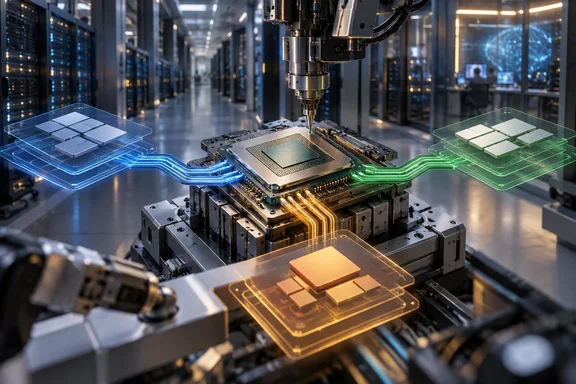
This is a description of a design process. There is no chip, no benchmark and no ISA yet. It's still worth understanding, because it breaks with how CPUs are usually built, and the people behind it have a record that Windows users will recognize.
What Nuvacore actually announced
The company made the announcement on X. In a post dated September 29, Nuvacore said "we can build a significant portion of the foundational CPU core IP before locking in an instruction set, giving our team the freedom to focus first on building the best core possible." It went on to say the approach lets it build its best core first "and then choose the best right instruction set for the system we—or our partners—want to build."
The core is called WarpCore. On its website, the company says WarpCore is engineered to sustain top-tier performance under the continuous, demanding workloads of modern hyperscale data centers and AI infrastructure. Nuvacore's statement to Tom's Hardware put it this way: instead of designing WarpCore around the requirements and limitations of a predetermined ISA, the company's engineers are developing a significant portion of the foundational CPU IP independent of a particular ISA.
The wording is careful. Nuvacore says a "significant portion" of the foundational IP comes before the ISA decision, not the whole processor. It has not said:
- which ISA it will pick, or when
- which blocks of the core are already finished
- a schedule, core configuration, manufacturing process, or power and performance targets
- whether it will sell finished chips, license IP, or do both
Section summary: Nuvacore has disclosed a development sequence: build much of the core first, choose the ISA later. It has not disclosed a product.
Who is behind it
The founders explain the attention. Notebookcheck reports that Gerard Williams III, John Bruno, and Ram Srinivasan founded the company, all of whom have deep experience in custom CPU design. Williams previously co-founded Nuvia before Qualcomm acquired the company. Williams was a senior architect on Apple's in-house silicon before that. Nuvia's work later fed into the Oryon cores in Snapdragon X, the chips that gave Windows on Arm its strongest hardware so far.
When Nuvacore came out of stealth in April, Tom's Hardware reported that the startup is funded by Sequoia Capital. Moor Insights & Strategy was cautious at the time, noting that the instruction set architecture (ISA) is undisclosed, and there is little technical information available publicly. Six months later, the new announcement explains why the ISA is still undisclosed: the company hasn't picked one.
Why "ISA later" is unusual, and where it stops working
For readers who don't follow CPU design, a comparison may help. The ISA is the contract between software and silicon. It defines the instructions Windows, Linux, compilers and applications can use, and how the processor must behave when it runs them. x86, Arm (Arm64) and RISC-V are the three that matter today.
As Tom's Hardware explains, traditionally, CPU developers start development of a new processor project with a particular ISA — such as Arm, RISC-V, or x86 — already selected. Modern high-performance cores already separate software from hardware to a degree. They break incoming instructions into internal micro-operations before running them. Even so, the instruction set still influences numerous architectural decisions, including instruction decoding, register handling, memory ordering, and, of course, software compatibility.
That is where Nuvacore's bet has a limit. Some parts of a CPU depend heavily on the ISA, and others arguably much less:
| Heavily ISA-dependent | Arguably more ISA-neutral (industry view) |
|---|---|
| Instruction decode / front end | Execution units and data paths |
| Architectural register model | Branch prediction machinery |
| Memory-ordering rules | Caches and parts of the memory subsystem |
| Software and OS compatibility | Physical design and power management approaches |
The right-hand column is Tom's Hardware's analysis and general industry knowledge. Nuvacore has not said which WarpCore blocks it treats as reusable. Some items on the "neutral" side still carry ISA effects. A memory subsystem built for x86's relatively strict ordering rules behaves differently from one built for Arm's weaker model. Nobody outside the company knows yet how much of WarpCore will stay portable once the front end is built.
Tom's Hardware compared the approach to the development of a car around its engine and not trying to fit an engine into an already developed platform. The comparison works up to a point. At some stage the engine still has to bolt to a transmission, and that part affects the rest of the car.
Section summary: Postponing the ISA is possible for some parts of a core but not all of it. How much of WarpCore survives the ISA decision is still an open question.
An ISA clue, with a large caveat
Nuvacore hasn't named an ISA, but Notebookcheck noticed that the company's hiring material references RISC-V, Arm64 and x86 as architectures relevant to its engineering work. That fits the "keep every option open" message. It is still a job listing, and job listings are not product roadmaps. Assuming the founders' Apple and Nuvia history means an Arm decision is a guess, not something the evidence supports.
AMD tried something like this before
Mixing ISAs on one roadmap has precedent. In a May 2014 announcement, AMD laid out an "ambidextrous computing" roadmap covering x86 and Arm. Its Project SkyBridge planned pin-compatible 20nm SoCs, one Arm version using Cortex-A57 cores and one x86 version using AMD's Puma+ cores. AMD also announced its own custom Arm core, K12, with first products planned for 2016.
Tom's Hardware summarizes how that ended: SkyBridge was eventually scrapped for lack of resources, and K12 never shipped because AMD put its effort into x86 Zen.
The differences matter. AMD named both ISAs up front and designed separate cores for each. The ambidextrous part was mostly shared platform infrastructure. Nuvacore says it will build much of a single core before choosing any ISA. AMD's experience shows how expensive it is to support several ISA ecosystems at once. It doesn't prove Nuvacore's approach will fail, because Nuvacore isn't trying to ship on multiple ISAs at the same time.
What's the business angle?
This is where analysts are guessing, and they say so. Tom's Hardware lays out possible buyers: an Arm licensee could use the underlying core technology for an Arm implementation; another customer could choose RISC-V or another ISA. An established x86 vendor could potentially acquire or license the underlying microarchitecture and create its own x86 CPUs if it needs to. The same outlet also notes that Nuvacore, of course, has not indicated that such a transaction is its objective.
The Nuvia history makes the question fair to ask. Nuvia was acquired before it shipped a server chip, and its core ended up in Windows laptops. A design that stays ISA-agnostic would, in theory, appeal to more possible partners or buyers. That is an inference about optionality. Nuvacore hasn't announced any customer, licensee or exit plan.
There is also a more cynical reading. Not committing to an ISA means not committing to much else. Wccftech was cautiously upbeat and still acknowledged that there are definitely a lot of unknowns in this announcement. Words like "top-tier" and "industry-leading" on Nuvacore's site are goals until independent measurements back them up.
Why Windows users and IT pros should care
- Server roadmaps: WarpCore is aimed at data centers and AI infrastructure, where CPUs increasingly coordinate the work around GPUs. Moor Insights has noted that NVIDIA's Vera, Arm's own server CPU work and Intel's Xeon positioning all point to a CPU's primary role in agentic AI as orchestration. If WarpCore gets there, it would eventually be competing in Azure-style hyperscale fleets.
- Windows on Arm lineage: Nuvia's previous core became the basis of the current generation of Windows on Arm laptops. It's reasonable to watch where this team's next core ends up, even though client PCs aren't the stated target.
- Software compatibility: For anyone running Windows workloads, the ISA decides what runs natively, what needs emulation such as Prism on Arm, and what doesn't run at all. Until Nuvacore chooses, nobody can assess WarpCore's value for a Windows environment.
Bottom line
Nuvacore has described an unconventional process, not a finished CPU. Designing much of a high-performance core before choosing between x86, Arm and RISC-V could free the architects to optimize without early constraints, and it would make the resulting IP appealing to many potential partners. The approach has real limits: the ISA eventually shapes the front end, memory ordering and software story, and AMD's shelved ambidextrous roadmap shows how hard multi-ISA plans are in practice.
The team's history justifies paying attention. The company hasn't published an ISA, specs, a process node or a date, so there's nothing yet to evaluate beyond the plan itself.
References
- Nuvacore reveals unconventional Core First CPU IP design strategy Tom's Hardware · 2026-09-30T11:00:00+00:00
- Nuvacore's WarpCore Ditches The ISA-First Playbook, Building CPU Silicon Before Deciding On x86, Arm, Or RISC-V wccftech.com
- Apple Silicon and Nuvia veterans reveal unusual CPU core that keeps its ISA options open - Notebookcheck News notebookcheck.net