

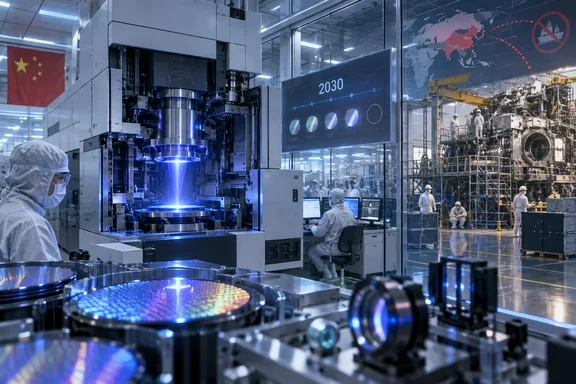
The important qualification is in what Huang did not specify. He did not say China will have a production-ready extreme ultraviolet, or EUV, scanner comparable to ASML’s leading systems by 2030; he answered a broad question about “advanced lithography systems.” That leaves room for a far more plausible near-term milestone: domestically built immersion deep-ultraviolet, or DUV, machines that Chinese fabs can qualify and run at useful volumes.
That distinction is more than semantic. A working domestic immersion DUV scanner would reduce China’s exposure to export restrictions and help sustain mature-node and some advanced-node production. It would not, by itself, erase ASML’s lead in EUV, high-NA EUV, optics, metrology, overlay control, and the manufacturing support needed to keep leading-edge fabs running day after day.
Huang’s forecast is about industrial time, not a disclosed machine
Huang’s comments came after a discussion of Elon Musk’s proposed Terafab project, when the podcast asked for his view on China’s homegrown advanced lithography. His answer was brief: China would get there by 2030, and a two- or three-year interval is effectively insignificant when planning at decade scale.
That framing reflects Huang’s position as the head of the company most exposed to the global AI-compute buildout. Nvidia needs more chip capacity, more advanced packaging capacity, and more competition among infrastructure builders—not necessarily a single supplier or country to dominate each bottleneck. His prediction should be read as a strategic assessment of China’s capacity to close industrial gaps, not as evidence that Nvidia has seen a Chinese EUV tool, certified one, or arranged production on it.
The podcast exchange also does not establish a definition of “there.” The original question did not ask whether China would match ASML’s current EUV systems, whether it would reach a particular process node, or whether the tools would be built from fully domestic components. Those are radically different thresholds. A Chinese immersion scanner that supports 28nm-class production would be a meaningful breakthrough; a high-throughput EUV platform suitable for high-volume 3nm-class logic would be a different category of achievement altogether.
For PC and enterprise buyers, that ambiguity matters because lithography progress can influence the availability and price of chips long before it changes the performance of a Windows laptop, a GeForce card, or an AI server. Domestic DUV capacity could shift supply resilience and improve China’s position in mainstream logic, analog, automotive, networking, and power semiconductors. It does not mean a near-term replacement for the advanced foundry capacity that currently produces leading Nvidia accelerators and modern PC processors.
China’s immediate opening is immersion DUV
The independently reported development behind Huang’s confidence is not a Chinese EUV production line. Reuters reported in July that Shanghai Aishengna Electronic Technology Group, a state-owned Chinese firm, was leading an effort to mass-produce domestically made immersion DUV lithography tools. The Information first reported that effort, and Reuters said the reported plan called for five machines in 2026 and 20 in 2027.
Those numbers are modest beside ASML’s output. Reuters noted that ASML shipped 131 immersion systems in 2025. Still, a small initial run would matter if Chinese fabs can qualify the equipment, establish a service chain, and improve yield and uptime. Semiconductor equipment is not judged only by whether a prototype exposes a wafer. Buyers need repeatable overlay accuracy, wafer throughput, contamination control, spare parts, software updates, process support, and maintenance performance measured across years.
China’s existing public record illustrates the gap between a working system and an industrially competitive platform. Shanghai Micro Electronics Equipment, or SMEE, describes its SSA600/20 argon-fluoride step-and-scan tool as supporting 90nm process-node lithography. The company’s public materials establish that China has long had a domestic scanner program, but they do not substantiate commercial high-volume 28nm immersion deployment or anything approaching an EUV equivalent.
Reports of newer Chinese immersion machines deserve close attention, but their production claims should not be inflated into proof of parity. Reuters itself characterized the expected near-term commercial impact on ASML as limited, citing the much lower planned Chinese unit volume. The more consequential result would be the beginning of a learning curve: fielded systems create feedback from fabs, which in turn drives revisions to stages, optics, masks, controls, and process recipes.
Export controls created both a constraint and a market
China’s incentive to make these machines has sharpened as the Netherlands and the United States restricted the most capable lithography equipment. ASML’s own annual reporting says sales of EUV systems and specific DUV immersion systems require export licenses, and that China-related deliveries have been increasingly affected by export regulations.
ASML has never shipped an EUV system to China, the company said in June while denying reports that one of its machines might somehow have reached the country. China also cannot obtain ASML’s best immersion DUV platforms under the present controls. The restrictions preserve a gap at the leading edge, but they also make an expensive domestic alternative economically rational for Chinese fabs and state-backed equipment programs.
Reuters quoted Leiden Asia Center-affiliated researcher Sanne van der Lugt describing the result bluntly: U.S. export controls created a business case for Chinese lithography. That does not mean the controls failed at their immediate objective. They have limited China’s legal access to the tools used for the world’s most advanced commercial logic production. But a policy can delay access while simultaneously increasing the incentive and funding to reproduce the capability internally.
The timeline is therefore the real issue in Huang’s forecast. China does not need to build a machine identical to ASML’s newest EUV platform to weaken the restrictions’ commercial leverage. A stable domestic immersion-DUV supply, even one generations behind ASML’s frontier offerings, could cover an important share of Chinese semiconductor demand and reserve scarce imported tools for the fabs and process layers where they deliver the greatest value.
EUV remains the test Huang did not define
EUV is the threshold that makes a 2030 prediction difficult to evaluate. The technology uses 13.5nm light rather than the 193nm light used in ArF DUV systems, but the wavelength is only one part of the challenge. A production EUV scanner demands exceptionally precise projection optics, source power, masks and pellicles, wafer and reticle stages, overlay performance, vacuum systems, computational lithography, inspection, and metrology. The machine must also run predictably enough that a fab can make money with it.
ASML remains the sole commercial supplier of EUV lithography systems, and even it relies on a deeply specialized supplier base. The company’s position was built over decades of work across the Netherlands, Germany, the United States, Japan, and other countries—not through one breakthrough component. That is why a Chinese laser-produced plasma source, a patent filing, or an experimental exposure platform would be noteworthy but insufficient evidence of a competitive manufacturing scanner.
China could also advance chip production without domestic EUV through DUV immersion lithography, multipatterning, advanced packaging, architecture choices, and process optimization. That approach carries costs in cycle time, complexity, yield, and power, but it is not theoretical: advanced DUV techniques already underpin substantial semiconductor production worldwide. A domestic immersion-DUV platform would therefore be strategically valuable even if EUV remains out of reach in 2030.
Huang’s prediction should be treated as a warning against assuming today’s export-control gap is permanent, rather than as confirmation that China is on the cusp of ASML-equivalent EUV. By 2030, the likelier near-term measure of progress will be whether Chinese immersion tools are installed, qualified, supported, and producing wafers at commercial scale—not whether a prototype can be shown operating in a laboratory.