

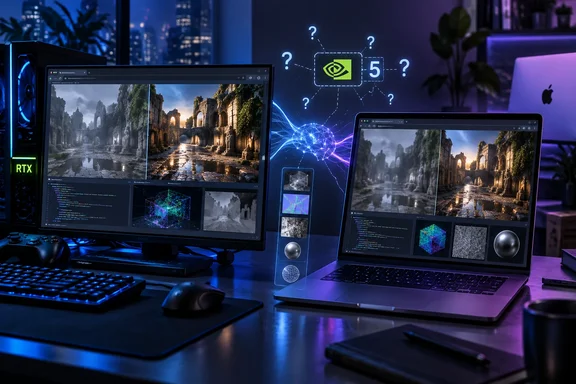
TechPowerUp first highlighted the claim, while VideoCardz separately inspected the public demonstration and reported that MAAN plans to publish source code on GitHub. Both accounts ultimately trace the macOS claim, custom-model support, and the project’s existence back to MAAN’s September 16 post. That is enough to establish that a demo has been shown, but it is not enough to establish what is actually executing, where it is executing, or whether it uses NVIDIA’s shipping DLSS 5 runtime.
NVIDIA’s own documentation creates a material complication for the headline claim. The company says DLSS 5’s 3D-Guided Neural Rendering runs locally inside game rendering pipelines on GeForce RTX 50-series GPUs. Apple Silicon is not an NVIDIA RTX platform, so a browser demo that works on a Mac cannot be a straightforward local execution of NVIDIA’s officially supported DLSS 5 stack as described by NVIDIA.
That does not make the demonstration uninteresting. It means the project should be treated as an early compatibility or reproduction experiment until MAAN publishes code and explains the rendering path.
The missing implementation detail changes the story
DLSS 5 is substantially different from the DLSS feature most PC players know as an upscaler. NVIDIA describes it as a final-stage generative renderer: a model that takes a rendered frame alongside motion vectors, temporal information, and artistic-direction controls, then produces the displayed image with generated lighting and material detail.
Those inputs explain why ordinary browser rendering is an awkward fit. A WebGPU application can render a scene and can run compute shaders, but a normal web page does not simply load arbitrary Windows driver components or NVIDIA runtime DLLs into the browser process. NVIDIA’s Streamline documentation lists DirectX 11 and DirectX 12 support, with Vulkan support described separately; it does not list WebGPU or WebGL. NVIDIA also offers the older NGX-style DLSS integration route, but that is likewise designed for native software that directly manages graphics resources.
VideoCardz accurately identifies the central unanswered question: how does MAAN connect a WebGPU-rendered scene to the neural-rendering model? There are several technically distinct possibilities, and they should not be blurred together.
The project could use a native companion process or local bridge that receives browser-generated buffers, invokes an NVIDIA component outside the browser, then returns the processed output. It could use a WebGPU implementation of a model that behaves similarly to DLSS 5 but is not NVIDIA’s production runtime. Or it could send work to a remote service, although neither MAAN’s post nor the reporting reviewed here says that it does.
Each route produces a very different result for Windows users and web developers. A native bridge would mean an installed local dependency and would not represent browser-native DLSS integration. A WebGPU port or reimplementation could be genuinely cross-platform, but it would need performance, visual-quality, and licensing scrutiny before anyone could call it DLSS 5 in the product sense. A remote renderer would make the demo closer to streamed inference than local graphics acceleration.
The macOS claim is evidence of portability — and a warning label
MAAN says the demo works on macOS, and VideoCardz reports it did run on Apple Silicon, albeit slowly. That is a potentially useful proof that a neural-rendering workflow can be made accessible across desktop platforms through a browser front end. It also conflicts with the simplest reading of “DLSS 5 running in a browser.”
NVIDIA’s published DLSS 5 material is explicit about its intended deployment: local real-time rendering in existing game pipelines on GeForce RTX 50-series GPUs. NVIDIA’s September launch material describes the initial retail availability in NBA 2K27 on RTX 50-series PCs and laptops, alongside GeForce NOW. Its research material similarly frames DLSS 5 as a model built to operate within strict per-frame budgets on that hardware class.
A Mac demonstration therefore points to an adaptation around the NVIDIA-supported route, not evidence that NVIDIA has made DLSS 5 cross-platform. There is no announced NVIDIA support for DLSS 5 on Apple Silicon, WebGPU, or browser-based 3D engines. There is also no indication that NVIDIA has blessed MAAN’s work, provided a browser SDK, or changed Streamline’s supported API list.
That distinction is more than legal or semantic. If the demo is powered by an independent WebGPU model implementation, Mac compatibility may be an expected outcome, while the NVIDIA branding describes the model lineage or visual target rather than an official runtime. If it relies on a server or external process, the browser is chiefly the interface. Either can be valuable, but neither gives a Three.js developer a drop-in, official DLSS control to add to a production site.
Loading time rules out the obvious gaming use
The one performance figure publicly reported is sobering. VideoCardz says its RTX 4090 test took roughly one to two seconds merely to load the DLSS-NR model. That measurement is not a frame-time benchmark, does not disclose model resolution or scene complexity, and comes from one outlet rather than an independently published test suite. Still, it shows the project is nowhere near a demonstrated plug-and-play route to browser gaming.
NVIDIA’s own DLSS 5 pitch is built around a radically different performance target: consistent per-frame operation at up to 4K, using game-engine data and RTX 50-series Tensor Cores. A multi-second model load can be tolerable if it occurs only once, before a product configurator or architectural scene opens. It says little about steady-state throughput on its own, but the reported slow performance on Apple Silicon makes real-time interactive play an unsupported assumption.
For web delivery, the performance bottleneck is also broader than neural inference. A practical implementation has to account for model download size, browser GPU-memory limits, shader compilation or model initialization, asset upload time, frame-buffer copies, and the cost of preserving temporal state between frames. If the design crosses from WebGPU to a native process, data transfer and synchronization become additional concerns.
The project could still fit workloads where the browser needs polished output but does not need a locked 60 or 120 frames per second. Product visualization, architecture walkthroughs, training scenes, and review tools for complex 3D assets are plausible candidates. In those cases, a short startup wait and an occasional high-quality redraw may be acceptable; a competitive game’s input-to-photon budget is a far harder constraint.
Windows developers should wait for the code, not the headline
For Windows PC users, there is no new NVIDIA driver feature to enable, no browser flag to flip, and no supported DLSS 5 API for WebGPU following this demonstration. NVIDIA’s official setup remains game-specific: supported software, the applicable RTX 50-series hardware, current drivers, and an integration through the company’s documented game-development mechanisms.
The most useful next evidence will be prosaic rather than cinematic. The published project needs to show whether it runs entirely client-side, identifies every native binary or service it requires, and explains how it produces the frame, depth, and motion-vector inputs needed by a temporally stable neural renderer. It should also state which browsers and operating systems work, whether an NVIDIA GPU is required on Windows, what macOS hardware was tested, and whether uploaded models ever leave the machine.
Security and deployment questions follow immediately if a local bridge is involved. An enterprise browser environment generally will not permit an arbitrary web page to install or communicate with a helper executable without explicit user action and administrative policy. If the final project asks users to sideload binaries, copy NVIDIA components, or weaken browser protections, that belongs prominently in its documentation rather than in a footnote.
MAAN’s promised GitHub release is the point at which this moves from an intriguing clip to a project that can be evaluated. Until then, the defensible conclusion is narrower: someone has demonstrated a WebGPU-fronted neural-rendering experience and says it works across Windows and macOS, but the available evidence does not show an officially supported or browser-native NVIDIA DLSS 5 implementation.
Update: Report identifies a 147MB WebGPU reimplementation, not NVIDIA’s browser runtime (September 18, 2026)
Tom’s Hardware reports that MAAN says the demo is a reimplementation of DLSS 5’s neural network in WebGPU compute shaders, using extracted model weights rather than NVIDIA’s NGX or Streamline runtime. The reported package includes roughly 147MB of weights and about 1MB of compressed JavaScript runtime code.
That clarification resolves the article’s central implementation question: the browser demo is not evidence of an official, browser-native NVIDIA DLSS 5 integration or a new WebGPU API from NVIDIA. Its macOS and non-NVIDIA-GPU compatibility follows from running the recreated network through WebGPU, although the provenance and licensing status of the extracted weights remain important unresolved issues.
Tom’s Hardware found the viewer smooth to navigate on an RTX 40-series desktop, but said individual neural renders took around one to two seconds and live mode was notably slow. That further limits the current project to preview-oriented uses such as architectural visualization and 3D asset inspection rather than real-time browser gaming.
Update: MAAN releases OpenDLSS-NR Vulkan code with RTX 40-series benchmarks (September 23, 2026)
Wccftech reports that MAAN has now released OpenDLSS-NR, an MIT-licensed Vulkan reimplementation of DLSS 5 Neural Rendering, moving the project beyond the earlier browser demonstration. MAAN claims the code recreates the 71-block network in NVIDIA’s DLSS-NR 310.8.0 runtime with bit-exact intermediate and final outputs.
The repository reportedly includes optimized PTX Tensor Core kernels, GLSL compute shaders, and a standalone Filament-based demonstration renderer that supplies motion vectors and temporal feedback. MAAN’s preliminary RTX 4070 SUPER figures list minimum whole-network execution times of 7.8 ms at 1080p, 12.6 ms at 1440p, and 29.3 ms at 4K—evidence that this independent implementation can run on Ada-generation RTX hardware, rather than only NVIDIA’s officially supported RTX 50-series path.
The browser version remains much slower. According to Wccftech, the independent WebGPU implementation takes roughly 72 ms at 512×512, compared with about 2.7 ms for the optimized native route at that resolution. That sharpens the distinction for Windows users: native Vulkan execution may be useful for experimentation and developer research, while the WebGPU build is still a portability-focused proof of concept rather than a practical real-time browser renderer.
The release does not distribute NVIDIA’s proprietary weights; users must provide them separately. It is also not a drop-in game mod and does not include DLSS Super Resolution, leaving licensing, redistribution, and production deployment questions unresolved.
References
- NVIDIA DLSS 5 Neural Rendering Now Runs in a Web Browser Via WebGPU TechPowerUp · 2026-09-17T15:24:46+00:00
- NVIDIA DLSS 5 Gets Open-Source Vulkan Reimplementation, Runs on RTX 40 GPUs and Even in Web Browsers Wccftech · 2026-09-23T18:43:33+00:00
- Modder gets Nvidia's DLSS 5 working in a web browser using WebGPU — 147MB browser port runs on non-Nvidia GPUs and macOS but takes two seconds per render Tom's Hardware · 2026-09-18T12:00:00+00:00