

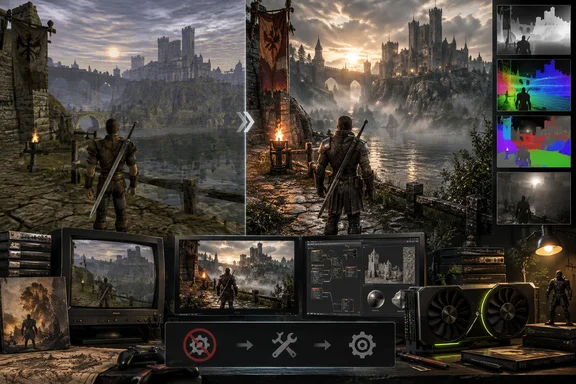
That is the important qualification missing from XDA Developers’ enthusiastic look at what DLSS 5 could do for classics such as The Elder Scrolls III: Morrowind and Star Wars: Knights of the Old Republic. Nvidia released DLSS 5’s 3D-Guided Neural Rendering in NBA 2K27 on September 3, and the company says the technology uses scene information including color, motion, lighting and material data to generate its enhanced result. That dependency on game-engine data is precisely why a 20-year-old title cannot simply be pointed at DLSS 5 and expected to gain convincing modern lighting.
For Windows gamers, the distinction separates a promising future for fan remasters from an expectation that existing back catalogs are about to receive a one-click visual upgrade.
DLSS 5 Is a Renderer Feature, Not a General-Purpose Upscaler
Earlier DLSS generations trained players to think of the brand in familiar terms: render at a lower internal resolution, reconstruct to a higher output resolution, and gain performance or image quality. DLSS 5 adds a more intrusive stage. Nvidia calls it 3D-Guided Neural Rendering, and says it can alter the appearance of lighting and materials while being constrained by the 3D scene and developer-selected controls.
That makes it potentially useful for scenes where conventional rendering has limited skin shading, hair detail, indirect light, reflections, or material response. NBA 2K27, the first officially supported game, is a logical showcase: basketball players, arena lights, polished courts, broadcast-style close-ups, and scanned faces give the model abundant visual information and a narrowly defined artistic target.
But this is not the same as dropping a modern anti-aliasing DLL into a legacy game folder. To produce a stable output, the neural-rendering stage needs reliable inputs from the game’s pipeline. Motion vectors must describe how objects move between frames; depth and material information need to line up with the scene; lighting inputs must be usable enough that the model is enhancing the intended surfaces rather than treating a flat image as a photograph to reinterpret.
A game released in 2002 may not expose that information in a form DLSS 5 can use. A console game running in an emulator is further removed: the emulator can increase internal rendering resolution and apply post-processing, but it does not automatically turn a PlayStation 2 game into a modern PC engine with DLSS-ready motion, material, and lighting buffers.
RTX Remix Is the More Relevant Tool for Older PC Games
XDA Developers correctly points to Nvidia RTX Remix as the existing route toward fan-made remasters, but RTX Remix and DLSS 5 are not interchangeable. RTX Remix captures compatible games’ rendering data, rebuilds the scene for a modern runtime, and allows modders to replace assets, add physically based materials, and apply path tracing. The resulting upgrade can be dramatic because it changes the rendering foundation rather than merely enhancing a final frame.
Nvidia’s own RTX Remix documentation puts a clear boundary around that opportunity. Remix is designed primarily for DirectX 8 and DirectX 9 titles that use the old fixed-function rendering pipeline. It works best where the game sends graphics instructions in a form the Remix runtime can capture and reinterpret. Some classics fit well; many do not.
That matters for Morrowind. Bethesda’s 2002 RPG has the right vintage to make it an appealing candidate, but a playable neural-rendered remaster would still require people to solve its specific engine, asset, user-interface, compatibility, and performance issues. Better water and lighting are not a DLSS 5 checkbox. They are mod-development work.
Nvidia’s current RTX Remix product page also advertises DLSS 4.5, rather than DLSS 5, as part of the platform. That does not rule out DLSS 5 arriving in Remix projects later, and community experimenters have already tried to force the new neural-rendering components into unsupported titles. It does mean Nvidia has not announced a supported, general DLSS 5 upgrade path for the classic games readers are most likely imagining.
The difference is substantial. A maintained RTX Remix project can re-author materials, account for broken geometry, tune lights, test scenes, and give players options. An injected effect may add visual punch in a screenshot while creating shimmering, unstable lighting, odd character faces, or an art style the original game never had in motion.
The Hardware Requirement Is Still a Major Constraint
Official DLSS 5 support is currently tied to GeForce RTX 50-series GPUs. NBA 2K27 support documentation says players need an RTX 50-series card and Nvidia’s September 3 Game Ready driver, and describes neural rendering as optional in the game’s video settings.
That makes today’s official launch narrower than the broad “old games glow-up” framing implies. A player with an RTX 20-, 30-, or 40-series GPU may be able to use conventional DLSS features in supported games, and may find community modifications claiming to run parts of DLSS 5 on older cards. Those experiments are not Nvidia’s supported deployment model.
Independent reporting from Tom’s Hardware and PC Gamer has documented community efforts to run extracted or modified neural-rendering components in games beyond the official launch title, including attempts on previous-generation RTX hardware. Those projects are useful evidence that enthusiasts can access the technology in more places than Nvidia’s product matrix suggests. They are not proof that the feature works consistently, preserves a game’s intended look, or is safe to install across a Steam library.
The performance cost is another reason to avoid treating DLSS 5 as a free improvement. Neural rendering is an image-quality workload, not merely a frame-rate multiplier. Reports on unofficial integrations have shown significant frame-rate losses, especially when the feature is applied through ReShade-based injection routes. Frame generation can make a counter look better, but it does not remove the latency, visual artifacts, or base-rendering cost that a demanding neural pass can introduce.
For an old game that already runs at hundreds of frames per second, sacrificing a large share of that headroom may be acceptable. For a game limited by its CPU, physics, old API behavior, or unstable mod stack, it may simply create a prettier but less reliable experience.
Old Console Games Are a Different Problem
The XDA article groups PC classics and console-era games together, but their upgrade paths diverge sharply. Morrowind and Knights of the Old Republic have native Windows versions and long-running PC modding communities. Their files, renderers, executable quirks, and compatibility problems are difficult, but modders can work directly with the games people install and run on Windows.
Dark Cloud and the original MediEvil are different cases. They are associated with PlayStation hardware, so a modern PC player typically encounters them through emulation, rereleases, streaming, or a remake rather than a native executable with a modern graphics integration path. Emulator resolution scaling can sharply clean up jagged geometry and make texture detail easier to see, but it cannot invent the engine-side data Nvidia’s official DLSS 5 pipeline expects.
There are techniques that can improve those games: high-resolution texture replacements, widescreen patches, geometry fixes, ambient-occlusion shaders, CRT-style presentation tools, and carefully tuned post-processing. Each comes with trade-offs. A texture pack can clash with original UI art; widescreen fixes can reveal scenes developers never intended players to see; aggressive sharpening can make low-resolution assets look worse rather than better.
This is where the aspiration behind DLSS 5 is still compelling. If a modding project can reconstruct the relevant scene data—or replace the old renderer with one that exposes it—neural rendering could become another tool in a deliberate remastering toolkit. The important word is deliberate. It would need an artist or mod author deciding what should change, what must remain untouched, and where the technology should be disabled.
The Best Result Is Not Always More Realism
Nvidia has emphasized that developers can tune DLSS 5 to preserve artistic intent. That control is necessary, because the quality target for an old game is rarely literal photorealism. Morrowind’s foggy vistas, exaggerated architecture, and alien color palette are part of why it remains recognizable. Knights of the Old Republic was designed around stylized cinematic lighting and hardware constraints, not physically precise materials. Forcing contemporary skin, hair, and surface behavior onto every character could make those worlds look less authentic, not more.
The most successful retro remasters tend to improve the elements that age poorly on modern displays—aliasing, low internal resolution, crude shadows, flat materials, lighting limitations, texture filtering—while retaining composition, proportions, color, animation, and atmosphere. Nvidia’s own RTX Remix examples make the same point indirectly: the impressive projects are not automatic upgrades. They are lengthy reconstructions made by teams that understand both the old game and the new renderer.
DLSS 5 may eventually help those teams make a remaster look more coherent under advanced lighting. At present, though, it is a supported feature in one current game, not a universal restoration layer for Windows back catalogs.
Players looking for a better return to a classic should continue to start with the game’s established modding community, renderer patches, compatibility guides, and emulator settings. DLSS 5 is worth watching because it may broaden what dedicated remaster projects can accomplish—but the glow-up will come from the people building the bridge between old engines and new hardware.
References
- Nvidia’s DLSS 5 could give my favorite old games the glow-up I’ve been waiting for XDA · 2026-09-17T11:00:17+00:00