

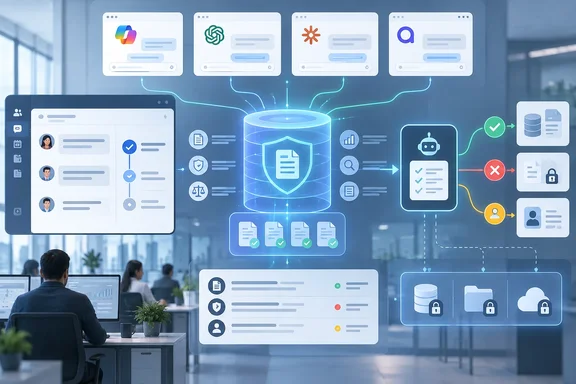
The caveat comes first. Nearly everything announced has a seasonal timeline ("Fall" or "Winter") rather than a calendar date. Most of it is headed for private preview, not general availability, and the performance claims are OneTrust's own. So this is a roadmap with a keynote attached, not a product you can deploy on Monday.
What OneTrust actually announced
The main platform release came out on September 30, 2026, during TrustWeek, which ran September 28–30. GlobeNewswire distributed it, and it says OneTrust announced its latest innovations enabling governance programs across privacy, consent, risk, data, and AI to move at the speed of business.
The day before, OneTrust put out a separate release for CORIE on its own. It described CORIE as a shared intelligence layer built into the OneTrust Platform, to enforce enterprise policies in real time and record agent decisions. The name stands for Contextual Orchestration for Reasoning, Intelligence and Evidence.
The platform has three layers:
- CORIE, the shared intelligence layer
- The AI Control Plane, which enforces policy at runtime
- The Governance Command Center, the single console where people review and step in
On top of those sit the MCP Gateway, five product capabilities, and a pilot engineering program.
Summary: This is a platform change plus a set of features, and most features are pre-release.
CORIE: one brain shared by the governance teams
OneTrust says CORIE connects context and decisions across privacy, consent, technology risk, third-party management, and AI risk, drawing on a pre-built understanding of an organization's environment and rules. It has three named parts:
| Component | What OneTrust says it does |
|---|---|
| Trust Graph | Maps AI systems and models to enterprise data, vendors and identities, plus consent signals and the governance rules that apply |
| Reasoning Engine | Uses policies, earlier assessments and past governance decisions to make consistent, context-aware calls across programs |
| Evidence Ledger | Records what was considered, which policy or control applied and what action followed, giving an audit trail |
OneTrust says CORIE works with any kind of agent: whether using OneTrust's native agents, customer-built agents, or third-party agents, CORIE provides the shared context, reasoning, and evidence needed to keep those agents' actions governed and explainable.
The CORIE release includes the clearest concrete example in the whole announcement. When a marketing agent asks for data it isn't allowed to use, OneTrust says CORIE enforces the policy at the tool call before the model sees the data. The company adds that it records the request and the policy behind the denial, providing evidence of how the decision was enforced.
That example matters. Blocking a request at the tool call, before the model ever sees the data, is a much stronger control than reviewing outputs afterwards. It is the difference between a locked door and a camera that records the burglary. Still, this is the vendor describing its own design. Neither release lists supported systems, enforcement protocols or deployment requirements.
Summary: CORIE is meant to give every agent the same policy context, with an audit trail built in. The marketing-agent example is the best clue to how it is supposed to work.
AI Control Plane: separation of duties built into the architecture
The AI Control Plane is where CORIE's reasoning turns into enforcement. In OneTrust's description, acting as an independent control layer between AI agents and enterprise systems, it evaluates actions as they occur and applies or orchestrates the policies, guardrails, and controls that determine whether an action proceeds, is blocked, or requires human approval.
OneTrust frames this as separation of duties for AI, enforced by architecture rather than by org charts. Blake Brannon, OneTrust's chief innovation officer, made the same case in the company's research release: governance judgment now has to live in the runtime, deciding and enforcing as AI acts, and standing apart from the tools it governs.
The idea will be familiar to Windows and Entra administrators. It looks a lot like Conditional Access for agent actions: a policy point that sits outside the thing being governed and decides allow, block or step-up. OneTrust doesn't make that comparison; it's our framing. The open question is the same one that applies to any policy point: does it see every path an agent can take, or only the ones routed through it?
Governance Command Center
The Governance Command Center is the human-facing console. It gives a combined view of risk posture, governance activity, decisions and exceptions. From one place, teams can manage policies and controls for privacy, consent, technology risk, third-party management and AI governance, and step in when a decision needs a person. No availability window was given for it separately.
MCP Gateway: governance inside ChatGPT, Claude, Copilot and Glean
OneTrust is going beyond traditional APIs with a "headless" experience delivered through an MCP (Model Context Protocol) Gateway. It names ChatGPT, Claude, Copilot and Glean as targets for AI-native integrations. The goal is to bring governance context and workflows into the AI tools people already use, cutting down on custom integration work for tasks such as assessments and agent development.
DV Lamba, OneTrust's Chief Product and Technology Officer, presented this as a developer story, saying TrustWeek showed enabling developers to embed governance into agent behavior via our headless experience through the MCP Gateway, while integrating CORIE into everyday business applications.
The timing needs a footnote. OneTrust's release says "private preview in Fall." Channel Insider wrote that the gateway is in private preview, which suggests it is available now. Until OneTrust says otherwise, assume access is limited and invitation-based. Also note that the release doesn't say which Copilot it means: Microsoft 365 Copilot, Copilot Studio agents or GitHub Copilot. Administrators should ask before planning anything around it.
Summary: MCP is how OneTrust puts governance inside the AI tools employees already use. Which Copilot it supports is still unclear.
The five product capabilities and their timelines
| Capability | What it does (per OneTrust) | Stated timing |
|---|---|---|
| AI-Driven Assessments | Conversational assessment agents, AI-generated answers with source lineage, Microsoft Teams engagement and built-in support in one flow; OneTrust claims a 66% average cut in completion time | Private preview, Fall |
| Posture Management for Regulations | A continuous, evidence-backed view of compliance with rules such as GDPR and the EU AI Act, showing which requirements were evaluated and what evidence supports each result | Private preview, Fall |
| Conversational Consent | Consent captured inside AI conversations through the MCP Gateway, with explicit confirmation for one or more purposes and the agent-user exchange kept on the consent receipt | Private preview, Fall |
| AI-Driven RoPA Management | Generates and updates Records of Processing Activities from project briefs, contracts and similar documents; users review changes before they are applied | Private preview, Winter |
| Risk, Issue and Control Recommendations | AI checks organisational policies against custom frameworks and control libraries, then flags gaps and recommends controls | General availability, Winter |
Only one item, Risk, Issue and Control Recommendations, is promised as generally available. The release gives no methodology, sample or comparison group for the 66% figure, so read it as a vendor claim.
Posture Management is described as a view of compliance. It doesn't claim to certify or guarantee compliance, and no dashboard turns green and makes regulators go away. The Teams angle is concrete, though. Assessments are the questionnaires that pile up in a privacy team's inbox, and reaching respondents inside Teams could be the most practical part of the whole announcement for Microsoft 365 organisations.
Forward Deployed Engineering pilot
OneTrust is also starting a Forward Deployed Engineering pilot. OneTrust engineers will work inside selected customer teams to build and test solutions against real requirements, following a shared 12–18-month plan and building on CORIE and the customer's existing stack. A plan that long says something by itself: OneTrust expects deep agent governance to be a long integration project, not a toggle.
The survey behind the pitch
OneTrust supports its argument with its 2026 AI-Ready Governance Report. According to OneTrust, the survey covered 1,200 senior business decision-makers and was run by Sapio Research for OneTrust in June and July 2026. Respondents came from the US, Canada, the UK, France, Germany, Spain, Australia and Singapore, at organisations with at least $100 million in annual revenue.
Key findings, all self-reported:
- 86% had at least one AI-related incident in the past year, such as exposure of sensitive data or IP, unapproved AI use by employees, misinformation, or data loss.
- 27% slowed or paused AI deployment in response. More common was extra employee training, at 49%.
- As Security Systems News summarised it, while 87% of organizations encourage employees to use AI agents, only 47% report having clear governance, oversight and control mechanisms in place.
- 28% had two or more incidents where AI systems or agents took unapproved actions.
- 33% saw employees use unapproved AI because approved tools or processes didn't arrive fast enough. That is shadow AI caused by governance friction.
- 80% said managing AI risk takes more of their time than a year earlier, by an average of 26% more working hours.
- 98% plan to raise AI-governance technology budgets next financial year, by an average of 25%.
A governance vendor commissioned a survey that found governance is underfunded. That doesn't make the numbers wrong, but readers should keep it in mind. The shadow-AI figure deserves the most attention. It suggests slow approvals can create risk instead of preventing it, which is a lesson for any IT department, whatever tooling it buys.
Voices from the stage
Lamba said the problem is scale, not expertise: governance teams already have the judgment, and the challenge is applying it to thousands of agent decisions a day.
Kelly Thewes, Global Head of Data Privacy Compliance and Chief Data Ethics & Privacy Officer at Fiserv, gave the customer view in OneTrust's release. She said governance should help move AI ideas into production with a clear picture of the risks, confidence that policies will hold, and evidence of what AI does. That is an endorsement of the direction, not an independent review of features that are mostly unreleased.
What Windows and Microsoft 365 admins should do with this
This section is our analysis based on general industry practice. None of it comes from OneTrust.
- Ask which Copilot. Find out whether the MCP Gateway covers Microsoft 365 Copilot, Copilot Studio agents, GitHub Copilot or all three, and what permissions it needs in your tenant.
- Map overlap with tools you already have. Many Microsoft 365 shops already run Purview, Entra Conditional Access and Defender. Work out where a third-party control plane adds coverage and where it just adds another console.
- Check where enforcement happens. The tool-call blocking example is promising. Confirm which agent paths go through the Control Plane and which can bypass it.
- Test the evidence trail. Ask to see Evidence Ledger records from a real denied action, and make sure your auditors would accept them.
- Budget for preview reality. Fall and Winter private previews mean limited access and possible changes. Don't build a compliance deadline around them.
- Fix approval latency anyway. The survey's own shadow-AI number shows slow approvals push employees toward unsanctioned tools, and no platform fixes that alone.
The bottom line
OneTrust's TrustWeek release is an ambitious redesign. It aims to combine policy context (CORIE), runtime enforcement (the AI Control Plane) and human review (the Governance Command Center), reaching into Copilot, ChatGPT, Claude, Glean and Microsoft Teams. The architecture is sensible, and the tool-call enforcement example shows real intent. But most of it is in preview, the timelines are given by season, and the strongest numbers come from the vendor's own research. Enterprise IT teams should treat this as something to watch and test closely, not something to buy on the spot.
References
- OneTrust Rolls Out Platform Overhaul To Tackle AI Governance At Enterprise Scale - SMBtech SMBtech · 2026-10-01T19:40:16+00:00
- The OneTrust 2026 AI-Ready Governance Survey Report | Resources | OneTrust onetrust.com
- OneTrust CORIE™ Governs AI Agents at Machine Speed globenewswire.com