

What OpenDLSS-NR is
Developer MAAN released OpenDLSS-NR as an open-source Vulkan reimplementation of DLSS 5's Neural Rendering network. It recreates the 71-block network found in DLSS-NR runtime version 310.8.0. The developer claims bit-exact results against Nvidia's implementation, including intermediate outputs.
The accuracy claim comes from the project's own testing. Duck-IT Tech News notes that it has not been certified by Nvidia. The README also says the parity checks compare against recorded captures of the original. Those captures are not in the repository, so outsiders can't rerun them.
The architecture is documented in the README. It is a U-net of shifted-window transformer blocks with a global Vision Transformer at the bottom. It has 71 blocks over six pooling levels. It uses FP8 activations with FP16 accumulation and about 141 MiB of weights.
Some boundaries matter for Windows and PC readers:
- It is not an upscaler. The README says input and output are the same resolution.
- It does not implement DLSS Super Resolution, which is a different network.
- It targets Windows and needs an Nvidia Ada or newer GPU. The driver must expose the cooperative-matrix, FP8 and CUDA-kernel-launch Vulkan extensions.
- You supply the weights. The README says nothing in the repository produces them, and a model with a different block count is refused at load.
The performance cost
The README benchmarks the whole network per frame on an RTX 4070 SUPER. It takes the minimum over 40 frames and runs 241 GPU dispatches at every resolution.
| Resolution | Network time |
|---|---|
| 768×768 | 2.8 ms |
| 1920×1080 | 7.8 ms |
| 2560×1440 | 12.6 ms |
| 3840×2160 | 29.3 ms |
A 60 fps frame budget is about 16.7 ms. The 1440p figure alone uses roughly three-quarters of it. The 4K figure exceeds it. This is my arithmetic on the project's numbers.
Three caveats apply:
- These timings cover only the network. The game's own rendering, feature preprocessing and compositing come on top.
- The README says the GPU alternates between two clock states under sustained load, so medians run a few percent higher than the minima.
- The test card is an Ada-generation RTX 4070 SUPER, not the RTX 50 Series hardware Nvidia says DLSS 5 runs on.
The XDA writer says the official DLSS 5 files halved his frame rate in The Blood of Dawnwalker. He says performance returned after he changed where the neural stage sat in the pipeline. That is one person's test, not a controlled benchmark. It shouldn't be read as validating the repository's numbers.
Is "AI filter" fair?
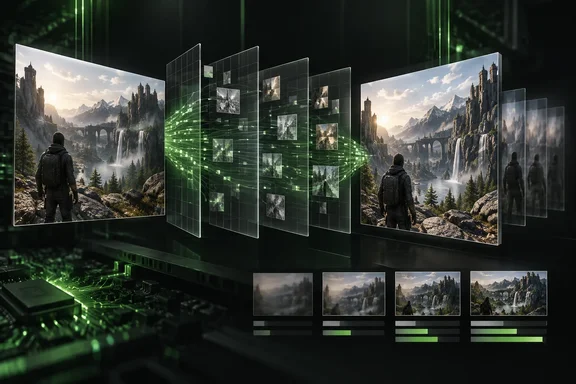
The README describes the network as re-rendering the frame the engine already drew. It generates detail from injected noise and adjusts tone, structure and skin under a style setting.
Its inputs are:
- a low-dynamic-range proxy of the rendered frame;
- three lanes of Gaussian noise;
- the previous frame's output, reprojected;
- five conditioning scalars.
It outputs four channels per pixel: an RGB residual and a temporal-blend logit. In other words, it computes a correction to apply to the rendered image and a weight for blending with history. It does not draw a new frame from nothing. In the demo, the history lanes and blend logit drive a reprojected feedback loop. The command-line tool runs single frames without history.
So "filter" is imprecise, but the criticism isn't baseless. A network that adds a learned residual to a finished frame under a style control is doing more than reconstruction.
Hallucination versus grounding
Nvidia's research page calls DLSS 5 a one-step, pixel-space diffusion model. Wccftech describes it as operating on an already rendered frame. Nvidia says generative models don't reliably preserve authored content, so its design conditions the model on the rendered frame, motion vectors, temporal state and artistic-direction values. During training it also uses supervision from renderer-derived scene attributes. Nvidia says inference is causal and deterministic.
Noise as an input explains why people worry about invented detail. The clone cannot show how well Nvidia's grounding works across games. It shows that generation is part of the design. It does not show that any given frame contains a made-up object.
Controls Nvidia says developers have
Nvidia's developer blog from September 2026 describes a "Structure Intensity" control and a "Tone Intensity" control. It also lists model selection, semantic AI masking and engine-level masks for props or asset groups. Nvidia says richer inputs, such as path-traced lighting, give more accurate results. It says DLSS 5 is live in NBA 2K27. In that game it says the developer used tone and style controls plus a per-pixel mask to respect player likenesses.
These are Nvidia's own descriptions. A hobbyist clone doesn't reproduce a studio's authored settings or masks, so the demo doesn't show how a shipped game looks.
What the code can't tell you
The repository exposes the network but not what it learned. It has no Nvidia training data, no training process and no weights. Questions such as "does it carry assumptions from its training material into skin or lighting?" stay open here. Only Nvidia can answer them.
The project is also not a way around Nvidia's hardware limits. It still needs an Nvidia GPU with the listed Vulkan extensions and weights from elsewhere. Third-party coverage differs on the project's significance:
- Xenospectrum says it does not mean official DLSS 5 can now be used on unsupported GPUs.
- Byteiota argues it suggests Nvidia's hardware exclusivity was a business call.
- The repository itself only shows that the network can run on an RTX 40-class card when supplied with weights.
The README also has a WebGPU port. It needs no tensor cores or FP8. It runs 512×512 in 72 ms, against 2.7 ms for the native path at a different resolution. That shows the exactness comes from the specification rather than the hardware. It is far too slow for games today.
Bottom line
The README's figures support the cost complaint, at least for the network alone: roughly 7.8 ms at 1080p, 12.6 ms at 1440p and 29.3 ms at 4K on an RTX 4070 SUPER. Its architecture supports a narrower "AI filter" reading: a learned residual with a style control, driven partly by injected noise. It can't settle whether DLSS 5's learned look is faithful or biased.
Before drawing conclusions about your own PC, keep three things in mind:
- Real frame rates depend on how a game integrates the technology.
- The 4070 SUPER numbers are not RTX 50 Series numbers.
- The weights, which hold what the network learned, remain Nvidia's.
References
- Reading DLSS 5's source code finally made sense of the neural rendering complaints XDA · 2026-10-07T20:30:18+00:00
- What’s New for Game Developers: DLSS 5 with 3D-Guided Neural Rendering, NVIDIA ACE Updates, and New RTX Kit Capabilities | NVIDIA Technical Blog developer.nvidia.com
- Solo Developer Reimplements DLSS 5's Neural Network in Open-Source OpenDLSS-NR, Even in a Browser xenospectrum.com